

208
I. Hisaki et al.
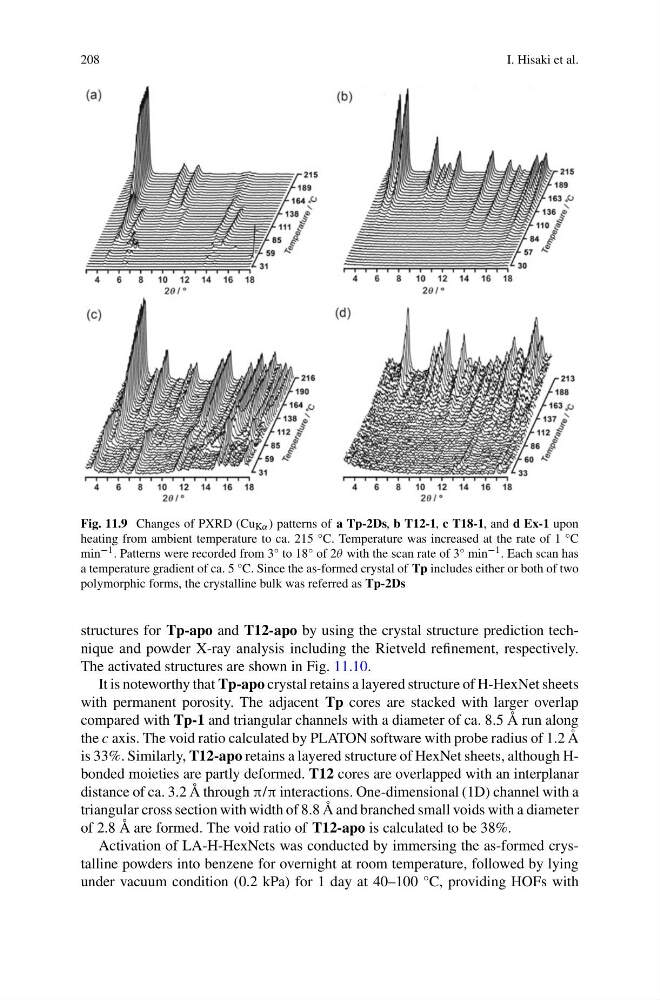
Fig. 11.9 Changes of PXRD (Cu Kα ) patterns of a Tp-2Ds, b T12-1, c T18-1, and d Ex-1 upon
heating from ambient temperature to ca. 215 °C. Temperature was increased at the rate of 1 °C
min −1 . Patterns were recorded from 3° to 18° of 2θ with the scan rate of 3° min −1 . Each scan has
a temperature gradient of ca. 5 °C. Since the as-formed crystal of Tp includes either or both of two
polymorphic forms, the crystalline bulk was referred as Tp-2Ds
structures for Tp-apo and T12-apo by using the crystal structure prediction technique and powder X-ray analysis including the Rietveld refinement, respectively.
The activated structures are shown in Fig. 11.10.
It is noteworthy that Tp-apo crystal retains a layered structure of H-HexNet sheets
with permanent porosity. The adjacent Tp cores are stacked with larger overlap
compared with Tp-1 and triangular channels with a diameter of ca. 8.5 Å run along
the c axis. The void ratio calculated by PLATON software with probe radius of 1.2 Å
is 33%. Similarly, T12-apo retains a layered structure of HexNet sheets, although Hbonded moieties are partly deformed. T12 cores are overlapped with an interplanar
distance of ca. 3.2 Å through π/π interactions. One-dimensional (1D) channel with a
triangular cross section with width of 8.8 Å and branched small voids with a diameter
of 2.8 Å are formed. The void ratio of T12-apo is calculated to be 38%.
Activation of LA-H-HexNets was conducted by immersing the as-formed crystalline powders into benzene for overnight at room temperature, followed by lying
under vacuum condition (0.2 kPa) for 1 day at 40–100 °C, providing HOFs with
I. Hisaki et al.
Fig. 11.9 Changes of PXRD (Cu Kα ) patterns of a Tp-2Ds, b T12-1, c T18-1, and d Ex-1 upon
heating from ambient temperature to ca. 215 °C. Temperature was increased at the rate of 1 °C
min −1 . Patterns were recorded from 3° to 18° of 2θ with the scan rate of 3° min −1 . Each scan has
a temperature gradient of ca. 5 °C. Since the as-formed crystal of Tp includes either or both of two
polymorphic forms, the crystalline bulk was referred as Tp-2Ds
structures for Tp-apo and T12-apo by using the crystal structure prediction technique and powder X-ray analysis including the Rietveld refinement, respectively.
The activated structures are shown in Fig. 11.10.
It is noteworthy that Tp-apo crystal retains a layered structure of H-HexNet sheets
with permanent porosity. The adjacent Tp cores are stacked with larger overlap
compared with Tp-1 and triangular channels with a diameter of ca. 8.5 Å run along
the c axis. The void ratio calculated by PLATON software with probe radius of 1.2 Å
is 33%. Similarly, T12-apo retains a layered structure of HexNet sheets, although Hbonded moieties are partly deformed. T12 cores are overlapped with an interplanar
distance of ca. 3.2 Å through π/π interactions. One-dimensional (1D) channel with a
triangular cross section with width of 8.8 Å and branched small voids with a diameter
of 2.8 Å are formed. The void ratio of T12-apo is calculated to be 38%.
Activation of LA-H-HexNets was conducted by immersing the as-formed crystalline powders into benzene for overnight at room temperature, followed by lying
under vacuum condition (0.2 kPa) for 1 day at 40–100 °C, providing HOFs with