

10 The Design of Porous Organic Salts with Hierarchical Process
193
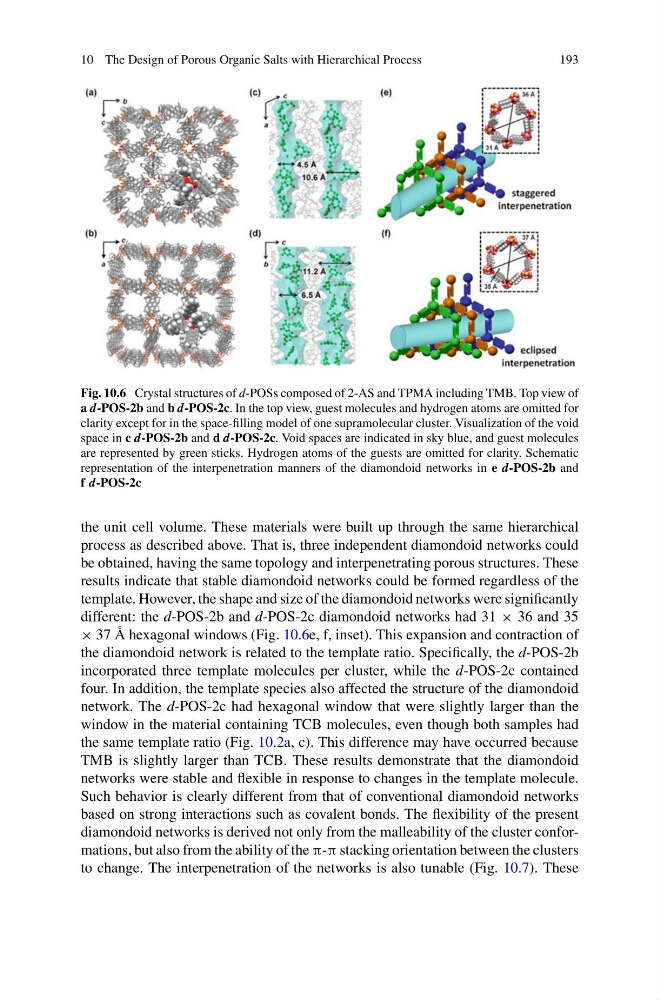
Fig. 10.6 Crystal structures of d-POSs composed of 2-AS and TPMA including TMB. Top view of
a d-POS-2b and b d-POS-2c. In the top view, guest molecules and hydrogen atoms are omitted for
clarity except for in the space-filling model of one supramolecular cluster. Visualization of the void
space in c d-POS-2b and d d-POS-2c. Void spaces are indicated in sky blue, and guest molecules
are represented by green sticks. Hydrogen atoms of the guests are omitted for clarity. Schematic
representation of the interpenetration manners of the diamondoid networks in e d-POS-2b and
f d-POS-2c
the unit cell volume. These materials were built up through the same hierarchical
process as described above. That is, three independent diamondoid networks could
be obtained, having the same topology and interpenetrating porous structures. These
results indicate that stable diamondoid networks could be formed regardless of the
template. However, the shape and size of the diamondoid networks were significantly
different: the d-POS-2b and d-POS-2c diamondoid networks had 31 × 36 and 35
× 37 Å hexagonal windows (Fig. 10.6e, f, inset). This expansion and contraction of
the diamondoid network is related to the template ratio. Specifically, the d-POS-2b
incorporated three template molecules per cluster, while the d-POS-2c contained
four. In addition, the template species also affected the structure of the diamondoid
network. The d-POS-2c had hexagonal window that were slightly larger than the
window in the material containing TCB molecules, even though both samples had
the same template ratio (Fig. 10.2a, c). This difference may have occurred because
TMB is slightly larger than TCB. These results demonstrate that the diamondoid
networks were stable and flexible in response to changes in the template molecule.
Such behavior is clearly different from that of conventional diamondoid networks
based on strong interactions such as covalent bonds. The flexibility of the present
diamondoid networks is derived not only from the malleability of the cluster conformations, but also from the ability of the π-π stacking orientation between the clusters
to change. The interpenetration of the networks is also tunable (Fig. 10.7). These
193
Fig. 10.6 Crystal structures of d-POSs composed of 2-AS and TPMA including TMB. Top view of
a d-POS-2b and b d-POS-2c. In the top view, guest molecules and hydrogen atoms are omitted for
clarity except for in the space-filling model of one supramolecular cluster. Visualization of the void
space in c d-POS-2b and d d-POS-2c. Void spaces are indicated in sky blue, and guest molecules
are represented by green sticks. Hydrogen atoms of the guests are omitted for clarity. Schematic
representation of the interpenetration manners of the diamondoid networks in e d-POS-2b and
f d-POS-2c
the unit cell volume. These materials were built up through the same hierarchical
process as described above. That is, three independent diamondoid networks could
be obtained, having the same topology and interpenetrating porous structures. These
results indicate that stable diamondoid networks could be formed regardless of the
template. However, the shape and size of the diamondoid networks were significantly
different: the d-POS-2b and d-POS-2c diamondoid networks had 31 × 36 and 35
× 37 Å hexagonal windows (Fig. 10.6e, f, inset). This expansion and contraction of
the diamondoid network is related to the template ratio. Specifically, the d-POS-2b
incorporated three template molecules per cluster, while the d-POS-2c contained
four. In addition, the template species also affected the structure of the diamondoid
network. The d-POS-2c had hexagonal window that were slightly larger than the
window in the material containing TCB molecules, even though both samples had
the same template ratio (Fig. 10.2a, c). This difference may have occurred because
TMB is slightly larger than TCB. These results demonstrate that the diamondoid
networks were stable and flexible in response to changes in the template molecule.
Such behavior is clearly different from that of conventional diamondoid networks
based on strong interactions such as covalent bonds. The flexibility of the present
diamondoid networks is derived not only from the malleability of the cluster conformations, but also from the ability of the π-π stacking orientation between the clusters
to change. The interpenetration of the networks is also tunable (Fig. 10.7). These