

192
N. Tohnai
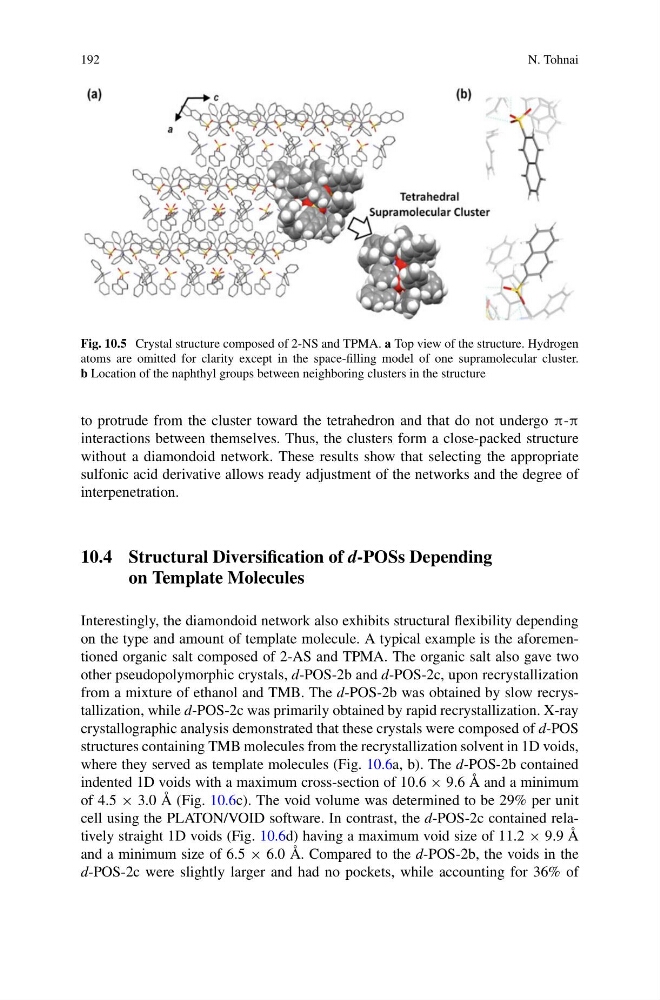
Fig. 10.5 Crystal structure composed of 2-NS and TPMA. a Top view of the structure. Hydrogen
atoms are omitted for clarity except in the space-filling model of one supramolecular cluster.
b Location of the naphthyl groups between neighboring clusters in the structure
to protrude from the cluster toward the tetrahedron and that do not undergo π-π
interactions between themselves. Thus, the clusters form a close-packed structure
without a diamondoid network. These results show that selecting the appropriate
sulfonic acid derivative allows ready adjustment of the networks and the degree of
interpenetration.
10.4 Structural Diversification of d-POSs Depending
on Template Molecules
Interestingly, the diamondoid network also exhibits structural flexibility depending
on the type and amount of template molecule. A typical example is the aforementioned organic salt composed of 2-AS and TPMA. The organic salt also gave two
other pseudopolymorphic crystals, d-POS-2b and d-POS-2c, upon recrystallization
from a mixture of ethanol and TMB. The d-POS-2b was obtained by slow recrystallization, while d-POS-2c was primarily obtained by rapid recrystallization. X-ray
crystallographic analysis demonstrated that these crystals were composed of d-POS
structures containing TMB molecules from the recrystallization solvent in 1D voids,
where they served as template molecules (Fig. 10.6a, b). The d-POS-2b contained
indented 1D voids with a maximum cross-section of 10.6 × 9.6 Å and a minimum
of 4.5 × 3.0 Å (Fig. 10.6c). The void volume was determined to be 29% per unit
cell using the PLATON/VOID software. In contrast, the d-POS-2c contained relatively straight 1D voids (Fig. 10.6d) having a maximum void size of 11.2 × 9.9 Å
and a minimum size of 6.5 × 6.0 Å. Compared to the d-POS-2b, the voids in the
d-POS-2c were slightly larger and had no pockets, while accounting for 36% of
N. Tohnai
Fig. 10.5 Crystal structure composed of 2-NS and TPMA. a Top view of the structure. Hydrogen
atoms are omitted for clarity except in the space-filling model of one supramolecular cluster.
b Location of the naphthyl groups between neighboring clusters in the structure
to protrude from the cluster toward the tetrahedron and that do not undergo π-π
interactions between themselves. Thus, the clusters form a close-packed structure
without a diamondoid network. These results show that selecting the appropriate
sulfonic acid derivative allows ready adjustment of the networks and the degree of
interpenetration.
10.4 Structural Diversification of d-POSs Depending
on Template Molecules
Interestingly, the diamondoid network also exhibits structural flexibility depending
on the type and amount of template molecule. A typical example is the aforementioned organic salt composed of 2-AS and TPMA. The organic salt also gave two
other pseudopolymorphic crystals, d-POS-2b and d-POS-2c, upon recrystallization
from a mixture of ethanol and TMB. The d-POS-2b was obtained by slow recrystallization, while d-POS-2c was primarily obtained by rapid recrystallization. X-ray
crystallographic analysis demonstrated that these crystals were composed of d-POS
structures containing TMB molecules from the recrystallization solvent in 1D voids,
where they served as template molecules (Fig. 10.6a, b). The d-POS-2b contained
indented 1D voids with a maximum cross-section of 10.6 × 9.6 Å and a minimum
of 4.5 × 3.0 Å (Fig. 10.6c). The void volume was determined to be 29% per unit
cell using the PLATON/VOID software. In contrast, the d-POS-2c contained relatively straight 1D voids (Fig. 10.6d) having a maximum void size of 11.2 × 9.9 Å
and a minimum size of 6.5 × 6.0 Å. Compared to the d-POS-2b, the voids in the
d-POS-2c were slightly larger and had no pockets, while accounting for 36% of