

9 Pharmaceutical Multicomponent Crystals: Structure, Design …
179
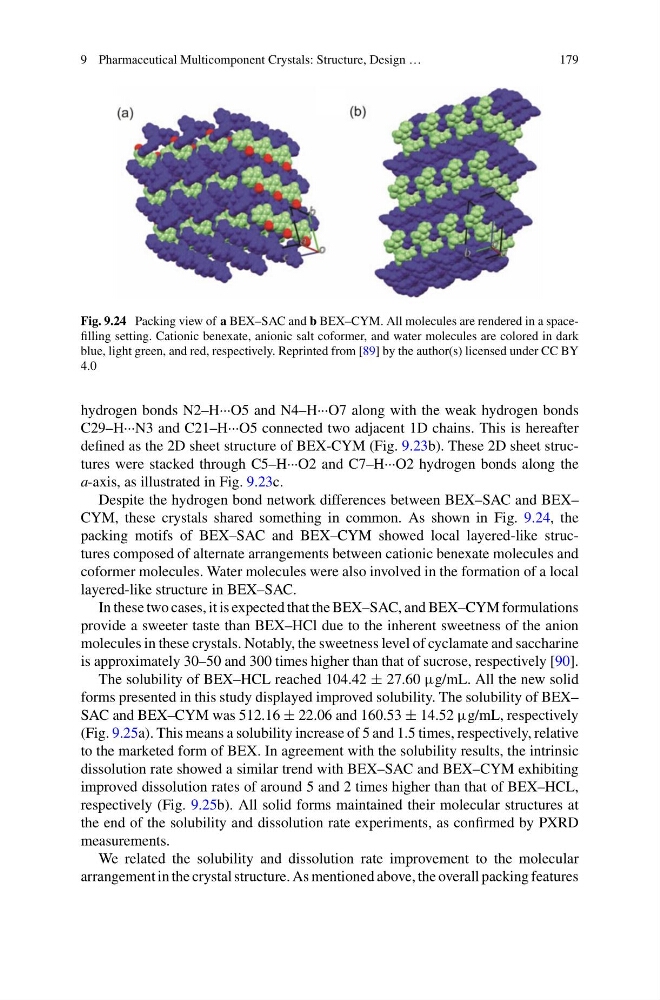
Fig. 9.24 Packing view of a BEX–SAC and b BEX–CYM. All molecules are rendered in a spacefilling setting. Cationic benexate, anionic salt coformer, and water molecules are colored in dark
blue, light green, and red, respectively. Reprinted from [89] by the author(s) licensed under CC BY
4.0
hydrogen bonds N2–H···O5 and N4–H···O7 along with the weak hydrogen bonds
C29–H···N3 and C21–H···O5 connected two adjacent 1D chains. This is hereafter
defined as the 2D sheet structure of BEX-CYM (Fig. 9.23b). These 2D sheet structures were stacked through C5–H···O2 and C7–H···O2 hydrogen bonds along the
a-axis, as illustrated in Fig. 9.23c.
Despite the hydrogen bond network differences between BEX–SAC and BEX–
CYM, these crystals shared something in common. As shown in Fig. 9.24, the
packing motifs of BEX–SAC and BEX–CYM showed local layered-like structures composed of alternate arrangements between cationic benexate molecules and
coformer molecules. Water molecules were also involved in the formation of a local
layered-like structure in BEX–SAC.
In these two cases, it is expected that the BEX–SAC, and BEX–CYM formulations
provide a sweeter taste than BEX–HCl due to the inherent sweetness of the anion
molecules in these crystals. Notably, the sweetness level of cyclamate and saccharine
is approximately 30–50 and 300 times higher than that of sucrose, respectively [90].
The solubility of BEX–HCL reached 104.42 ± 27.60 μg/mL. All the new solid
forms presented in this study displayed improved solubility. The solubility of BEX–
SAC and BEX–CYM was 512.16 ± 22.06 and 160.53 ± 14.52 μg/mL, respectively
(Fig. 9.25a). This means a solubility increase of 5 and 1.5 times, respectively, relative
to the marketed form of BEX. In agreement with the solubility results, the intrinsic
dissolution rate showed a similar trend with BEX–SAC and BEX–CYM exhibiting
improved dissolution rates of around 5 and 2 times higher than that of BEX–HCL,
respectively (Fig. 9.25b). All solid forms maintained their molecular structures at
the end of the solubility and dissolution rate experiments, as confirmed by PXRD
measurements.
We related the solubility and dissolution rate improvement to the molecular
arrangement in the crystal structure. As mentioned above, the overall packing features
179
Fig. 9.24 Packing view of a BEX–SAC and b BEX–CYM. All molecules are rendered in a spacefilling setting. Cationic benexate, anionic salt coformer, and water molecules are colored in dark
blue, light green, and red, respectively. Reprinted from [89] by the author(s) licensed under CC BY
4.0
hydrogen bonds N2–H···O5 and N4–H···O7 along with the weak hydrogen bonds
C29–H···N3 and C21–H···O5 connected two adjacent 1D chains. This is hereafter
defined as the 2D sheet structure of BEX-CYM (Fig. 9.23b). These 2D sheet structures were stacked through C5–H···O2 and C7–H···O2 hydrogen bonds along the
a-axis, as illustrated in Fig. 9.23c.
Despite the hydrogen bond network differences between BEX–SAC and BEX–
CYM, these crystals shared something in common. As shown in Fig. 9.24, the
packing motifs of BEX–SAC and BEX–CYM showed local layered-like structures composed of alternate arrangements between cationic benexate molecules and
coformer molecules. Water molecules were also involved in the formation of a local
layered-like structure in BEX–SAC.
In these two cases, it is expected that the BEX–SAC, and BEX–CYM formulations
provide a sweeter taste than BEX–HCl due to the inherent sweetness of the anion
molecules in these crystals. Notably, the sweetness level of cyclamate and saccharine
is approximately 30–50 and 300 times higher than that of sucrose, respectively [90].
The solubility of BEX–HCL reached 104.42 ± 27.60 μg/mL. All the new solid
forms presented in this study displayed improved solubility. The solubility of BEX–
SAC and BEX–CYM was 512.16 ± 22.06 and 160.53 ± 14.52 μg/mL, respectively
(Fig. 9.25a). This means a solubility increase of 5 and 1.5 times, respectively, relative
to the marketed form of BEX. In agreement with the solubility results, the intrinsic
dissolution rate showed a similar trend with BEX–SAC and BEX–CYM exhibiting
improved dissolution rates of around 5 and 2 times higher than that of BEX–HCL,
respectively (Fig. 9.25b). All solid forms maintained their molecular structures at
the end of the solubility and dissolution rate experiments, as confirmed by PXRD
measurements.
We related the solubility and dissolution rate improvement to the molecular
arrangement in the crystal structure. As mentioned above, the overall packing features