

178
O. D. Putra and H. Uekusa
O8–H···O5 hydrogen bonds, leading to a two-dimensional (2D) sheet structure, as
illustrated in Fig. 9.22c.
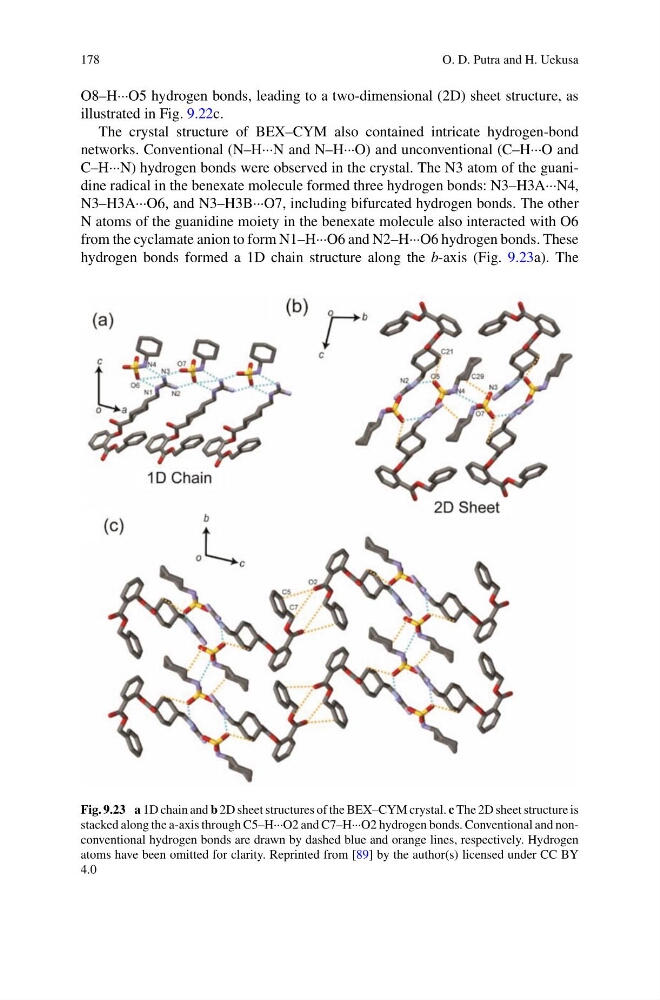
The crystal structure of BEX–CYM also contained intricate hydrogen-bond
networks. Conventional (N–H···N and N–H···O) and unconventional (C–H···O and
C–H···N) hydrogen bonds were observed in the crystal. The N3 atom of the guanidine radical in the benexate molecule formed three hydrogen bonds: N3–H3A···N4,
N3–H3A···O6, and N3–H3B···O7, including bifurcated hydrogen bonds. The other
N atoms of the guanidine moiety in the benexate molecule also interacted with O6
from the cyclamate anion to form N1–H···O6 and N2–H···O6 hydrogen bonds. These
hydrogen bonds formed a 1D chain structure along the b-axis (Fig. 9.23a). The
Fig. 9.23 a 1D chain and b 2D sheet structures of the BEX–CYM crystal. c The 2D sheet structure is
stacked along the a-axis through C5–H···O2 and C7–H···O2 hydrogen bonds. Conventional and nonconventional hydrogen bonds are drawn by dashed blue and orange lines, respectively. Hydrogen
atoms have been omitted for clarity. Reprinted from [89] by the author(s) licensed under CC BY
4.0
O. D. Putra and H. Uekusa
O8–H···O5 hydrogen bonds, leading to a two-dimensional (2D) sheet structure, as
illustrated in Fig. 9.22c.
The crystal structure of BEX–CYM also contained intricate hydrogen-bond
networks. Conventional (N–H···N and N–H···O) and unconventional (C–H···O and
C–H···N) hydrogen bonds were observed in the crystal. The N3 atom of the guanidine radical in the benexate molecule formed three hydrogen bonds: N3–H3A···N4,
N3–H3A···O6, and N3–H3B···O7, including bifurcated hydrogen bonds. The other
N atoms of the guanidine moiety in the benexate molecule also interacted with O6
from the cyclamate anion to form N1–H···O6 and N2–H···O6 hydrogen bonds. These
hydrogen bonds formed a 1D chain structure along the b-axis (Fig. 9.23a). The
Fig. 9.23 a 1D chain and b 2D sheet structures of the BEX–CYM crystal. c The 2D sheet structure is
stacked along the a-axis through C5–H···O2 and C7–H···O2 hydrogen bonds. Conventional and nonconventional hydrogen bonds are drawn by dashed blue and orange lines, respectively. Hydrogen
atoms have been omitted for clarity. Reprinted from [89] by the author(s) licensed under CC BY
4.0