

180
O. D. Putra and H. Uekusa
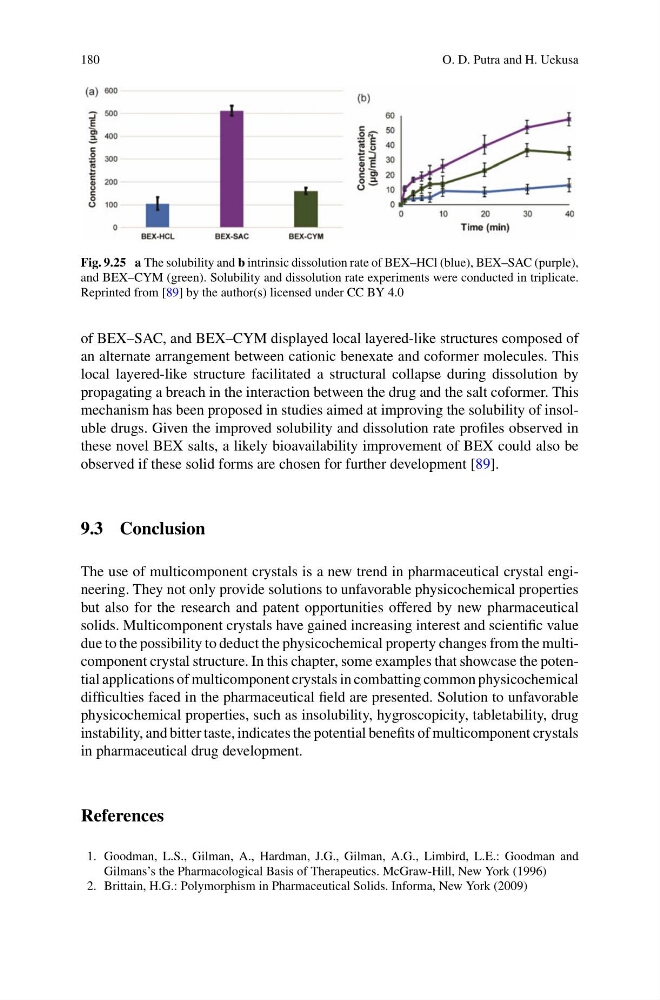
Fig. 9.25 a The solubility and b intrinsic dissolution rate of BEX–HCl (blue), BEX–SAC (purple),
and BEX–CYM (green). Solubility and dissolution rate experiments were conducted in triplicate.
Reprinted from [89] by the author(s) licensed under CC BY 4.0
of BEX–SAC, and BEX–CYM displayed local layered-like structures composed of
an alternate arrangement between cationic benexate and coformer molecules. This
local layered-like structure facilitated a structural collapse during dissolution by
propagating a breach in the interaction between the drug and the salt coformer. This
mechanism has been proposed in studies aimed at improving the solubility of insoluble drugs. Given the improved solubility and dissolution rate profiles observed in
these novel BEX salts, a likely bioavailability improvement of BEX could also be
observed if these solid forms are chosen for further development [89].
9.3 Conclusion
The use of multicomponent crystals is a new trend in pharmaceutical crystal engineering. They not only provide solutions to unfavorable physicochemical properties
but also for the research and patent opportunities offered by new pharmaceutical
solids. Multicomponent crystals have gained increasing interest and scientific value
due to the possibility to deduct the physicochemical property changes from the multicomponent crystal structure. In this chapter, some examples that showcase the potential applications of multicomponent crystals in combatting common physicochemical
difficulties faced in the pharmaceutical field are presented. Solution to unfavorable
physicochemical properties, such as insolubility, hygroscopicity, tabletability, drug
instability, and bitter taste, indicates the potential benefits of multicomponent crystals
in pharmaceutical drug development.
References
1. Goodman, L.S., Gilman, A., Hardman, J.G., Gilman, A.G., Limbird, L.E.: Goodman and
Gilmans’s the Pharmacological Basis of Therapeutics. McGraw-Hill, New York (1996)
2. Brittain, H.G.: Polymorphism in Pharmaceutical Solids. Informa, New York (2009)
O. D. Putra and H. Uekusa
Fig. 9.25 a The solubility and b intrinsic dissolution rate of BEX–HCl (blue), BEX–SAC (purple),
and BEX–CYM (green). Solubility and dissolution rate experiments were conducted in triplicate.
Reprinted from [89] by the author(s) licensed under CC BY 4.0
of BEX–SAC, and BEX–CYM displayed local layered-like structures composed of
an alternate arrangement between cationic benexate and coformer molecules. This
local layered-like structure facilitated a structural collapse during dissolution by
propagating a breach in the interaction between the drug and the salt coformer. This
mechanism has been proposed in studies aimed at improving the solubility of insoluble drugs. Given the improved solubility and dissolution rate profiles observed in
these novel BEX salts, a likely bioavailability improvement of BEX could also be
observed if these solid forms are chosen for further development [89].
9.3 Conclusion
The use of multicomponent crystals is a new trend in pharmaceutical crystal engineering. They not only provide solutions to unfavorable physicochemical properties
but also for the research and patent opportunities offered by new pharmaceutical
solids. Multicomponent crystals have gained increasing interest and scientific value
due to the possibility to deduct the physicochemical property changes from the multicomponent crystal structure. In this chapter, some examples that showcase the potential applications of multicomponent crystals in combatting common physicochemical
difficulties faced in the pharmaceutical field are presented. Solution to unfavorable
physicochemical properties, such as insolubility, hygroscopicity, tabletability, drug
instability, and bitter taste, indicates the potential benefits of multicomponent crystals
in pharmaceutical drug development.
References
1. Goodman, L.S., Gilman, A., Hardman, J.G., Gilman, A.G., Limbird, L.E.: Goodman and
Gilmans’s the Pharmacological Basis of Therapeutics. McGraw-Hill, New York (1996)
2. Brittain, H.G.: Polymorphism in Pharmaceutical Solids. Informa, New York (2009)