

176
O. D. Putra and H. Uekusa
low solubility of BEX, but that proved to be insufficient due to the high molecular
weight of BEX–HCl (molecular weight = 445.93 g mol
−1 ). Later, BEX–HCl was
complexed with β-cyclodextrin, aiming to improve its solubility and to reduce the
bitter taste [86, 87].
From the crystal engineering perspective, BEX is both an interesting and challenging compound because it has two major problems: bitter taste and low solubility.
To date, no new reported salt structure could tackle these unfavorable characteristics of BEX. Therefore, we explored artificial sweeteners that can be used as salt
coformers for naturally overcoming the native unpleasant taste of BEX. Artificial
sweeteners have been reported to improve the solubility and dissolution rate of
several drugs, including quinine, haloperidol, mirtazapine, pseudoephedrine, lamivudine, risperidone, sertraline, venlafaxine, zolpidem, amlodipine, and piroxicam [88].
This implies that artificial sweeteners are also potentially applicable to BEX’s low
solubility issue.
The preparation of novel salts involved an anion exchange reaction between the
chloride anion and the saccharinate (SAC, Scheme 9.5 middle) or cyclamate (CYM,
Scheme 9.5 right) anion; therefore, the sodium salts of those sweeteners were chosen.
Notably, other coformers used in either salt or acidic form failed to form new solid
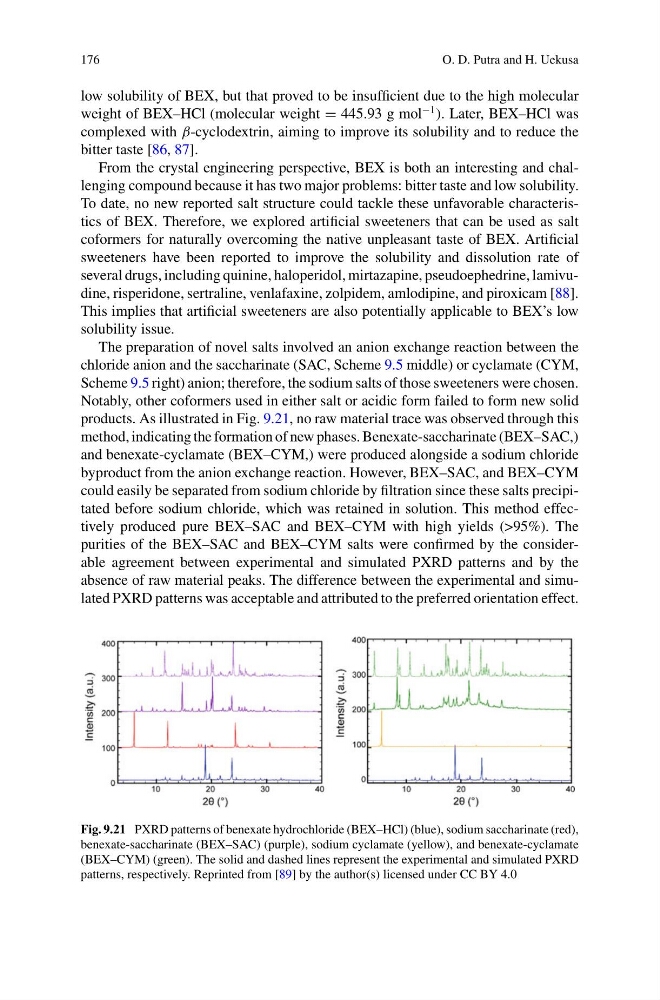
products. As illustrated in Fig. 9.21, no raw material trace was observed through this
method, indicating the formation of new phases. Benexate-saccharinate (BEX–SAC,)
and benexate-cyclamate (BEX–CYM,) were produced alongside a sodium chloride
byproduct from the anion exchange reaction. However, BEX–SAC, and BEX–CYM
could easily be separated from sodium chloride by filtration since these salts precipitated before sodium chloride, which was retained in solution. This method effectively produced pure BEX–SAC and BEX–CYM with high yields (>95%). The
purities of the BEX–SAC and BEX–CYM salts were confirmed by the considerable agreement between experimental and simulated PXRD patterns and by the
absence of raw material peaks. The difference between the experimental and simulated PXRD patterns was acceptable and attributed to the preferred orientation effect.
Fig. 9.21 PXRD patterns of benexate hydrochloride (BEX–HCl) (blue), sodium saccharinate (red),
benexate-saccharinate (BEX–SAC) (purple), sodium cyclamate (yellow), and benexate-cyclamate
(BEX–CYM) (green). The solid and dashed lines represent the experimental and simulated PXRD
patterns, respectively. Reprinted from [89] by the author(s) licensed under CC BY 4.0
O. D. Putra and H. Uekusa
low solubility of BEX, but that proved to be insufficient due to the high molecular
weight of BEX–HCl (molecular weight = 445.93 g mol
−1 ). Later, BEX–HCl was
complexed with β-cyclodextrin, aiming to improve its solubility and to reduce the
bitter taste [86, 87].
From the crystal engineering perspective, BEX is both an interesting and challenging compound because it has two major problems: bitter taste and low solubility.
To date, no new reported salt structure could tackle these unfavorable characteristics of BEX. Therefore, we explored artificial sweeteners that can be used as salt
coformers for naturally overcoming the native unpleasant taste of BEX. Artificial
sweeteners have been reported to improve the solubility and dissolution rate of
several drugs, including quinine, haloperidol, mirtazapine, pseudoephedrine, lamivudine, risperidone, sertraline, venlafaxine, zolpidem, amlodipine, and piroxicam [88].
This implies that artificial sweeteners are also potentially applicable to BEX’s low
solubility issue.
The preparation of novel salts involved an anion exchange reaction between the
chloride anion and the saccharinate (SAC, Scheme 9.5 middle) or cyclamate (CYM,
Scheme 9.5 right) anion; therefore, the sodium salts of those sweeteners were chosen.
Notably, other coformers used in either salt or acidic form failed to form new solid
products. As illustrated in Fig. 9.21, no raw material trace was observed through this
method, indicating the formation of new phases. Benexate-saccharinate (BEX–SAC,)
and benexate-cyclamate (BEX–CYM,) were produced alongside a sodium chloride
byproduct from the anion exchange reaction. However, BEX–SAC, and BEX–CYM
could easily be separated from sodium chloride by filtration since these salts precipitated before sodium chloride, which was retained in solution. This method effectively produced pure BEX–SAC and BEX–CYM with high yields (>95%). The
purities of the BEX–SAC and BEX–CYM salts were confirmed by the considerable agreement between experimental and simulated PXRD patterns and by the
absence of raw material peaks. The difference between the experimental and simulated PXRD patterns was acceptable and attributed to the preferred orientation effect.
Fig. 9.21 PXRD patterns of benexate hydrochloride (BEX–HCl) (blue), sodium saccharinate (red),
benexate-saccharinate (BEX–SAC) (purple), sodium cyclamate (yellow), and benexate-cyclamate
(BEX–CYM) (green). The solid and dashed lines represent the experimental and simulated PXRD
patterns, respectively. Reprinted from [89] by the author(s) licensed under CC BY 4.0