

9 Pharmaceutical Multicomponent Crystals: Structure, Design …
175
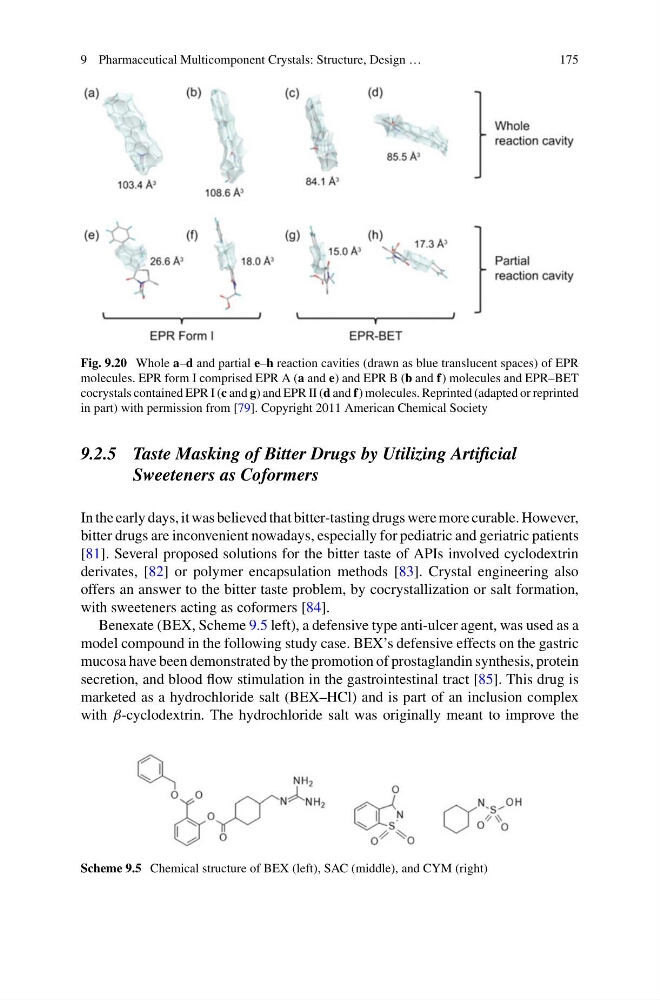
Fig. 9.20 Whole a–d and partial e–h reaction cavities (drawn as blue translucent spaces) of EPR
molecules. EPR form I comprised EPR A (a and e) and EPR B (b and f) molecules and EPR–BET
cocrystals contained EPR I (c and g) and EPR II (d and f) molecules. Reprinted (adapted or reprinted
in part) with permission from [79]. Copyright 2011 American Chemical Society
9.2.5 Taste Masking of Bitter Drugs by Utilizing Artificial
Sweeteners as Coformers
In the early days, it was believed that bitter-tasting drugs were more curable. However,
bitter drugs are inconvenient nowadays, especially for pediatric and geriatric patients
[81]. Several proposed solutions for the bitter taste of APIs involved cyclodextrin
derivates, [82] or polymer encapsulation methods [83]. Crystal engineering also
offers an answer to the bitter taste problem, by cocrystallization or salt formation,
with sweeteners acting as coformers [84].
Benexate (BEX, Scheme 9.5 left), a defensive type anti-ulcer agent, was used as a
model compound in the following study case. BEX’s defensive effects on the gastric
mucosa have been demonstrated by the promotion of prostaglandin synthesis, protein
secretion, and blood flow stimulation in the gastrointestinal tract [85]. This drug is
marketed as a hydrochloride salt (BEX–HCl) and is part of an inclusion complex
with β-cyclodextrin. The hydrochloride salt was originally meant to improve the
Scheme 9.5 Chemical structure of BEX (left), SAC (middle), and CYM (right)
175
Fig. 9.20 Whole a–d and partial e–h reaction cavities (drawn as blue translucent spaces) of EPR
molecules. EPR form I comprised EPR A (a and e) and EPR B (b and f) molecules and EPR–BET
cocrystals contained EPR I (c and g) and EPR II (d and f) molecules. Reprinted (adapted or reprinted
in part) with permission from [79]. Copyright 2011 American Chemical Society
9.2.5 Taste Masking of Bitter Drugs by Utilizing Artificial
Sweeteners as Coformers
In the early days, it was believed that bitter-tasting drugs were more curable. However,
bitter drugs are inconvenient nowadays, especially for pediatric and geriatric patients
[81]. Several proposed solutions for the bitter taste of APIs involved cyclodextrin
derivates, [82] or polymer encapsulation methods [83]. Crystal engineering also
offers an answer to the bitter taste problem, by cocrystallization or salt formation,
with sweeteners acting as coformers [84].
Benexate (BEX, Scheme 9.5 left), a defensive type anti-ulcer agent, was used as a
model compound in the following study case. BEX’s defensive effects on the gastric
mucosa have been demonstrated by the promotion of prostaglandin synthesis, protein
secretion, and blood flow stimulation in the gastrointestinal tract [85]. This drug is
marketed as a hydrochloride salt (BEX–HCl) and is part of an inclusion complex
with β-cyclodextrin. The hydrochloride salt was originally meant to improve the
Scheme 9.5 Chemical structure of BEX (left), SAC (middle), and CYM (right)