

174
O. D. Putra and H. Uekusa
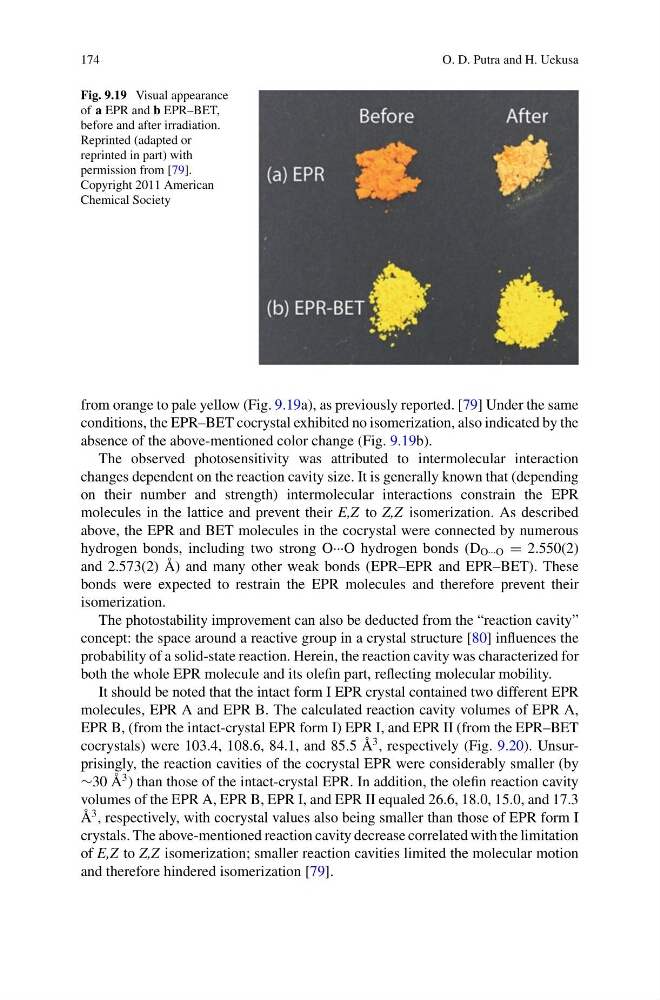
Fig. 9.19 Visual appearance
of a EPR and b EPR–BET,
before and after irradiation.
Reprinted (adapted or
reprinted in part) with
permission from [79].
Copyright 2011 American
Chemical Society
from orange to pale yellow (Fig. 9.19a), as previously reported. [79] Under the same
conditions, the EPR–BET cocrystal exhibited no isomerization, also indicated by the
absence of the above-mentioned color change (Fig. 9.19b).
The observed photosensitivity was attributed to intermolecular interaction
changes dependent on the reaction cavity size. It is generally known that (depending
on their number and strength) intermolecular interactions constrain the EPR
molecules in the lattice and prevent their E,Z to Z,Z isomerization. As described
above, the EPR and BET molecules in the cocrystal were connected by numerous
hydrogen bonds, including two strong O···O hydrogen bonds (D O···O = 2.550(2)
and 2.573(2) Å) and many other weak bonds (EPR–EPR and EPR–BET). These
bonds were expected to restrain the EPR molecules and therefore prevent their
isomerization.
The photostability improvement can also be deducted from the “reaction cavity”
concept: the space around a reactive group in a crystal structure [80] influences the
probability of a solid-state reaction. Herein, the reaction cavity was characterized for
both the whole EPR molecule and its olefin part, reflecting molecular mobility.
It should be noted that the intact form I EPR crystal contained two different EPR
molecules, EPR A and EPR B. The calculated reaction cavity volumes of EPR A,
EPR B, (from the intact-crystal EPR form I) EPR I, and EPR II (from the EPR–BET
cocrystals) were 103.4, 108.6, 84.1, and 85.5 Å
3 , respectively (Fig. 9.20). Unsurprisingly, the reaction cavities of the cocrystal EPR were considerably smaller (by
∼30 Å
3 ) than those of the intact-crystal EPR. In addition, the olefin reaction cavity
volumes of the EPR A, EPR B, EPR I, and EPR II equaled 26.6, 18.0, 15.0, and 17.3
Å
3 , respectively, with cocrystal values also being smaller than those of EPR form I
crystals. The above-mentioned reaction cavity decrease correlated with the limitation
of E,Z to Z,Z isomerization; smaller reaction cavities limited the molecular motion
and therefore hindered isomerization [79].
O. D. Putra and H. Uekusa
Fig. 9.19 Visual appearance
of a EPR and b EPR–BET,
before and after irradiation.
Reprinted (adapted or
reprinted in part) with
permission from [79].
Copyright 2011 American
Chemical Society
from orange to pale yellow (Fig. 9.19a), as previously reported. [79] Under the same
conditions, the EPR–BET cocrystal exhibited no isomerization, also indicated by the
absence of the above-mentioned color change (Fig. 9.19b).
The observed photosensitivity was attributed to intermolecular interaction
changes dependent on the reaction cavity size. It is generally known that (depending
on their number and strength) intermolecular interactions constrain the EPR
molecules in the lattice and prevent their E,Z to Z,Z isomerization. As described
above, the EPR and BET molecules in the cocrystal were connected by numerous
hydrogen bonds, including two strong O···O hydrogen bonds (D O···O = 2.550(2)
and 2.573(2) Å) and many other weak bonds (EPR–EPR and EPR–BET). These
bonds were expected to restrain the EPR molecules and therefore prevent their
isomerization.
The photostability improvement can also be deducted from the “reaction cavity”
concept: the space around a reactive group in a crystal structure [80] influences the
probability of a solid-state reaction. Herein, the reaction cavity was characterized for
both the whole EPR molecule and its olefin part, reflecting molecular mobility.
It should be noted that the intact form I EPR crystal contained two different EPR
molecules, EPR A and EPR B. The calculated reaction cavity volumes of EPR A,
EPR B, (from the intact-crystal EPR form I) EPR I, and EPR II (from the EPR–BET
cocrystals) were 103.4, 108.6, 84.1, and 85.5 Å
3 , respectively (Fig. 9.20). Unsurprisingly, the reaction cavities of the cocrystal EPR were considerably smaller (by
∼30 Å
3 ) than those of the intact-crystal EPR. In addition, the olefin reaction cavity
volumes of the EPR A, EPR B, EPR I, and EPR II equaled 26.6, 18.0, 15.0, and 17.3
Å
3 , respectively, with cocrystal values also being smaller than those of EPR form I
crystals. The above-mentioned reaction cavity decrease correlated with the limitation
of E,Z to Z,Z isomerization; smaller reaction cavities limited the molecular motion
and therefore hindered isomerization [79].