

9 Pharmaceutical Multicomponent Crystals: Structure, Design …
173
I and EPR II molecules via x + 1, y, z symmetry operations. The above hydrogen
bonds resulted in a layered structure (Fig. 9.17b) with alternately arranged EPR I,
BET, and EPR II molecules, stacked along the a-axis.
Photoinstability is one of the greatest, not yet successfully tackled challenges of
the pharmaceutical field. Solid-state EPR is stable in the dark, but undergoing E,Z to
Z,Z isomerization even when exposed to ambient light. From a crystal engineering
viewpoint, zwitterionic cocrystals should provide a good opportunity to overcome
this problem, since the zwitterionic coformer is expected to form strong, chargeassisted hydrogen bonds with the EPR molecules, stabilizing their conformation, a
phenomenon, however not yet observed in other EPR cocrystals and salts. Therefore,
BET was selected as a coformer due to its inherent ability to form charge-assisted
hydrogen bonds.
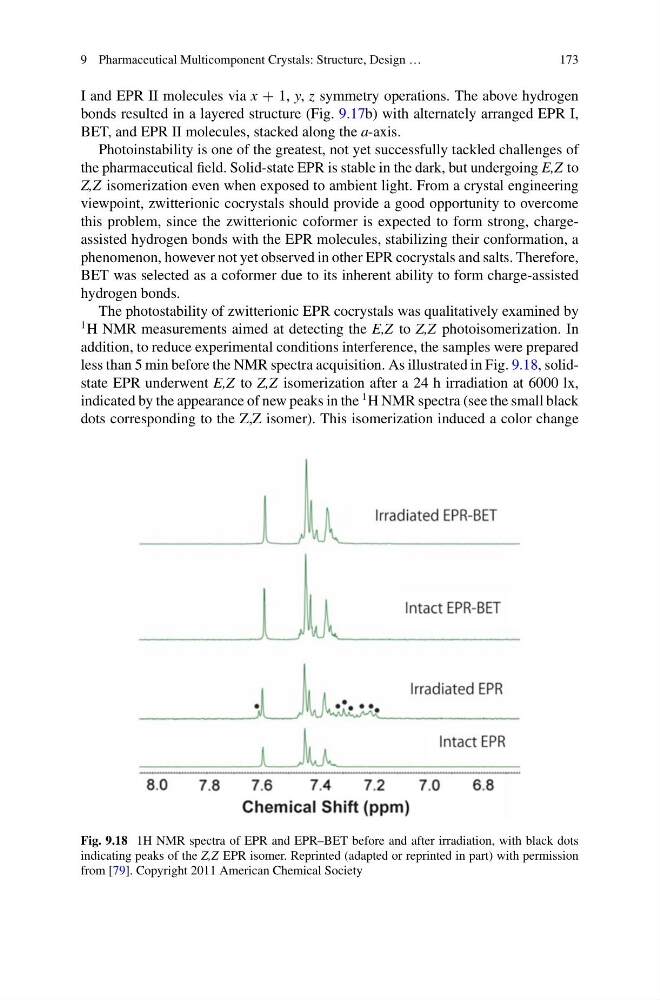
The photostability of zwitterionic EPR cocrystals was qualitatively examined by
1 H NMR measurements aimed at detecting the E,Z to Z,Z photoisomerization. In
addition, to reduce experimental conditions interference, the samples were prepared
less than 5 min before the NMR spectra acquisition. As illustrated in Fig. 9.18, solidstate EPR underwent E,Z to Z,Z isomerization after a 24 h irradiation at 6000 lx,
indicated by the appearance of new peaks in the
1 H NMR spectra (see the small black
dots corresponding to the Z,Z isomer). This isomerization induced a color change
Fig. 9.18 1H NMR spectra of EPR and EPR–BET before and after irradiation, with black dots
indicating peaks of the Z,Z EPR isomer. Reprinted (adapted or reprinted in part) with permission
from [79]. Copyright 2011 American Chemical Society
173
I and EPR II molecules via x + 1, y, z symmetry operations. The above hydrogen
bonds resulted in a layered structure (Fig. 9.17b) with alternately arranged EPR I,
BET, and EPR II molecules, stacked along the a-axis.
Photoinstability is one of the greatest, not yet successfully tackled challenges of
the pharmaceutical field. Solid-state EPR is stable in the dark, but undergoing E,Z to
Z,Z isomerization even when exposed to ambient light. From a crystal engineering
viewpoint, zwitterionic cocrystals should provide a good opportunity to overcome
this problem, since the zwitterionic coformer is expected to form strong, chargeassisted hydrogen bonds with the EPR molecules, stabilizing their conformation, a
phenomenon, however not yet observed in other EPR cocrystals and salts. Therefore,
BET was selected as a coformer due to its inherent ability to form charge-assisted
hydrogen bonds.
The photostability of zwitterionic EPR cocrystals was qualitatively examined by
1 H NMR measurements aimed at detecting the E,Z to Z,Z photoisomerization. In
addition, to reduce experimental conditions interference, the samples were prepared
less than 5 min before the NMR spectra acquisition. As illustrated in Fig. 9.18, solidstate EPR underwent E,Z to Z,Z isomerization after a 24 h irradiation at 6000 lx,
indicated by the appearance of new peaks in the
1 H NMR spectra (see the small black
dots corresponding to the Z,Z isomer). This isomerization induced a color change
Fig. 9.18 1H NMR spectra of EPR and EPR–BET before and after irradiation, with black dots
indicating peaks of the Z,Z EPR isomer. Reprinted (adapted or reprinted in part) with permission
from [79]. Copyright 2011 American Chemical Society