

172
O. D. Putra and H. Uekusa
the experimental and simulated PXRD patterns were ascribed to the preferred orientation effect. As expected, the utilization of a zwitterionic coformer preserved the
neutrality of EPR molecules.
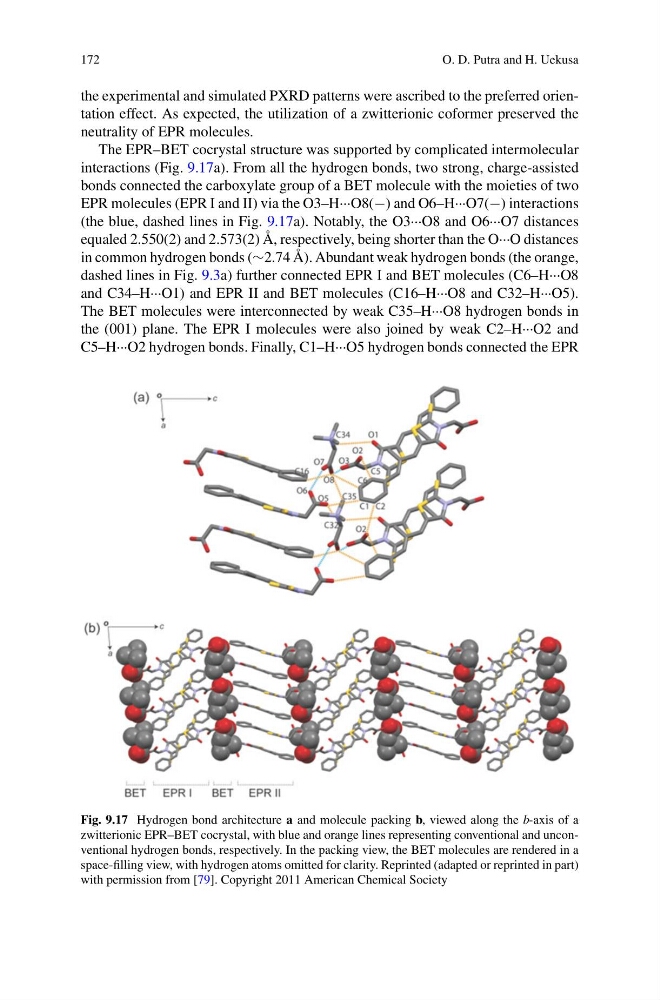
The EPR–BET cocrystal structure was supported by complicated intermolecular
interactions (Fig. 9.17a). From all the hydrogen bonds, two strong, charge-assisted
bonds connected the carboxylate group of a BET molecule with the moieties of two
EPR molecules (EPR I and II) via the O3–H···O8(−) and O6–H···O7(−) interactions
(the blue, dashed lines in Fig. 9.17a). Notably, the O3···O8 and O6···O7 distances
equaled 2.550(2) and 2.573(2) Å, respectively, being shorter than the O···O distances
in common hydrogen bonds (∼2.74 Å). Abundant weak hydrogen bonds (the orange,
dashed lines in Fig. 9.3a) further connected EPR I and BET molecules (C6–H···O8
and C34–H···O1) and EPR II and BET molecules (C16–H···O8 and C32–H···O5).
The BET molecules were interconnected by weak C35–H···O8 hydrogen bonds in
the (001) plane. The EPR I molecules were also joined by weak C2–H···O2 and
C5–H···O2 hydrogen bonds. Finally, C1–H···O5 hydrogen bonds connected the EPR
Fig. 9.17 Hydrogen bond architecture a and molecule packing b, viewed along the b-axis of a
zwitterionic EPR–BET cocrystal, with blue and orange lines representing conventional and unconventional hydrogen bonds, respectively. In the packing view, the BET molecules are rendered in a
space-filling view, with hydrogen atoms omitted for clarity. Reprinted (adapted or reprinted in part)
with permission from [79]. Copyright 2011 American Chemical Society
O. D. Putra and H. Uekusa
the experimental and simulated PXRD patterns were ascribed to the preferred orientation effect. As expected, the utilization of a zwitterionic coformer preserved the
neutrality of EPR molecules.
The EPR–BET cocrystal structure was supported by complicated intermolecular
interactions (Fig. 9.17a). From all the hydrogen bonds, two strong, charge-assisted
bonds connected the carboxylate group of a BET molecule with the moieties of two
EPR molecules (EPR I and II) via the O3–H···O8(−) and O6–H···O7(−) interactions
(the blue, dashed lines in Fig. 9.17a). Notably, the O3···O8 and O6···O7 distances
equaled 2.550(2) and 2.573(2) Å, respectively, being shorter than the O···O distances
in common hydrogen bonds (∼2.74 Å). Abundant weak hydrogen bonds (the orange,
dashed lines in Fig. 9.3a) further connected EPR I and BET molecules (C6–H···O8
and C34–H···O1) and EPR II and BET molecules (C16–H···O8 and C32–H···O5).
The BET molecules were interconnected by weak C35–H···O8 hydrogen bonds in
the (001) plane. The EPR I molecules were also joined by weak C2–H···O2 and
C5–H···O2 hydrogen bonds. Finally, C1–H···O5 hydrogen bonds connected the EPR
Fig. 9.17 Hydrogen bond architecture a and molecule packing b, viewed along the b-axis of a
zwitterionic EPR–BET cocrystal, with blue and orange lines representing conventional and unconventional hydrogen bonds, respectively. In the packing view, the BET molecules are rendered in a
space-filling view, with hydrogen atoms omitted for clarity. Reprinted (adapted or reprinted in part)
with permission from [79]. Copyright 2011 American Chemical Society