

170
O. D. Putra and H. Uekusa
9.2.4 Improving Photostability by Preventing
Tautomerization
Although many drugs successfully surmount the long development process, many
of them still have chemical stability problems. It is suggested that these drugs are
still present in the market due to their pharmacological importance. Drugs that pose
stability problems usually require a strict control strategy in their design and development stages. Chemical instability is considered an ominous feature, which not
only leads to drug ineffectiveness but also endangers the patient through potentially
toxic decomposition products [73]. Therefore, chemical instability is a subject of
increased concern for the pharmaceutical industry.
Numerous studies described the benefits of cocrystals in overcoming the stability
problems of APIs. A common strategy for producing pharmaceutical cocrystals
utilizes the so-called pK a rule, [74] which states that a neutral cocrystal is generated instead of an ionic salt when the difference between the pK a of a base and
that of its conjugate is negative or at least as low as possible. However, the proton
transfer is sometimes unavoidable, even in systems with a low pK a (<1) [45, 75].
An alternative approach features the use of a zwitterionic coformer to avoid the
proton transfer between drug molecules. Since the proton donor and acceptor sites
of zwitterionic molecules are already deprotonated and protonated, respectively, such
coformers cannot participate in the proton transfer between drug molecules. They
consequently enable the formation of zwitterionic cocrystals, a less explored type
of cocrystals compared to molecular or ionic types [76]. In this context, we were
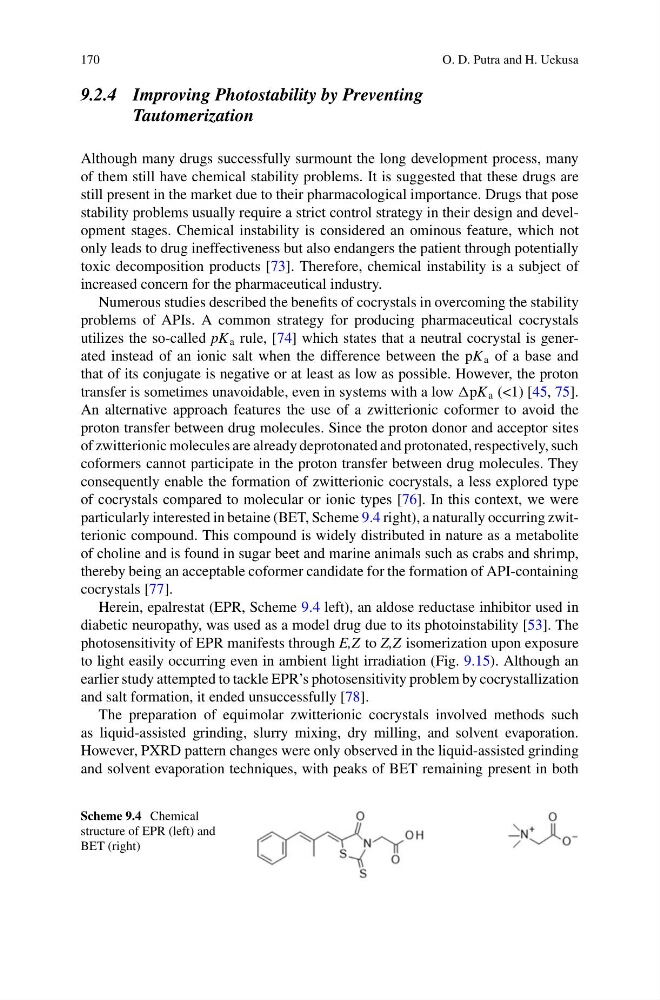
particularly interested in betaine (BET, Scheme 9.4 right), a naturally occurring zwitterionic compound. This compound is widely distributed in nature as a metabolite
of choline and is found in sugar beet and marine animals such as crabs and shrimp,
thereby being an acceptable coformer candidate for the formation of API-containing
cocrystals [77].
Herein, epalrestat (EPR, Scheme 9.4 left), an aldose reductase inhibitor used in
diabetic neuropathy, was used as a model drug due to its photoinstability [53]. The
photosensitivity of EPR manifests through E,Z to Z,Z isomerization upon exposure
to light easily occurring even in ambient light irradiation (Fig. 9.15). Although an
earlier study attempted to tackle EPR’s photosensitivity problem by cocrystallization
and salt formation, it ended unsuccessfully [78].
The preparation of equimolar zwitterionic cocrystals involved methods such
as liquid-assisted grinding, slurry mixing, dry milling, and solvent evaporation.
However, PXRD pattern changes were only observed in the liquid-assisted grinding
and solvent evaporation techniques, with peaks of BET remaining present in both
Scheme 9.4 Chemical
structure of EPR (left) and
BET (right)
O. D. Putra and H. Uekusa
9.2.4 Improving Photostability by Preventing
Tautomerization
Although many drugs successfully surmount the long development process, many
of them still have chemical stability problems. It is suggested that these drugs are
still present in the market due to their pharmacological importance. Drugs that pose
stability problems usually require a strict control strategy in their design and development stages. Chemical instability is considered an ominous feature, which not
only leads to drug ineffectiveness but also endangers the patient through potentially
toxic decomposition products [73]. Therefore, chemical instability is a subject of
increased concern for the pharmaceutical industry.
Numerous studies described the benefits of cocrystals in overcoming the stability
problems of APIs. A common strategy for producing pharmaceutical cocrystals
utilizes the so-called pK a rule, [74] which states that a neutral cocrystal is generated instead of an ionic salt when the difference between the pK a of a base and
that of its conjugate is negative or at least as low as possible. However, the proton
transfer is sometimes unavoidable, even in systems with a low pK a (<1) [45, 75].
An alternative approach features the use of a zwitterionic coformer to avoid the
proton transfer between drug molecules. Since the proton donor and acceptor sites
of zwitterionic molecules are already deprotonated and protonated, respectively, such
coformers cannot participate in the proton transfer between drug molecules. They
consequently enable the formation of zwitterionic cocrystals, a less explored type
of cocrystals compared to molecular or ionic types [76]. In this context, we were
particularly interested in betaine (BET, Scheme 9.4 right), a naturally occurring zwitterionic compound. This compound is widely distributed in nature as a metabolite
of choline and is found in sugar beet and marine animals such as crabs and shrimp,
thereby being an acceptable coformer candidate for the formation of API-containing
cocrystals [77].
Herein, epalrestat (EPR, Scheme 9.4 left), an aldose reductase inhibitor used in
diabetic neuropathy, was used as a model drug due to its photoinstability [53]. The
photosensitivity of EPR manifests through E,Z to Z,Z isomerization upon exposure
to light easily occurring even in ambient light irradiation (Fig. 9.15). Although an
earlier study attempted to tackle EPR’s photosensitivity problem by cocrystallization
and salt formation, it ended unsuccessfully [78].
The preparation of equimolar zwitterionic cocrystals involved methods such
as liquid-assisted grinding, slurry mixing, dry milling, and solvent evaporation.
However, PXRD pattern changes were only observed in the liquid-assisted grinding
and solvent evaporation techniques, with peaks of BET remaining present in both
Scheme 9.4 Chemical
structure of EPR (left) and
BET (right)