

9 Pharmaceutical Multicomponent Crystals: Structure, Design …
169
Fig. 9.13 Tablet overview of a DES and b DES-BA after applying a compaction pressure of
350 MPa. Reprinted from [72]. Copyright 2012, with permission from Elsevier
profiles due to the elastic deformation of DES. However, neither capping nor lamination tendency was observed in the DES-BA multicomponent crystal, as illustrated
in Fig. 9.13b.
The fact that DES-BA exhibited better tabletability profiles than DES can be
understood from a structural point of view. Therefore, it is very useful to compare the
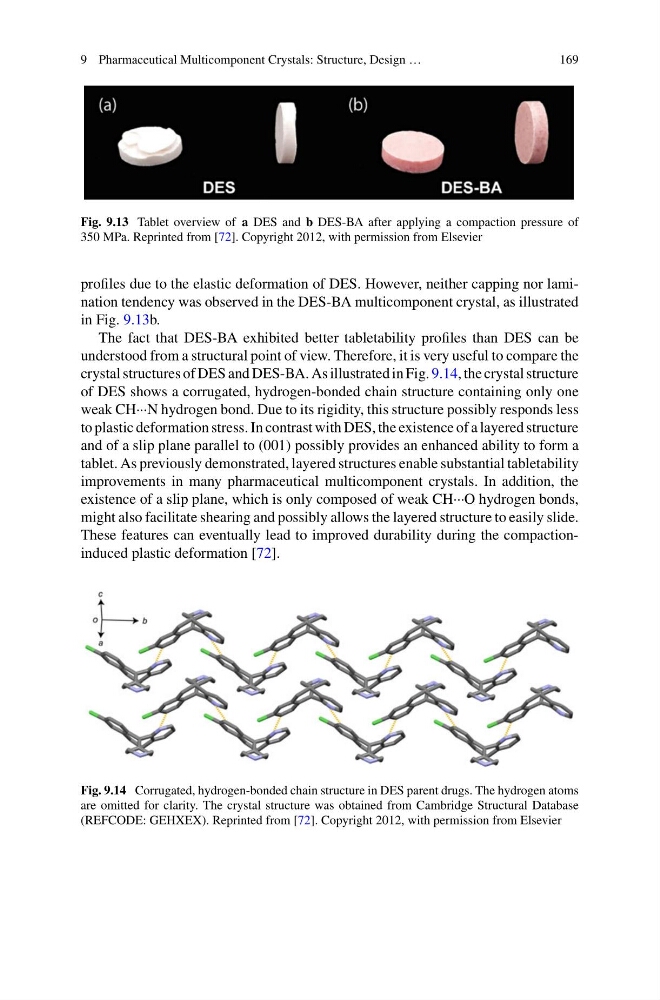
crystal structures of DES and DES-BA. As illustrated in Fig. 9.14, the crystal structure
of DES shows a corrugated, hydrogen-bonded chain structure containing only one
weak CH···N hydrogen bond. Due to its rigidity, this structure possibly responds less
to plastic deformation stress. In contrast with DES, the existence of a layered structure
and of a slip plane parallel to (001) possibly provides an enhanced ability to form a
tablet. As previously demonstrated, layered structures enable substantial tabletability
improvements in many pharmaceutical multicomponent crystals. In addition, the
existence of a slip plane, which is only composed of weak CH···O hydrogen bonds,
might also facilitate shearing and possibly allows the layered structure to easily slide.
These features can eventually lead to improved durability during the compactioninduced plastic deformation [72].
Fig. 9.14 Corrugated, hydrogen-bonded chain structure in DES parent drugs. The hydrogen atoms
are omitted for clarity. The crystal structure was obtained from Cambridge Structural Database
(REFCODE: GEHXEX). Reprinted from [72]. Copyright 2012, with permission from Elsevier
169
Fig. 9.13 Tablet overview of a DES and b DES-BA after applying a compaction pressure of
350 MPa. Reprinted from [72]. Copyright 2012, with permission from Elsevier
profiles due to the elastic deformation of DES. However, neither capping nor lamination tendency was observed in the DES-BA multicomponent crystal, as illustrated
in Fig. 9.13b.
The fact that DES-BA exhibited better tabletability profiles than DES can be
understood from a structural point of view. Therefore, it is very useful to compare the
crystal structures of DES and DES-BA. As illustrated in Fig. 9.14, the crystal structure
of DES shows a corrugated, hydrogen-bonded chain structure containing only one
weak CH···N hydrogen bond. Due to its rigidity, this structure possibly responds less
to plastic deformation stress. In contrast with DES, the existence of a layered structure
and of a slip plane parallel to (001) possibly provides an enhanced ability to form a
tablet. As previously demonstrated, layered structures enable substantial tabletability
improvements in many pharmaceutical multicomponent crystals. In addition, the
existence of a slip plane, which is only composed of weak CH···O hydrogen bonds,
might also facilitate shearing and possibly allows the layered structure to easily slide.
These features can eventually lead to improved durability during the compactioninduced plastic deformation [72].
Fig. 9.14 Corrugated, hydrogen-bonded chain structure in DES parent drugs. The hydrogen atoms
are omitted for clarity. The crystal structure was obtained from Cambridge Structural Database
(REFCODE: GEHXEX). Reprinted from [72]. Copyright 2012, with permission from Elsevier