

166
O. D. Putra and H. Uekusa
compaction behavior that overcomes the root of poor mechanical properties itself,
the arrangement of API molecules within the crystal structure [69].
This section presents the study case of desloratadine (DES, Scheme 9.3 left), a
derivative of loratadine used to treat allergic rhinitis, urticaria, and inflammation.
Pharmacologically, DES is a selective H 1 histamine receptor inverse agonist [70].
DES exhibits poor mechanical characteristics, manifested by capping during tablet
compression and results in drug processing difficulties [71].
DES has pyridine and piperidine rings that can enable many potential intermolecular interactions with mildly acidic carboxylic acids. Therefore, the screening
targeted generally recognized as safe (GRAS) compounds containing carboxylic acid
moieties. The attempts to prepare a multicomponent crystal of DES used highly efficient cocrystal generating methods, such as liquid-assisted grinding, slurry mixing,
dry milling, and solvent evaporation techniques.
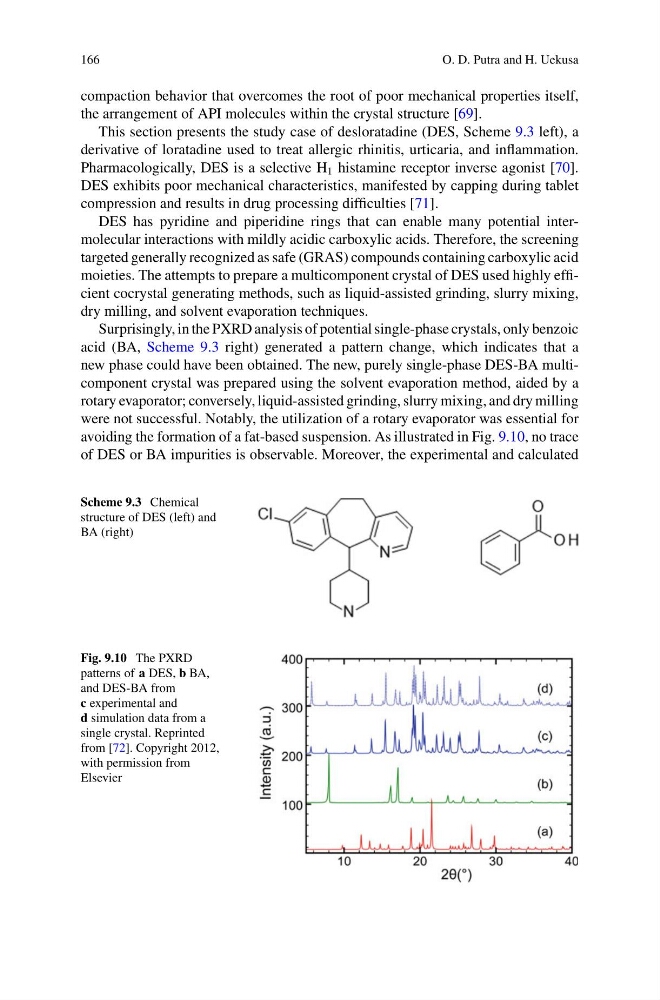
Surprisingly, in the PXRD analysis of potential single-phase crystals, only benzoic
acid (BA, Scheme 9.3 right) generated a pattern change, which indicates that a
new phase could have been obtained. The new, purely single-phase DES-BA multicomponent crystal was prepared using the solvent evaporation method, aided by a
rotary evaporator; conversely, liquid-assisted grinding, slurry mixing, and dry milling
were not successful. Notably, the utilization of a rotary evaporator was essential for
avoiding the formation of a fat-based suspension. As illustrated in Fig. 9.10, no trace
of DES or BA impurities is observable. Moreover, the experimental and calculated
Scheme 9.3 Chemical
structure of DES (left) and
BA (right)
Fig. 9.10 The PXRD
patterns of a DES, b BA,
and DES-BA from
c experimental and
d simulation data from a
single crystal. Reprinted
from [72]. Copyright 2012,
with permission from
Elsevier
O. D. Putra and H. Uekusa
compaction behavior that overcomes the root of poor mechanical properties itself,
the arrangement of API molecules within the crystal structure [69].
This section presents the study case of desloratadine (DES, Scheme 9.3 left), a
derivative of loratadine used to treat allergic rhinitis, urticaria, and inflammation.
Pharmacologically, DES is a selective H 1 histamine receptor inverse agonist [70].
DES exhibits poor mechanical characteristics, manifested by capping during tablet
compression and results in drug processing difficulties [71].
DES has pyridine and piperidine rings that can enable many potential intermolecular interactions with mildly acidic carboxylic acids. Therefore, the screening
targeted generally recognized as safe (GRAS) compounds containing carboxylic acid
moieties. The attempts to prepare a multicomponent crystal of DES used highly efficient cocrystal generating methods, such as liquid-assisted grinding, slurry mixing,
dry milling, and solvent evaporation techniques.
Surprisingly, in the PXRD analysis of potential single-phase crystals, only benzoic
acid (BA, Scheme 9.3 right) generated a pattern change, which indicates that a
new phase could have been obtained. The new, purely single-phase DES-BA multicomponent crystal was prepared using the solvent evaporation method, aided by a
rotary evaporator; conversely, liquid-assisted grinding, slurry mixing, and dry milling
were not successful. Notably, the utilization of a rotary evaporator was essential for
avoiding the formation of a fat-based suspension. As illustrated in Fig. 9.10, no trace
of DES or BA impurities is observable. Moreover, the experimental and calculated
Scheme 9.3 Chemical
structure of DES (left) and
BA (right)
Fig. 9.10 The PXRD
patterns of a DES, b BA,
and DES-BA from
c experimental and
d simulation data from a
single crystal. Reprinted
from [72]. Copyright 2012,
with permission from
Elsevier