

9 Pharmaceutical Multicomponent Crystals: Structure, Design …
167
PXRD patterns are similar, indicating the absence of significant amounts of impurities. It should be noted here that the differences between the experimental and
simulated powder patterns, in this case, might be caused by experimental factors
such as differences in temperature and preferred orientation.
Single-crystal structure analysis revealed that the DES-BA multicomponent
crystal is a salt. The crystal structure of DES-BA is constructed both by conventional
N–H···O and unconventional C–H···O hydrogen bonds. The charge-assisted hydrogen
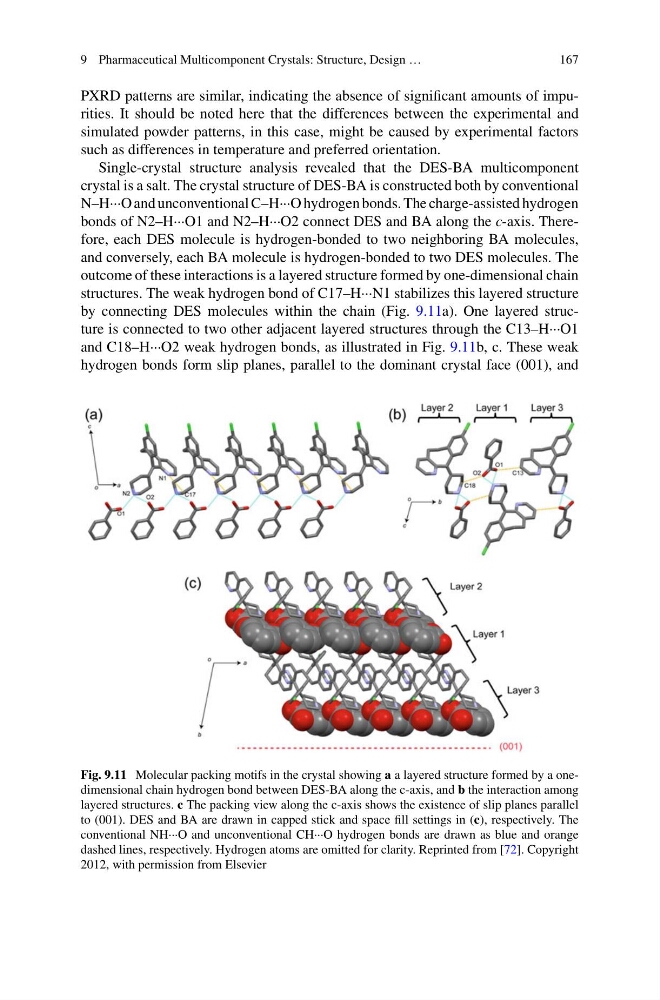
bonds of N2–H···O1 and N2–H···O2 connect DES and BA along the c-axis. Therefore, each DES molecule is hydrogen-bonded to two neighboring BA molecules,
and conversely, each BA molecule is hydrogen-bonded to two DES molecules. The
outcome of these interactions is a layered structure formed by one-dimensional chain
structures. The weak hydrogen bond of C17–H···N1 stabilizes this layered structure
by connecting DES molecules within the chain (Fig. 9.11a). One layered structure is connected to two other adjacent layered structures through the C13–H···O1
and C18–H···O2 weak hydrogen bonds, as illustrated in Fig. 9.11b, c. These weak
hydrogen bonds form slip planes, parallel to the dominant crystal face (001), and
Fig. 9.11 Molecular packing motifs in the crystal showing a a layered structure formed by a onedimensional chain hydrogen bond between DES-BA along the c-axis, and b the interaction among
layered structures. c The packing view along the c-axis shows the existence of slip planes parallel
to (001). DES and BA are drawn in capped stick and space fill settings in (c), respectively. The
conventional NH···O and unconventional CH···O hydrogen bonds are drawn as blue and orange
dashed lines, respectively. Hydrogen atoms are omitted for clarity. Reprinted from [72]. Copyright
2012, with permission from Elsevier
167
PXRD patterns are similar, indicating the absence of significant amounts of impurities. It should be noted here that the differences between the experimental and
simulated powder patterns, in this case, might be caused by experimental factors
such as differences in temperature and preferred orientation.
Single-crystal structure analysis revealed that the DES-BA multicomponent
crystal is a salt. The crystal structure of DES-BA is constructed both by conventional
N–H···O and unconventional C–H···O hydrogen bonds. The charge-assisted hydrogen
bonds of N2–H···O1 and N2–H···O2 connect DES and BA along the c-axis. Therefore, each DES molecule is hydrogen-bonded to two neighboring BA molecules,
and conversely, each BA molecule is hydrogen-bonded to two DES molecules. The
outcome of these interactions is a layered structure formed by one-dimensional chain
structures. The weak hydrogen bond of C17–H···N1 stabilizes this layered structure
by connecting DES molecules within the chain (Fig. 9.11a). One layered structure is connected to two other adjacent layered structures through the C13–H···O1
and C18–H···O2 weak hydrogen bonds, as illustrated in Fig. 9.11b, c. These weak
hydrogen bonds form slip planes, parallel to the dominant crystal face (001), and
Fig. 9.11 Molecular packing motifs in the crystal showing a a layered structure formed by a onedimensional chain hydrogen bond between DES-BA along the c-axis, and b the interaction among
layered structures. c The packing view along the c-axis shows the existence of slip planes parallel
to (001). DES and BA are drawn in capped stick and space fill settings in (c), respectively. The
conventional NH···O and unconventional CH···O hydrogen bonds are drawn as blue and orange
dashed lines, respectively. Hydrogen atoms are omitted for clarity. Reprinted from [72]. Copyright
2012, with permission from Elsevier