

9 Pharmaceutical Multicomponent Crystals: Structure, Design …
165
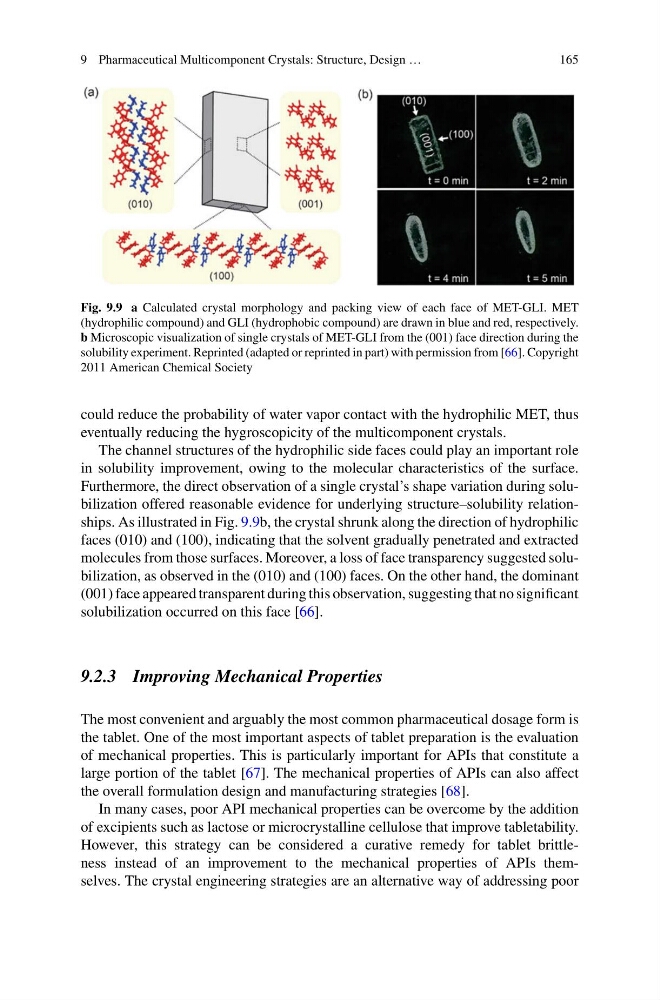
Fig. 9.9 a Calculated crystal morphology and packing view of each face of MET-GLI. MET
(hydrophilic compound) and GLI (hydrophobic compound) are drawn in blue and red, respectively.
b Microscopic visualization of single crystals of MET-GLI from the (001) face direction during the
solubility experiment. Reprinted (adapted or reprinted in part) with permission from [66]. Copyright
2011 American Chemical Society
could reduce the probability of water vapor contact with the hydrophilic MET, thus
eventually reducing the hygroscopicity of the multicomponent crystals.
The channel structures of the hydrophilic side faces could play an important role
in solubility improvement, owing to the molecular characteristics of the surface.
Furthermore, the direct observation of a single crystal’s shape variation during solubilization offered reasonable evidence for underlying structure–solubility relationships. As illustrated in Fig. 9.9b, the crystal shrunk along the direction of hydrophilic
faces (010) and (100), indicating that the solvent gradually penetrated and extracted
molecules from those surfaces. Moreover, a loss of face transparency suggested solubilization, as observed in the (010) and (100) faces. On the other hand, the dominant
(001) face appeared transparent during this observation, suggesting that no significant
solubilization occurred on this face [66].
9.2.3 Improving Mechanical Properties
The most convenient and arguably the most common pharmaceutical dosage form is
the tablet. One of the most important aspects of tablet preparation is the evaluation
of mechanical properties. This is particularly important for APIs that constitute a
large portion of the tablet [67]. The mechanical properties of APIs can also affect
the overall formulation design and manufacturing strategies [68].
In many cases, poor API mechanical properties can be overcome by the addition
of excipients such as lactose or microcrystalline cellulose that improve tabletability.
However, this strategy can be considered a curative remedy for tablet brittleness instead of an improvement to the mechanical properties of APIs themselves. The crystal engineering strategies are an alternative way of addressing poor
165
Fig. 9.9 a Calculated crystal morphology and packing view of each face of MET-GLI. MET
(hydrophilic compound) and GLI (hydrophobic compound) are drawn in blue and red, respectively.
b Microscopic visualization of single crystals of MET-GLI from the (001) face direction during the
solubility experiment. Reprinted (adapted or reprinted in part) with permission from [66]. Copyright
2011 American Chemical Society
could reduce the probability of water vapor contact with the hydrophilic MET, thus
eventually reducing the hygroscopicity of the multicomponent crystals.
The channel structures of the hydrophilic side faces could play an important role
in solubility improvement, owing to the molecular characteristics of the surface.
Furthermore, the direct observation of a single crystal’s shape variation during solubilization offered reasonable evidence for underlying structure–solubility relationships. As illustrated in Fig. 9.9b, the crystal shrunk along the direction of hydrophilic
faces (010) and (100), indicating that the solvent gradually penetrated and extracted
molecules from those surfaces. Moreover, a loss of face transparency suggested solubilization, as observed in the (010) and (100) faces. On the other hand, the dominant
(001) face appeared transparent during this observation, suggesting that no significant
solubilization occurred on this face [66].
9.2.3 Improving Mechanical Properties
The most convenient and arguably the most common pharmaceutical dosage form is
the tablet. One of the most important aspects of tablet preparation is the evaluation
of mechanical properties. This is particularly important for APIs that constitute a
large portion of the tablet [67]. The mechanical properties of APIs can also affect
the overall formulation design and manufacturing strategies [68].
In many cases, poor API mechanical properties can be overcome by the addition
of excipients such as lactose or microcrystalline cellulose that improve tabletability.
However, this strategy can be considered a curative remedy for tablet brittleness instead of an improvement to the mechanical properties of APIs themselves. The crystal engineering strategies are an alternative way of addressing poor