

9 Pharmaceutical Multicomponent Crystals: Structure, Design …
163
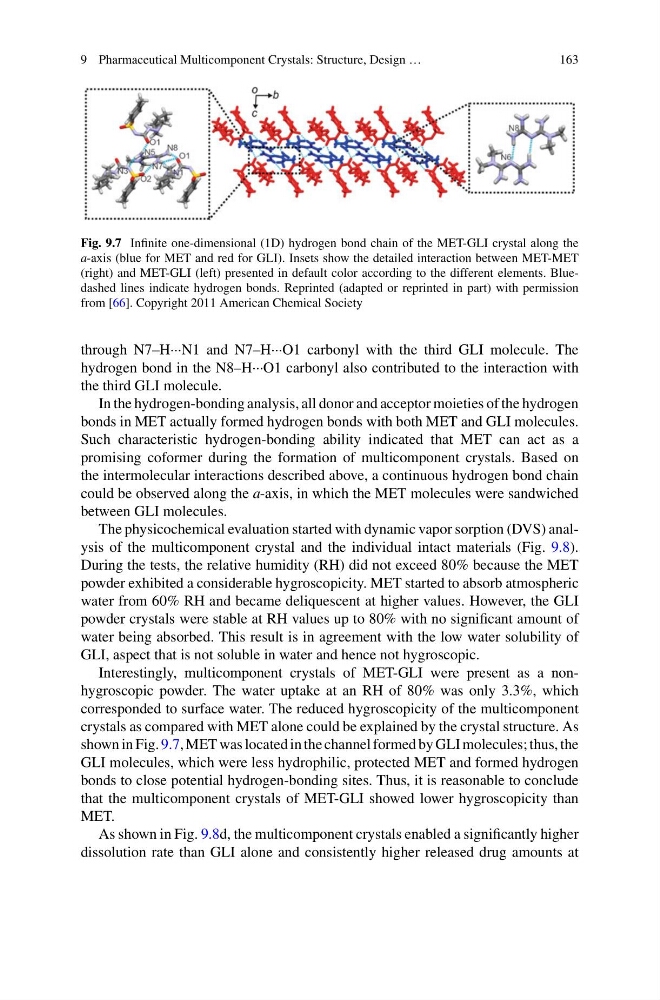
Fig. 9.7 Infinite one-dimensional (1D) hydrogen bond chain of the MET-GLI crystal along the
a-axis (blue for MET and red for GLI). Insets show the detailed interaction between MET-MET
(right) and MET-GLI (left) presented in default color according to the different elements. Bluedashed lines indicate hydrogen bonds. Reprinted (adapted or reprinted in part) with permission
from [66]. Copyright 2011 American Chemical Society
through N7–H···N1 and N7–H···O1 carbonyl with the third GLI molecule. The
hydrogen bond in the N8–H···O1 carbonyl also contributed to the interaction with
the third GLI molecule.
In the hydrogen-bonding analysis, all donor and acceptor moieties of the hydrogen
bonds in MET actually formed hydrogen bonds with both MET and GLI molecules.
Such characteristic hydrogen-bonding ability indicated that MET can act as a
promising coformer during the formation of multicomponent crystals. Based on
the intermolecular interactions described above, a continuous hydrogen bond chain
could be observed along the a-axis, in which the MET molecules were sandwiched
between GLI molecules.
The physicochemical evaluation started with dynamic vapor sorption (DVS) analysis of the multicomponent crystal and the individual intact materials (Fig. 9.8).
During the tests, the relative humidity (RH) did not exceed 80% because the MET
powder exhibited a considerable hygroscopicity. MET started to absorb atmospheric
water from 60% RH and became deliquescent at higher values. However, the GLI
powder crystals were stable at RH values up to 80% with no significant amount of
water being absorbed. This result is in agreement with the low water solubility of
GLI, aspect that is not soluble in water and hence not hygroscopic.
Interestingly, multicomponent crystals of MET-GLI were present as a nonhygroscopic powder. The water uptake at an RH of 80% was only 3.3%, which
corresponded to surface water. The reduced hygroscopicity of the multicomponent
crystals as compared with MET alone could be explained by the crystal structure. As
shown in Fig. 9.7, MET was located in the channel formed by GLI molecules; thus, the
GLI molecules, which were less hydrophilic, protected MET and formed hydrogen
bonds to close potential hydrogen-bonding sites. Thus, it is reasonable to conclude
that the multicomponent crystals of MET-GLI showed lower hygroscopicity than
MET.
As shown in Fig. 9.8d, the multicomponent crystals enabled a significantly higher
dissolution rate than GLI alone and consistently higher released drug amounts at
163
Fig. 9.7 Infinite one-dimensional (1D) hydrogen bond chain of the MET-GLI crystal along the
a-axis (blue for MET and red for GLI). Insets show the detailed interaction between MET-MET
(right) and MET-GLI (left) presented in default color according to the different elements. Bluedashed lines indicate hydrogen bonds. Reprinted (adapted or reprinted in part) with permission
from [66]. Copyright 2011 American Chemical Society
through N7–H···N1 and N7–H···O1 carbonyl with the third GLI molecule. The
hydrogen bond in the N8–H···O1 carbonyl also contributed to the interaction with
the third GLI molecule.
In the hydrogen-bonding analysis, all donor and acceptor moieties of the hydrogen
bonds in MET actually formed hydrogen bonds with both MET and GLI molecules.
Such characteristic hydrogen-bonding ability indicated that MET can act as a
promising coformer during the formation of multicomponent crystals. Based on
the intermolecular interactions described above, a continuous hydrogen bond chain
could be observed along the a-axis, in which the MET molecules were sandwiched
between GLI molecules.
The physicochemical evaluation started with dynamic vapor sorption (DVS) analysis of the multicomponent crystal and the individual intact materials (Fig. 9.8).
During the tests, the relative humidity (RH) did not exceed 80% because the MET
powder exhibited a considerable hygroscopicity. MET started to absorb atmospheric
water from 60% RH and became deliquescent at higher values. However, the GLI
powder crystals were stable at RH values up to 80% with no significant amount of
water being absorbed. This result is in agreement with the low water solubility of
GLI, aspect that is not soluble in water and hence not hygroscopic.
Interestingly, multicomponent crystals of MET-GLI were present as a nonhygroscopic powder. The water uptake at an RH of 80% was only 3.3%, which
corresponded to surface water. The reduced hygroscopicity of the multicomponent
crystals as compared with MET alone could be explained by the crystal structure. As
shown in Fig. 9.7, MET was located in the channel formed by GLI molecules; thus, the
GLI molecules, which were less hydrophilic, protected MET and formed hydrogen
bonds to close potential hydrogen-bonding sites. Thus, it is reasonable to conclude
that the multicomponent crystals of MET-GLI showed lower hygroscopicity than
MET.
As shown in Fig. 9.8d, the multicomponent crystals enabled a significantly higher
dissolution rate than GLI alone and consistently higher released drug amounts at