

162
O. D. Putra and H. Uekusa
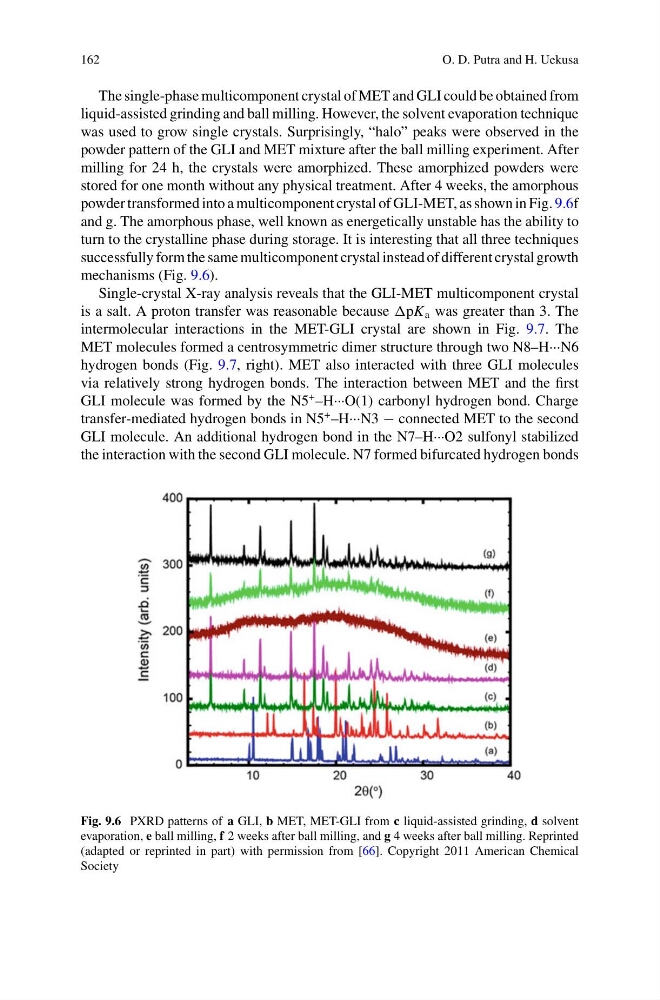
The single-phase multicomponent crystal of MET and GLI could be obtained from
liquid-assisted grinding and ball milling. However, the solvent evaporation technique
was used to grow single crystals. Surprisingly, “halo” peaks were observed in the
powder pattern of the GLI and MET mixture after the ball milling experiment. After
milling for 24 h, the crystals were amorphized. These amorphized powders were
stored for one month without any physical treatment. After 4 weeks, the amorphous
powder transformed into a multicomponent crystal of GLI-MET, as shown in Fig. 9.6f
and g. The amorphous phase, well known as energetically unstable has the ability to
turn to the crystalline phase during storage. It is interesting that all three techniques
successfully form the same multicomponent crystal instead of different crystal growth
mechanisms (Fig. 9.6).
Single-crystal X-ray analysis reveals that the GLI-MET multicomponent crystal
is a salt. A proton transfer was reasonable because pK a was greater than 3. The
intermolecular interactions in the MET-GLI crystal are shown in Fig. 9.7. The
MET molecules formed a centrosymmetric dimer structure through two N8–H···N6
hydrogen bonds (Fig. 9.7, right). MET also interacted with three GLI molecules
via relatively strong hydrogen bonds. The interaction between MET and the first
GLI molecule was formed by the N5
+ –H···O(1) carbonyl hydrogen bond. Charge
transfer-mediated hydrogen bonds in N5
+ –H···N3 − connected MET to the second
GLI molecule. An additional hydrogen bond in the N7–H···O2 sulfonyl stabilized
the interaction with the second GLI molecule. N7 formed bifurcated hydrogen bonds
Fig. 9.6 PXRD patterns of a GLI, b MET, MET-GLI from c liquid-assisted grinding, d solvent
evaporation, e ball milling, f 2 weeks after ball milling, and g 4 weeks after ball milling. Reprinted
(adapted or reprinted in part) with permission from [66]. Copyright 2011 American Chemical
Society
O. D. Putra and H. Uekusa
The single-phase multicomponent crystal of MET and GLI could be obtained from
liquid-assisted grinding and ball milling. However, the solvent evaporation technique
was used to grow single crystals. Surprisingly, “halo” peaks were observed in the
powder pattern of the GLI and MET mixture after the ball milling experiment. After
milling for 24 h, the crystals were amorphized. These amorphized powders were
stored for one month without any physical treatment. After 4 weeks, the amorphous
powder transformed into a multicomponent crystal of GLI-MET, as shown in Fig. 9.6f
and g. The amorphous phase, well known as energetically unstable has the ability to
turn to the crystalline phase during storage. It is interesting that all three techniques
successfully form the same multicomponent crystal instead of different crystal growth
mechanisms (Fig. 9.6).
Single-crystal X-ray analysis reveals that the GLI-MET multicomponent crystal
is a salt. A proton transfer was reasonable because pK a was greater than 3. The
intermolecular interactions in the MET-GLI crystal are shown in Fig. 9.7. The
MET molecules formed a centrosymmetric dimer structure through two N8–H···N6
hydrogen bonds (Fig. 9.7, right). MET also interacted with three GLI molecules
via relatively strong hydrogen bonds. The interaction between MET and the first
GLI molecule was formed by the N5
+ –H···O(1) carbonyl hydrogen bond. Charge
transfer-mediated hydrogen bonds in N5
+ –H···N3 − connected MET to the second
GLI molecule. An additional hydrogen bond in the N7–H···O2 sulfonyl stabilized
the interaction with the second GLI molecule. N7 formed bifurcated hydrogen bonds
Fig. 9.6 PXRD patterns of a GLI, b MET, MET-GLI from c liquid-assisted grinding, d solvent
evaporation, e ball milling, f 2 weeks after ball milling, and g 4 weeks after ball milling. Reprinted
(adapted or reprinted in part) with permission from [66]. Copyright 2011 American Chemical
Society