

9 Pharmaceutical Multicomponent Crystals: Structure, Design …
161
more soluble and having a faster dissolution, enables possible EPR dose reductions
in future applications. In addition, from a pharmacological point of view, the dose of
CAF in this cocrystal will not exceed the maximum daily intake (200 mg per day)
for a diabetic patient [58].
9.2.2 Simultaneous Modulation of Hygroscopicity
and Solubility of APIs by Drug-Drug Multicomponent
Crystal Formation
Hygroscopicity or the stability of solid APIs to water vapor is a major concern for
the pharmaceutical industry. The conversion of an API into a wet powder could
bring undesired physicochemical properties and difficulties for both drug storage
and processing. The preparation of new multicomponent crystals, cocrystals, and
salts alike has been widely reported to prevent API hydrate formation. The potential
of multicomponent crystals containing drug combinations to offer physicochemical
properties superior to the parent drugs has been investigated [59, 60]. This family of
crystals, besides providing technological advantages, also offers improved pharmacological effects and patient compliance [61]. These are likely the most important
advantages of drug-drug multicomponent crystals over single drug and nondrug
multicomponent crystals.
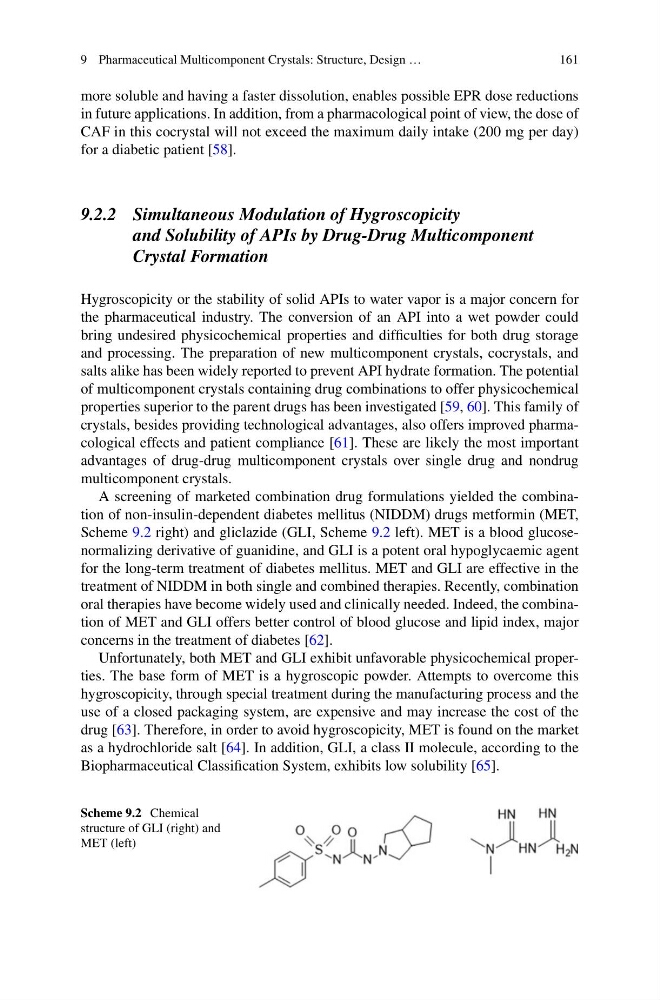
A screening of marketed combination drug formulations yielded the combination of non-insulin-dependent diabetes mellitus (NIDDM) drugs metformin (MET,
Scheme 9.2 right) and gliclazide (GLI, Scheme 9.2 left). MET is a blood glucosenormalizing derivative of guanidine, and GLI is a potent oral hypoglycaemic agent
for the long-term treatment of diabetes mellitus. MET and GLI are effective in the
treatment of NIDDM in both single and combined therapies. Recently, combination
oral therapies have become widely used and clinically needed. Indeed, the combination of MET and GLI offers better control of blood glucose and lipid index, major
concerns in the treatment of diabetes [62].
Unfortunately, both MET and GLI exhibit unfavorable physicochemical properties. The base form of MET is a hygroscopic powder. Attempts to overcome this
hygroscopicity, through special treatment during the manufacturing process and the
use of a closed packaging system, are expensive and may increase the cost of the
drug [63]. Therefore, in order to avoid hygroscopicity, MET is found on the market
as a hydrochloride salt [64]. In addition, GLI, a class II molecule, according to the
Biopharmaceutical Classification System, exhibits low solubility [65].
Scheme 9.2 Chemical
structure of GLI (right) and
MET (left)
161
more soluble and having a faster dissolution, enables possible EPR dose reductions
in future applications. In addition, from a pharmacological point of view, the dose of
CAF in this cocrystal will not exceed the maximum daily intake (200 mg per day)
for a diabetic patient [58].
9.2.2 Simultaneous Modulation of Hygroscopicity
and Solubility of APIs by Drug-Drug Multicomponent
Crystal Formation
Hygroscopicity or the stability of solid APIs to water vapor is a major concern for
the pharmaceutical industry. The conversion of an API into a wet powder could
bring undesired physicochemical properties and difficulties for both drug storage
and processing. The preparation of new multicomponent crystals, cocrystals, and
salts alike has been widely reported to prevent API hydrate formation. The potential
of multicomponent crystals containing drug combinations to offer physicochemical
properties superior to the parent drugs has been investigated [59, 60]. This family of
crystals, besides providing technological advantages, also offers improved pharmacological effects and patient compliance [61]. These are likely the most important
advantages of drug-drug multicomponent crystals over single drug and nondrug
multicomponent crystals.
A screening of marketed combination drug formulations yielded the combination of non-insulin-dependent diabetes mellitus (NIDDM) drugs metformin (MET,
Scheme 9.2 right) and gliclazide (GLI, Scheme 9.2 left). MET is a blood glucosenormalizing derivative of guanidine, and GLI is a potent oral hypoglycaemic agent
for the long-term treatment of diabetes mellitus. MET and GLI are effective in the
treatment of NIDDM in both single and combined therapies. Recently, combination
oral therapies have become widely used and clinically needed. Indeed, the combination of MET and GLI offers better control of blood glucose and lipid index, major
concerns in the treatment of diabetes [62].
Unfortunately, both MET and GLI exhibit unfavorable physicochemical properties. The base form of MET is a hygroscopic powder. Attempts to overcome this
hygroscopicity, through special treatment during the manufacturing process and the
use of a closed packaging system, are expensive and may increase the cost of the
drug [63]. Therefore, in order to avoid hygroscopicity, MET is found on the market
as a hydrochloride salt [64]. In addition, GLI, a class II molecule, according to the
Biopharmaceutical Classification System, exhibits low solubility [65].
Scheme 9.2 Chemical
structure of GLI (right) and
MET (left)