

160
O. D. Putra and H. Uekusa
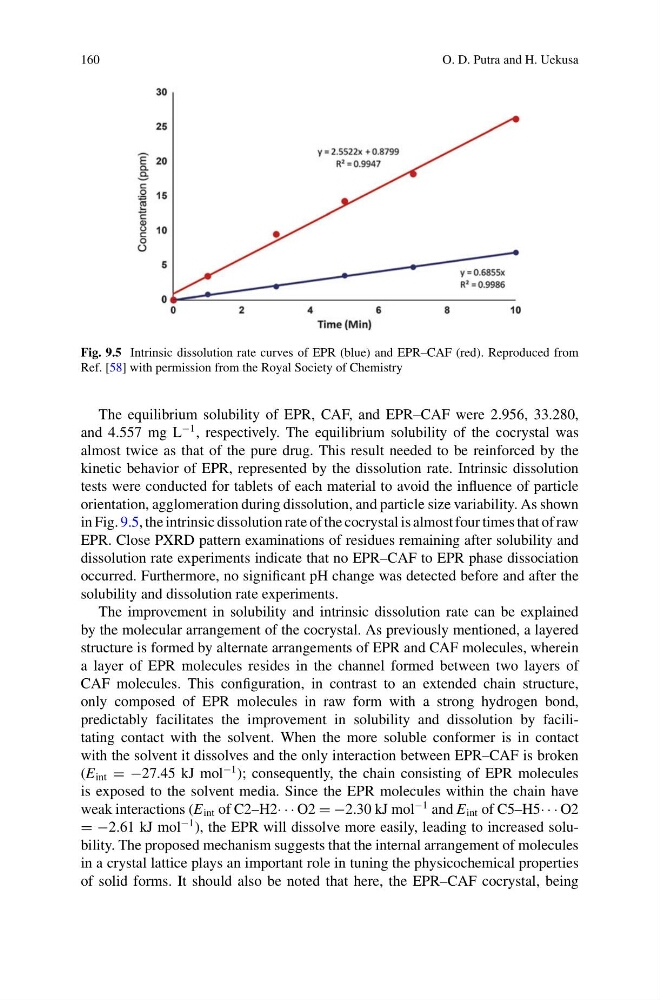
Fig. 9.5 Intrinsic dissolution rate curves of EPR (blue) and EPR–CAF (red). Reproduced from
Ref. [58] with permission from the Royal Society of Chemistry
The equilibrium solubility of EPR, CAF, and EPR–CAF were 2.956, 33.280,
and 4.557 mg L
−1 , respectively. The equilibrium solubility of the cocrystal was
almost twice as that of the pure drug. This result needed to be reinforced by the
kinetic behavior of EPR, represented by the dissolution rate. Intrinsic dissolution
tests were conducted for tablets of each material to avoid the influence of particle
orientation, agglomeration during dissolution, and particle size variability. As shown
in Fig. 9.5, the intrinsic dissolution rate of the cocrystal is almost four times that of raw
EPR. Close PXRD pattern examinations of residues remaining after solubility and
dissolution rate experiments indicate that no EPR–CAF to EPR phase dissociation
occurred. Furthermore, no significant pH change was detected before and after the
solubility and dissolution rate experiments.
The improvement in solubility and intrinsic dissolution rate can be explained
by the molecular arrangement of the cocrystal. As previously mentioned, a layered
structure is formed by alternate arrangements of EPR and CAF molecules, wherein
a layer of EPR molecules resides in the channel formed between two layers of
CAF molecules. This configuration, in contrast to an extended chain structure,
only composed of EPR molecules in raw form with a strong hydrogen bond,
predictably facilitates the improvement in solubility and dissolution by facilitating contact with the solvent. When the more soluble conformer is in contact
with the solvent it dissolves and the only interaction between EPR–CAF is broken
(E int = −27.45 kJ mol
−1 ); consequently, the chain consisting of EPR molecules
is exposed to the solvent media. Since the EPR molecules within the chain have
weak interactions (E int of C2–H2· · · O2 = −2.30 kJ mol
−1 and E int of C5–H5· · · O2
= −2.61 kJ mol
−1 ), the EPR will dissolve more easily, leading to increased solubility. The proposed mechanism suggests that the internal arrangement of molecules
in a crystal lattice plays an important role in tuning the physicochemical properties
of solid forms. It should also be noted that here, the EPR–CAF cocrystal, being
O. D. Putra and H. Uekusa
Fig. 9.5 Intrinsic dissolution rate curves of EPR (blue) and EPR–CAF (red). Reproduced from
Ref. [58] with permission from the Royal Society of Chemistry
The equilibrium solubility of EPR, CAF, and EPR–CAF were 2.956, 33.280,
and 4.557 mg L
−1 , respectively. The equilibrium solubility of the cocrystal was
almost twice as that of the pure drug. This result needed to be reinforced by the
kinetic behavior of EPR, represented by the dissolution rate. Intrinsic dissolution
tests were conducted for tablets of each material to avoid the influence of particle
orientation, agglomeration during dissolution, and particle size variability. As shown
in Fig. 9.5, the intrinsic dissolution rate of the cocrystal is almost four times that of raw
EPR. Close PXRD pattern examinations of residues remaining after solubility and
dissolution rate experiments indicate that no EPR–CAF to EPR phase dissociation
occurred. Furthermore, no significant pH change was detected before and after the
solubility and dissolution rate experiments.
The improvement in solubility and intrinsic dissolution rate can be explained
by the molecular arrangement of the cocrystal. As previously mentioned, a layered
structure is formed by alternate arrangements of EPR and CAF molecules, wherein
a layer of EPR molecules resides in the channel formed between two layers of
CAF molecules. This configuration, in contrast to an extended chain structure,
only composed of EPR molecules in raw form with a strong hydrogen bond,
predictably facilitates the improvement in solubility and dissolution by facilitating contact with the solvent. When the more soluble conformer is in contact
with the solvent it dissolves and the only interaction between EPR–CAF is broken
(E int = −27.45 kJ mol
−1 ); consequently, the chain consisting of EPR molecules
is exposed to the solvent media. Since the EPR molecules within the chain have
weak interactions (E int of C2–H2· · · O2 = −2.30 kJ mol
−1 and E int of C5–H5· · · O2
= −2.61 kJ mol
−1 ), the EPR will dissolve more easily, leading to increased solubility. The proposed mechanism suggests that the internal arrangement of molecules
in a crystal lattice plays an important role in tuning the physicochemical properties
of solid forms. It should also be noted that here, the EPR–CAF cocrystal, being