

142
S. Tsuzuki
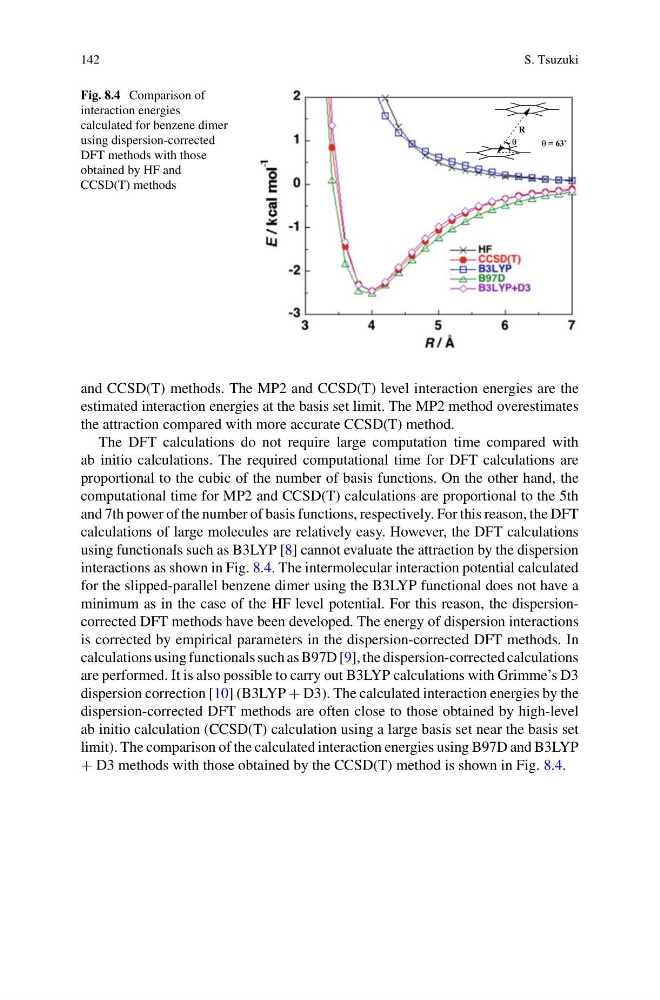
Fig. 8.4 Comparison of
interaction energies
calculated for benzene dimer
using dispersion-corrected
DFT methods with those
obtained by HF and
CCSD(T) methods
θ
θ = 63˚
R
and CCSD(T) methods. The MP2 and CCSD(T) level interaction energies are the
estimated interaction energies at the basis set limit. The MP2 method overestimates
the attraction compared with more accurate CCSD(T) method.
The DFT calculations do not require large computation time compared with
ab initio calculations. The required computational time for DFT calculations are
proportional to the cubic of the number of basis functions. On the other hand, the
computational time for MP2 and CCSD(T) calculations are proportional to the 5th
and 7th power of the number of basis functions, respectively. For this reason, the DFT
calculations of large molecules are relatively easy. However, the DFT calculations
using functionals such as B3LYP [8] cannot evaluate the attraction by the dispersion
interactions as shown in Fig. 8.4. The intermolecular interaction potential calculated
for the slipped-parallel benzene dimer using the B3LYP functional does not have a
minimum as in the case of the HF level potential. For this reason, the dispersioncorrected DFT methods have been developed. The energy of dispersion interactions
is corrected by empirical parameters in the dispersion-corrected DFT methods. In
calculations using functionals such as B97D [9], the dispersion-corrected calculations
are performed. It is also possible to carry out B3LYP calculations with Grimme’s D3
dispersion correction [10] (B3LYP + D3). The calculated interaction energies by the
dispersion-corrected DFT methods are often close to those obtained by high-level
ab initio calculation (CCSD(T) calculation using a large basis set near the basis set
limit). The comparison of the calculated interaction energies using B97D and B3LYP
+ D3 methods with those obtained by the CCSD(T) method is shown in Fig. 8.4.
S. Tsuzuki
Fig. 8.4 Comparison of
interaction energies
calculated for benzene dimer
using dispersion-corrected
DFT methods with those
obtained by HF and
CCSD(T) methods
θ
θ = 63˚
R
and CCSD(T) methods. The MP2 and CCSD(T) level interaction energies are the
estimated interaction energies at the basis set limit. The MP2 method overestimates
the attraction compared with more accurate CCSD(T) method.
The DFT calculations do not require large computation time compared with
ab initio calculations. The required computational time for DFT calculations are
proportional to the cubic of the number of basis functions. On the other hand, the
computational time for MP2 and CCSD(T) calculations are proportional to the 5th
and 7th power of the number of basis functions, respectively. For this reason, the DFT
calculations of large molecules are relatively easy. However, the DFT calculations
using functionals such as B3LYP [8] cannot evaluate the attraction by the dispersion
interactions as shown in Fig. 8.4. The intermolecular interaction potential calculated
for the slipped-parallel benzene dimer using the B3LYP functional does not have a
minimum as in the case of the HF level potential. For this reason, the dispersioncorrected DFT methods have been developed. The energy of dispersion interactions
is corrected by empirical parameters in the dispersion-corrected DFT methods. In
calculations using functionals such as B97D [9], the dispersion-corrected calculations
are performed. It is also possible to carry out B3LYP calculations with Grimme’s D3
dispersion correction [10] (B3LYP + D3). The calculated interaction energies by the
dispersion-corrected DFT methods are often close to those obtained by high-level
ab initio calculation (CCSD(T) calculation using a large basis set near the basis set
limit). The comparison of the calculated interaction energies using B97D and B3LYP
+ D3 methods with those obtained by the CCSD(T) method is shown in Fig. 8.4.