

8 Relationship Between Atomic Contact and Intermolecular …
141
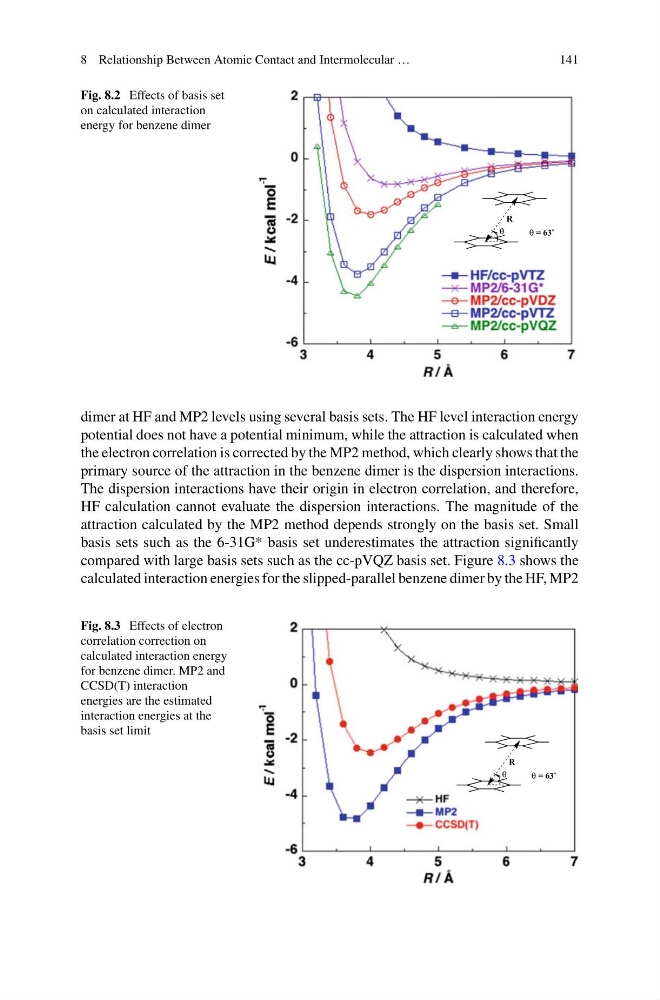
Fig. 8.2 Effects of basis set
on calculated interaction
energy for benzene dimer
θ
θ = 63˚
R
dimer at HF and MP2 levels using several basis sets. The HF level interaction energy
potential does not have a potential minimum, while the attraction is calculated when
the electron correlation is corrected by the MP2 method, which clearly shows that the
primary source of the attraction in the benzene dimer is the dispersion interactions.
The dispersion interactions have their origin in electron correlation, and therefore,
HF calculation cannot evaluate the dispersion interactions. The magnitude of the
attraction calculated by the MP2 method depends strongly on the basis set. Small
basis sets such as the 6-31G* basis set underestimates the attraction significantly
compared with large basis sets such as the cc-pVQZ basis set. Figure 8.3 shows the
calculated interaction energies for the slipped-parallel benzene dimer by the HF, MP2
Fig. 8.3 Effects of electron
correlation correction on
calculated interaction energy
for benzene dimer. MP2 and
CCSD(T) interaction
energies are the estimated
interaction energies at the
basis set limit
θ
θ = 63˚
R
141
Fig. 8.2 Effects of basis set
on calculated interaction
energy for benzene dimer
θ
θ = 63˚
R
dimer at HF and MP2 levels using several basis sets. The HF level interaction energy
potential does not have a potential minimum, while the attraction is calculated when
the electron correlation is corrected by the MP2 method, which clearly shows that the
primary source of the attraction in the benzene dimer is the dispersion interactions.
The dispersion interactions have their origin in electron correlation, and therefore,
HF calculation cannot evaluate the dispersion interactions. The magnitude of the
attraction calculated by the MP2 method depends strongly on the basis set. Small
basis sets such as the 6-31G* basis set underestimates the attraction significantly
compared with large basis sets such as the cc-pVQZ basis set. Figure 8.3 shows the
calculated interaction energies for the slipped-parallel benzene dimer by the HF, MP2
Fig. 8.3 Effects of electron
correlation correction on
calculated interaction energy
for benzene dimer. MP2 and
CCSD(T) interaction
energies are the estimated
interaction energies at the
basis set limit
θ
θ = 63˚
R