

140
S. Tsuzuki
strong directionality. On the other hand, the major source of the attraction in the
CH/π interactions is the dispersion interactions. The contribution of the electrostatic
interaction is very small. Therefore, the directionality of the CH/π interactions is very
weak. The directionality of hydrogen bonds is important for controlling orientation
of molecules in crystals and supermolecules [6]. The weak directionality of the CH/π
interactions suggests that the CH/π interactions are difficult to play important roles
in controlling arrangement of molecules in molecular assemblies as in the cases of
hydrogen bonds. Another example is the interactions between benzene and aromatic
cations. The structure of the benzene-N-methylpyridinium complex is similar to
the structure of the π-stacked benzene dimer. But the nature of the interactions in
the benzene-N-methylpyridinium complex is completely different from that in the
benzene dimer [7]. The interactions in the benzene-N-methylpyridinium complex are
significantly stronger than that in the benzene dimer owing to the strong electrostatic
and induction interactions. On the other hand, the dispersion interactions are the
major source of the weak attraction in the benzene dimer.
8.3 Calculation of Intermolecular Interaction Energy
The energies of molecules and dimers obtained by molecular orbital calculations and
DFT calculations are the stabilization energies by the formation of molecules and
dimers from isolated nuclei and electrons. Therefore, the intermolecular interaction
energy (E int ) can be obtained by subtracting the sum of the energies of monomers
(E A + E B ) from the energy of dimer (E AB ) as shown in Eq. 8.1. This method for
the calculation of intermolecular interaction energy is called supermolecule method.
Since the intermolecular interaction energy calculated by the supermolecule method
is overestimated by the basis set superposition error (BSSE), the BSSE is corrected
by the counterpoise method.
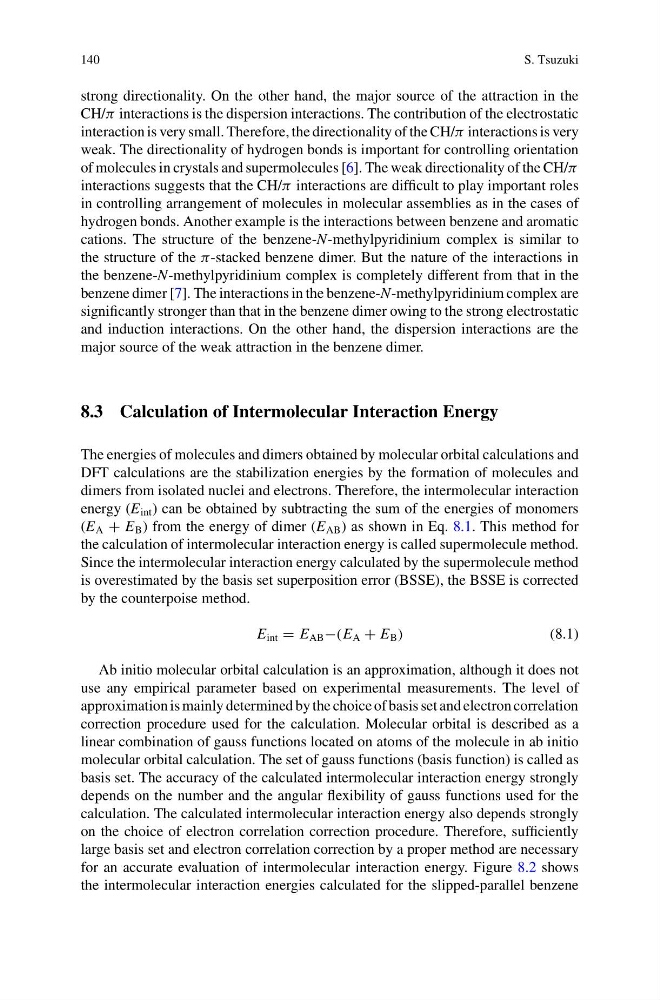
E int = E AB −(E A + E B )
(8.1)
Ab initio molecular orbital calculation is an approximation, although it does not
use any empirical parameter based on experimental measurements. The level of
approximation is mainly determined by the choice of basis set and electron correlation
correction procedure used for the calculation. Molecular orbital is described as a
linear combination of gauss functions located on atoms of the molecule in ab initio
molecular orbital calculation. The set of gauss functions (basis function) is called as
basis set. The accuracy of the calculated intermolecular interaction energy strongly
depends on the number and the angular flexibility of gauss functions used for the
calculation. The calculated intermolecular interaction energy also depends strongly
on the choice of electron correlation correction procedure. Therefore, sufficiently
large basis set and electron correlation correction by a proper method are necessary
for an accurate evaluation of intermolecular interaction energy. Figure 8.2 shows
the intermolecular interaction energies calculated for the slipped-parallel benzene
S. Tsuzuki
strong directionality. On the other hand, the major source of the attraction in the
CH/π interactions is the dispersion interactions. The contribution of the electrostatic
interaction is very small. Therefore, the directionality of the CH/π interactions is very
weak. The directionality of hydrogen bonds is important for controlling orientation
of molecules in crystals and supermolecules [6]. The weak directionality of the CH/π
interactions suggests that the CH/π interactions are difficult to play important roles
in controlling arrangement of molecules in molecular assemblies as in the cases of
hydrogen bonds. Another example is the interactions between benzene and aromatic
cations. The structure of the benzene-N-methylpyridinium complex is similar to
the structure of the π-stacked benzene dimer. But the nature of the interactions in
the benzene-N-methylpyridinium complex is completely different from that in the
benzene dimer [7]. The interactions in the benzene-N-methylpyridinium complex are
significantly stronger than that in the benzene dimer owing to the strong electrostatic
and induction interactions. On the other hand, the dispersion interactions are the
major source of the weak attraction in the benzene dimer.
8.3 Calculation of Intermolecular Interaction Energy
The energies of molecules and dimers obtained by molecular orbital calculations and
DFT calculations are the stabilization energies by the formation of molecules and
dimers from isolated nuclei and electrons. Therefore, the intermolecular interaction
energy (E int ) can be obtained by subtracting the sum of the energies of monomers
(E A + E B ) from the energy of dimer (E AB ) as shown in Eq. 8.1. This method for
the calculation of intermolecular interaction energy is called supermolecule method.
Since the intermolecular interaction energy calculated by the supermolecule method
is overestimated by the basis set superposition error (BSSE), the BSSE is corrected
by the counterpoise method.
E int = E AB −(E A + E B )
(8.1)
Ab initio molecular orbital calculation is an approximation, although it does not
use any empirical parameter based on experimental measurements. The level of
approximation is mainly determined by the choice of basis set and electron correlation
correction procedure used for the calculation. Molecular orbital is described as a
linear combination of gauss functions located on atoms of the molecule in ab initio
molecular orbital calculation. The set of gauss functions (basis function) is called as
basis set. The accuracy of the calculated intermolecular interaction energy strongly
depends on the number and the angular flexibility of gauss functions used for the
calculation. The calculated intermolecular interaction energy also depends strongly
on the choice of electron correlation correction procedure. Therefore, sufficiently
large basis set and electron correlation correction by a proper method are necessary
for an accurate evaluation of intermolecular interaction energy. Figure 8.2 shows
the intermolecular interaction energies calculated for the slipped-parallel benzene