

8 Relationship Between Atomic Contact and Intermolecular …
139
long-range interactions. The magnitude of the energies of the long-range interactions
are proportional to some inverse power of the intermolecular distance, and therefore,
the energies of the long-range interactions decrease slowly with the increase of
the intermolecular distance. On the other hand, the exchange-repulsion, that is the
strong repulsion at short distance, and the charge-transfer, that is the attraction due to
the interactions between molecular orbitals, are the short-range interactions. Since
the energies of the short-range interactions are approximately proportional to the
overlap integral, they decrease rapidly as the intermolecular distance increases. For
this reason, the short-range interactions do not work at long distance.
The classification of intermolecular interactions by structural features is also often
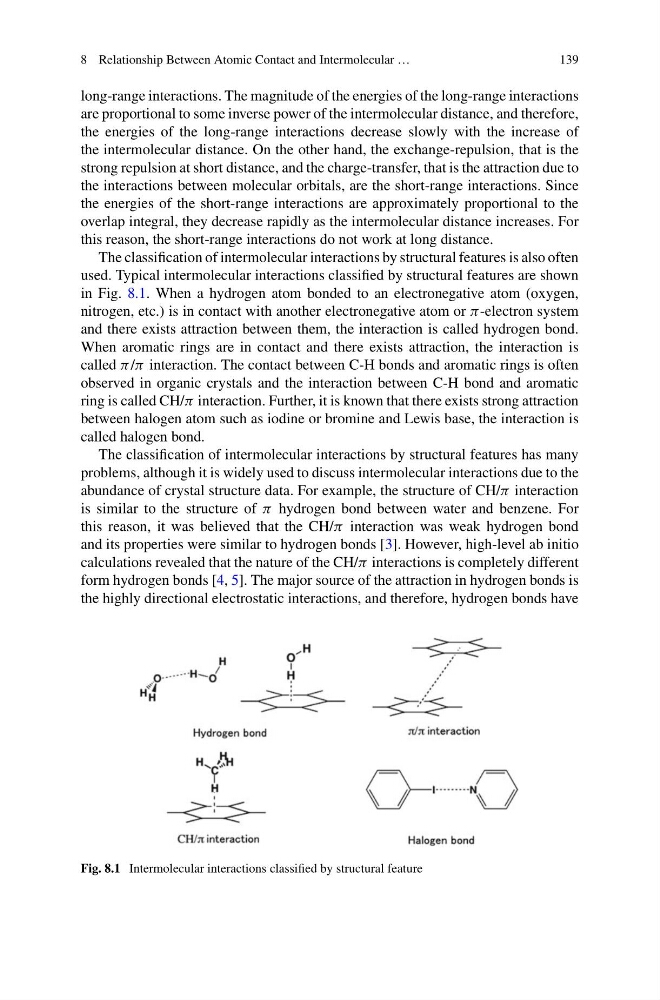
used. Typical intermolecular interactions classified by structural features are shown
in Fig. 8.1. When a hydrogen atom bonded to an electronegative atom (oxygen,
nitrogen, etc.) is in contact with another electronegative atom or π-electron system
and there exists attraction between them, the interaction is called hydrogen bond.
When aromatic rings are in contact and there exists attraction, the interaction is
called π /π interaction. The contact between C-H bonds and aromatic rings is often
observed in organic crystals and the interaction between C-H bond and aromatic
ring is called CH/π interaction. Further, it is known that there exists strong attraction
between halogen atom such as iodine or bromine and Lewis base, the interaction is
called halogen bond.
The classification of intermolecular interactions by structural features has many
problems, although it is widely used to discuss intermolecular interactions due to the
abundance of crystal structure data. For example, the structure of CH/π interaction
is similar to the structure of π hydrogen bond between water and benzene. For
this reason, it was believed that the CH/π interaction was weak hydrogen bond
and its properties were similar to hydrogen bonds [3]. However, high-level ab initio
calculations revealed that the nature of the CH/π interactions is completely different
form hydrogen bonds [4, 5]. The major source of the attraction in hydrogen bonds is
the highly directional electrostatic interactions, and therefore, hydrogen bonds have
Fig. 8.1 Intermolecular interactions classified by structural feature
139
long-range interactions. The magnitude of the energies of the long-range interactions
are proportional to some inverse power of the intermolecular distance, and therefore,
the energies of the long-range interactions decrease slowly with the increase of
the intermolecular distance. On the other hand, the exchange-repulsion, that is the
strong repulsion at short distance, and the charge-transfer, that is the attraction due to
the interactions between molecular orbitals, are the short-range interactions. Since
the energies of the short-range interactions are approximately proportional to the
overlap integral, they decrease rapidly as the intermolecular distance increases. For
this reason, the short-range interactions do not work at long distance.
The classification of intermolecular interactions by structural features is also often
used. Typical intermolecular interactions classified by structural features are shown
in Fig. 8.1. When a hydrogen atom bonded to an electronegative atom (oxygen,
nitrogen, etc.) is in contact with another electronegative atom or π-electron system
and there exists attraction between them, the interaction is called hydrogen bond.
When aromatic rings are in contact and there exists attraction, the interaction is
called π /π interaction. The contact between C-H bonds and aromatic rings is often
observed in organic crystals and the interaction between C-H bond and aromatic
ring is called CH/π interaction. Further, it is known that there exists strong attraction
between halogen atom such as iodine or bromine and Lewis base, the interaction is
called halogen bond.
The classification of intermolecular interactions by structural features has many
problems, although it is widely used to discuss intermolecular interactions due to the
abundance of crystal structure data. For example, the structure of CH/π interaction
is similar to the structure of π hydrogen bond between water and benzene. For
this reason, it was believed that the CH/π interaction was weak hydrogen bond
and its properties were similar to hydrogen bonds [3]. However, high-level ab initio
calculations revealed that the nature of the CH/π interactions is completely different
form hydrogen bonds [4, 5]. The major source of the attraction in hydrogen bonds is
the highly directional electrostatic interactions, and therefore, hydrogen bonds have
Fig. 8.1 Intermolecular interactions classified by structural feature