

138
S. Tsuzuki
based on the presence or absence of atomic contact at short distances (contact at
interatomic distances less than the sum of the van der Waals radii). Recently, highlevel ab initio molecular orbital calculations and dispersion-corrected DFT (density
functional theory) calculations can evaluate intermolecular interaction energies in
organic crystals sufficiently accurately. Recently reported calculations show that
strong attraction owing to the dispersion interactions often exists between molecules
in crystals which do not have short atom–atom contact. For example, in crystals of
polycyclic aromatic molecules such as thienoacenes [1], strong attraction owing to
dispersion interactions exist between adjacent molecules which do not have short
atom–atom contacts. Here, the intermolecular interactions in the crystals of polycyclic aromatic molecules, n-hexane, and hexamine analyzed by dispersion-corrected
DFT calculations are shown. They are compared with HF calculations which cannot
evaluate the dispersion interactions to estimate the contribution of the dispersion
interactions to the attraction. We also point out the danger of the discussion on intermolecular interactions in organic crystals based solely on the presence or absence of
contact of atoms at short distances.
8.2 Intermolecular Interactions
There exist several intermolecular interactions which have different origins between
interacting molecules [2]. The intermolecular interactions classified by physical
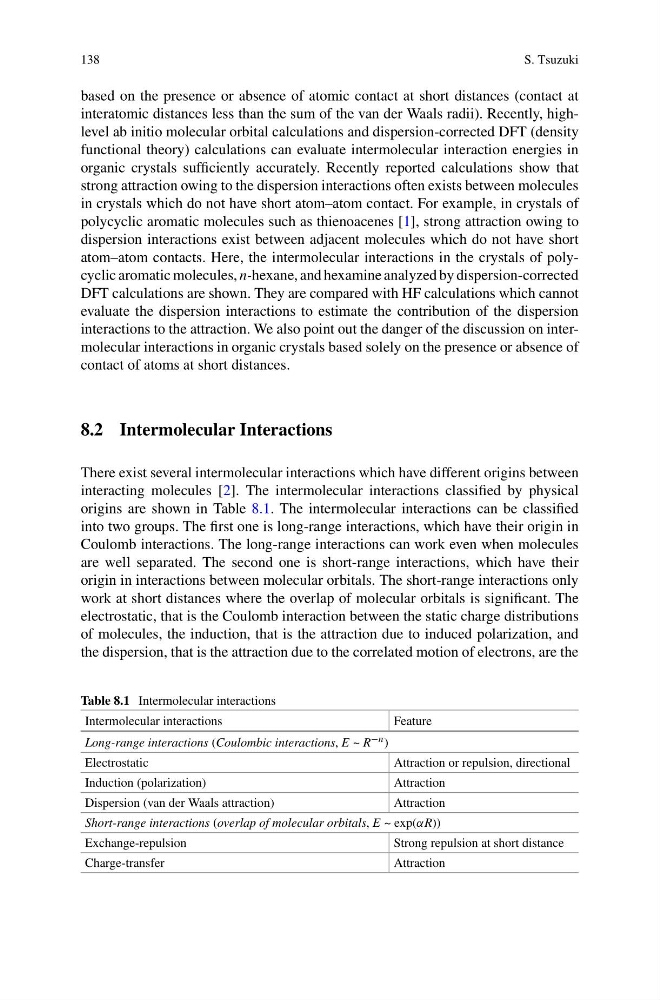
origins are shown in Table 8.1. The intermolecular interactions can be classified
into two groups. The first one is long-range interactions, which have their origin in
Coulomb interactions. The long-range interactions can work even when molecules
are well separated. The second one is short-range interactions, which have their
origin in interactions between molecular orbitals. The short-range interactions only
work at short distances where the overlap of molecular orbitals is significant. The
electrostatic, that is the Coulomb interaction between the static charge distributions
of molecules, the induction, that is the attraction due to induced polarization, and
the dispersion, that is the attraction due to the correlated motion of electrons, are the
Table 8.1 Intermolecular interactions
Intermolecular interactions
Feature
Long-range interactions (Coulombic interactions, E ~ R −n )
Electrostatic
Attraction or repulsion, directional
Induction (polarization)
Attraction
Dispersion (van der Waals attraction)
Attraction
Short-range interactions (overlap of molecular orbitals, E ~ exp(αR))
Exchange-repulsion
Strong repulsion at short distance
Charge-transfer
Attraction
S. Tsuzuki
based on the presence or absence of atomic contact at short distances (contact at
interatomic distances less than the sum of the van der Waals radii). Recently, highlevel ab initio molecular orbital calculations and dispersion-corrected DFT (density
functional theory) calculations can evaluate intermolecular interaction energies in
organic crystals sufficiently accurately. Recently reported calculations show that
strong attraction owing to the dispersion interactions often exists between molecules
in crystals which do not have short atom–atom contact. For example, in crystals of
polycyclic aromatic molecules such as thienoacenes [1], strong attraction owing to
dispersion interactions exist between adjacent molecules which do not have short
atom–atom contacts. Here, the intermolecular interactions in the crystals of polycyclic aromatic molecules, n-hexane, and hexamine analyzed by dispersion-corrected
DFT calculations are shown. They are compared with HF calculations which cannot
evaluate the dispersion interactions to estimate the contribution of the dispersion
interactions to the attraction. We also point out the danger of the discussion on intermolecular interactions in organic crystals based solely on the presence or absence of
contact of atoms at short distances.
8.2 Intermolecular Interactions
There exist several intermolecular interactions which have different origins between
interacting molecules [2]. The intermolecular interactions classified by physical
origins are shown in Table 8.1. The intermolecular interactions can be classified
into two groups. The first one is long-range interactions, which have their origin in
Coulomb interactions. The long-range interactions can work even when molecules
are well separated. The second one is short-range interactions, which have their
origin in interactions between molecular orbitals. The short-range interactions only
work at short distances where the overlap of molecular orbitals is significant. The
electrostatic, that is the Coulomb interaction between the static charge distributions
of molecules, the induction, that is the attraction due to induced polarization, and
the dispersion, that is the attraction due to the correlated motion of electrons, are the
Table 8.1 Intermolecular interactions
Intermolecular interactions
Feature
Long-range interactions (Coulombic interactions, E ~ R −n )
Electrostatic
Attraction or repulsion, directional
Induction (polarization)
Attraction
Dispersion (van der Waals attraction)
Attraction
Short-range interactions (overlap of molecular orbitals, E ~ exp(αR))
Exchange-repulsion
Strong repulsion at short distance
Charge-transfer
Attraction