

8 Relationship Between Atomic Contact and Intermolecular …
143
8.4 Intermolecular Interactions of Naphthalene
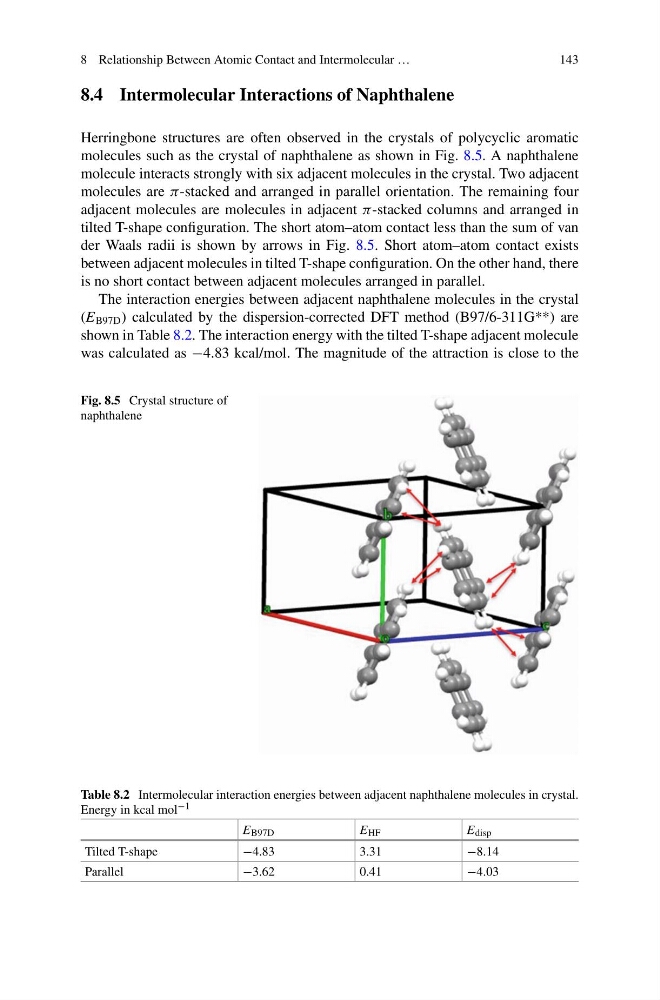
Herringbone structures are often observed in the crystals of polycyclic aromatic
molecules such as the crystal of naphthalene as shown in Fig. 8.5. A naphthalene
molecule interacts strongly with six adjacent molecules in the crystal. Two adjacent
molecules are π-stacked and arranged in parallel orientation. The remaining four
adjacent molecules are molecules in adjacent π-stacked columns and arranged in
tilted T-shape configuration. The short atom–atom contact less than the sum of van
der Waals radii is shown by arrows in Fig. 8.5. Short atom–atom contact exists
between adjacent molecules in tilted T-shape configuration. On the other hand, there
is no short contact between adjacent molecules arranged in parallel.
The interaction energies between adjacent naphthalene molecules in the crystal
(E B97D ) calculated by the dispersion-corrected DFT method (B97/6-311G**) are
shown in Table 8.2. The interaction energy with the tilted T-shape adjacent molecule
was calculated as −4.83 kcal/mol. The magnitude of the attraction is close to the
Fig. 8.5 Crystal structure of
naphthalene
Table 8.2 Intermolecular interaction energies between adjacent naphthalene molecules in crystal.
Energy in kcal mol −1
E B97D
E HF
E disp
Tilted T-shape
−4.83
3.31
−8.14
Parallel
−3.62
0.41
−4.03
143
8.4 Intermolecular Interactions of Naphthalene
Herringbone structures are often observed in the crystals of polycyclic aromatic
molecules such as the crystal of naphthalene as shown in Fig. 8.5. A naphthalene
molecule interacts strongly with six adjacent molecules in the crystal. Two adjacent
molecules are π-stacked and arranged in parallel orientation. The remaining four
adjacent molecules are molecules in adjacent π-stacked columns and arranged in
tilted T-shape configuration. The short atom–atom contact less than the sum of van
der Waals radii is shown by arrows in Fig. 8.5. Short atom–atom contact exists
between adjacent molecules in tilted T-shape configuration. On the other hand, there
is no short contact between adjacent molecules arranged in parallel.
The interaction energies between adjacent naphthalene molecules in the crystal
(E B97D ) calculated by the dispersion-corrected DFT method (B97/6-311G**) are
shown in Table 8.2. The interaction energy with the tilted T-shape adjacent molecule
was calculated as −4.83 kcal/mol. The magnitude of the attraction is close to the
Fig. 8.5 Crystal structure of
naphthalene
Table 8.2 Intermolecular interaction energies between adjacent naphthalene molecules in crystal.
Energy in kcal mol −1
E B97D
E HF
E disp
Tilted T-shape
−4.83
3.31
−8.14
Parallel
−3.62
0.41
−4.03