

7 Supramolecular, Hierarchical, and Energetical Interpretation …
123
a
b
d
c
e
f
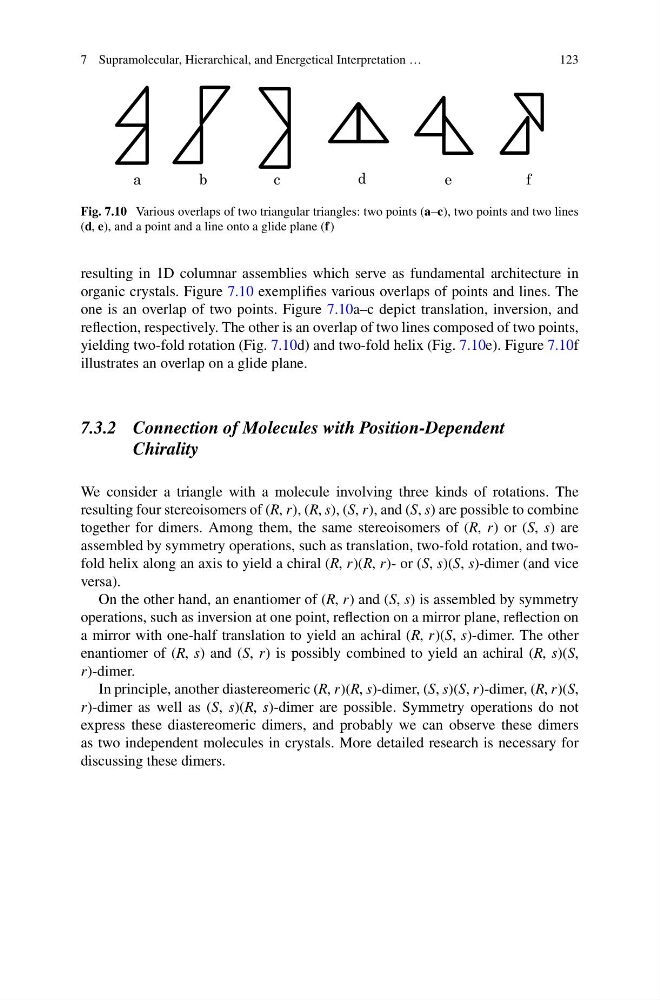
Fig. 7.10 Various overlaps of two triangular triangles: two points (a–c), two points and two lines
(d, e), and a point and a line onto a glide plane (f)
resulting in 1D columnar assemblies which serve as fundamental architecture in
organic crystals. Figure 7.10 exemplifies various overlaps of points and lines. The
one is an overlap of two points. Figure 7.10a–c depict translation, inversion, and
reflection, respectively. The other is an overlap of two lines composed of two points,
yielding two-fold rotation (Fig. 7.10d) and two-fold helix (Fig. 7.10e). Figure 7.10f
illustrates an overlap on a glide plane.
7.3.2 Connection of Molecules with Position-Dependent
Chirality
We consider a triangle with a molecule involving three kinds of rotations. The
resulting four stereoisomers of (R, r), (R, s), (S, r), and (S, s) are possible to combine
together for dimers. Among them, the same stereoisomers of (R, r) or (S, s) are
assembled by symmetry operations, such as translation, two-fold rotation, and twofold helix along an axis to yield a chiral (R, r)(R, r)- or (S, s)(S, s)-dimer (and vice
versa).
On the other hand, an enantiomer of (R, r) and (S, s) is assembled by symmetry
operations, such as inversion at one point, reflection on a mirror plane, reflection on
a mirror with one-half translation to yield an achiral (R, r)(S, s)-dimer. The other
enantiomer of (R, s) and (S, r) is possibly combined to yield an achiral (R, s)(S,
r)-dimer.
In principle, another diastereomeric (R, r)(R, s)-dimer, (S, s)(S, r)-dimer, (R, r)(S,
r)-dimer as well as (S, s)(R, s)-dimer are possible. Symmetry operations do not
express these diastereomeric dimers, and probably we can observe these dimers
as two independent molecules in crystals. More detailed research is necessary for
discussing these dimers.
123
a
b
d
c
e
f
Fig. 7.10 Various overlaps of two triangular triangles: two points (a–c), two points and two lines
(d, e), and a point and a line onto a glide plane (f)
resulting in 1D columnar assemblies which serve as fundamental architecture in
organic crystals. Figure 7.10 exemplifies various overlaps of points and lines. The
one is an overlap of two points. Figure 7.10a–c depict translation, inversion, and
reflection, respectively. The other is an overlap of two lines composed of two points,
yielding two-fold rotation (Fig. 7.10d) and two-fold helix (Fig. 7.10e). Figure 7.10f
illustrates an overlap on a glide plane.
7.3.2 Connection of Molecules with Position-Dependent
Chirality
We consider a triangle with a molecule involving three kinds of rotations. The
resulting four stereoisomers of (R, r), (R, s), (S, r), and (S, s) are possible to combine
together for dimers. Among them, the same stereoisomers of (R, r) or (S, s) are
assembled by symmetry operations, such as translation, two-fold rotation, and twofold helix along an axis to yield a chiral (R, r)(R, r)- or (S, s)(S, s)-dimer (and vice
versa).
On the other hand, an enantiomer of (R, r) and (S, s) is assembled by symmetry
operations, such as inversion at one point, reflection on a mirror plane, reflection on
a mirror with one-half translation to yield an achiral (R, r)(S, s)-dimer. The other
enantiomer of (R, s) and (S, r) is possibly combined to yield an achiral (R, s)(S,
r)-dimer.
In principle, another diastereomeric (R, r)(R, s)-dimer, (S, s)(S, r)-dimer, (R, r)(S,
r)-dimer as well as (S, s)(R, s)-dimer are possible. Symmetry operations do not
express these diastereomeric dimers, and probably we can observe these dimers
as two independent molecules in crystals. More detailed research is necessary for
discussing these dimers.