

124
M. Miyata and S. Tsuzuki
b
c
a
d
Two-fold Helix
(R,r)-1 to (R,r)-2
X7 2 0.5Ba 3 90 1 0
X8 2 0.5Ba 3 90 1 180
X9 8 Bb 2 90 3 180
X10 9 1.0 8 φ 7 -90
X11 9 1.0 10 ψ 8 90
X12 9 1.0 11 90 10 -ω
Inversion
(R,r)-1 to (S,s)-2
X7 3 Ba 2 90 1 180
X8 7 Bb 3 90 2 180
X9 8 Ba 7 90 3 180
X10 7 1.0 8 φ 9 90
X11 7 1.0 10 ψ 8 -90
X12 7 1.0 11 90 10 ω
Translation
(R,r)-1 to (R,r)-2
X7 3 Bb 4 φ 2 0
X8 7 Ba 3 90 1 180
X9 8 Bb 7 90 3 0
X10 9 1.0 8 φ 7 -90
X11 9 1.0 10 ψ 8 90
X12 9 1.0 11 90 10 -ω
Two-fold Rotation
(R,r)-1 to (R,r)-2
X7 2 Ba 3 90 1 0
X8 3 Bb 4 φ 2 0
X9 8 Bb 7 90 3 180
X10 9 1.0 8 φ 7 -90
X11 9 1.0 10 ψ 8 90
X12 9 1.0 11 90 10 -ω
1
1
1
2
2
2
2
1
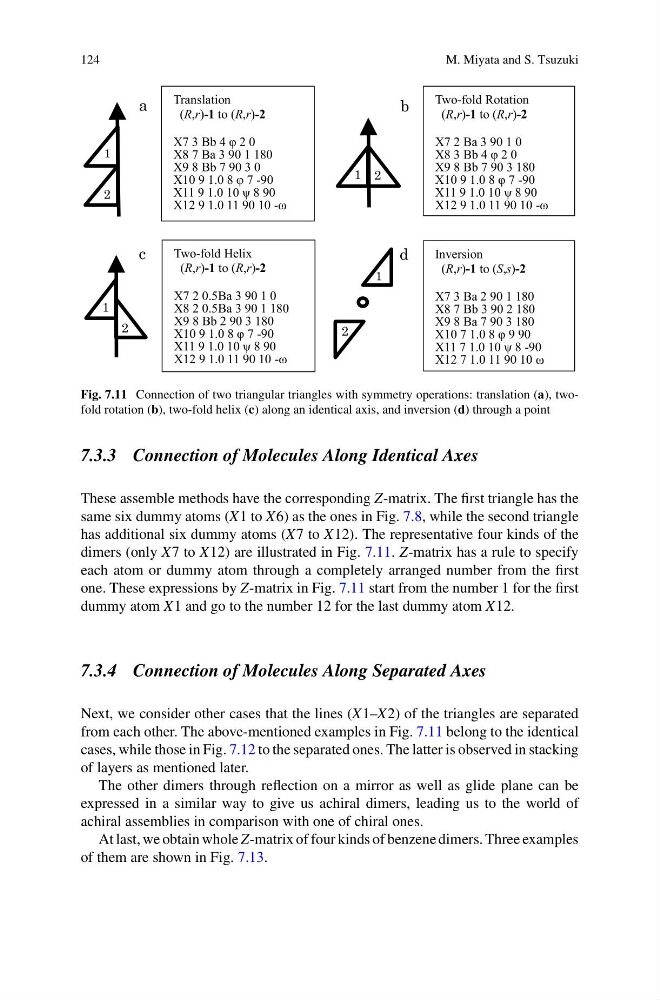
Fig. 7.11 Connection of two triangular triangles with symmetry operations: translation (a), twofold rotation (b), two-fold helix (c) along an identical axis, and inversion (d) through a point
7.3.3 Connection of Molecules Along Identical Axes
These assemble methods have the corresponding Z-matrix. The first triangle has the
same six dummy atoms (X1 to X6) as the ones in Fig. 7.8, while the second triangle
has additional six dummy atoms (X7 to X12). The representative four kinds of the
dimers (only X7 to X12) are illustrated in Fig. 7.11. Z-matrix has a rule to specify
each atom or dummy atom through a completely arranged number from the first
one. These expressions by Z-matrix in Fig. 7.11 start from the number 1 for the first
dummy atom X1 and go to the number 12 for the last dummy atom X12.
7.3.4 Connection of Molecules Along Separated Axes
Next, we consider other cases that the lines (X1–X2) of the triangles are separated
from each other. The above-mentioned examples in Fig. 7.11 belong to the identical
cases, while those in Fig. 7.12 to the separated ones. The latter is observed in stacking
of layers as mentioned later.
The other dimers through reflection on a mirror as well as glide plane can be
expressed in a similar way to give us achiral dimers, leading us to the world of
achiral assemblies in comparison with one of chiral ones.
At last, we obtain whole Z-matrix of four kinds of benzene dimers. Three examples
of them are shown in Fig. 7.13.
M. Miyata and S. Tsuzuki
b
c
a
d
Two-fold Helix
(R,r)-1 to (R,r)-2
X7 2 0.5Ba 3 90 1 0
X8 2 0.5Ba 3 90 1 180
X9 8 Bb 2 90 3 180
X10 9 1.0 8 φ 7 -90
X11 9 1.0 10 ψ 8 90
X12 9 1.0 11 90 10 -ω
Inversion
(R,r)-1 to (S,s)-2
X7 3 Ba 2 90 1 180
X8 7 Bb 3 90 2 180
X9 8 Ba 7 90 3 180
X10 7 1.0 8 φ 9 90
X11 7 1.0 10 ψ 8 -90
X12 7 1.0 11 90 10 ω
Translation
(R,r)-1 to (R,r)-2
X7 3 Bb 4 φ 2 0
X8 7 Ba 3 90 1 180
X9 8 Bb 7 90 3 0
X10 9 1.0 8 φ 7 -90
X11 9 1.0 10 ψ 8 90
X12 9 1.0 11 90 10 -ω
Two-fold Rotation
(R,r)-1 to (R,r)-2
X7 2 Ba 3 90 1 0
X8 3 Bb 4 φ 2 0
X9 8 Bb 7 90 3 180
X10 9 1.0 8 φ 7 -90
X11 9 1.0 10 ψ 8 90
X12 9 1.0 11 90 10 -ω
1
1
1
2
2
2
2
1
Fig. 7.11 Connection of two triangular triangles with symmetry operations: translation (a), twofold rotation (b), two-fold helix (c) along an identical axis, and inversion (d) through a point
7.3.3 Connection of Molecules Along Identical Axes
These assemble methods have the corresponding Z-matrix. The first triangle has the
same six dummy atoms (X1 to X6) as the ones in Fig. 7.8, while the second triangle
has additional six dummy atoms (X7 to X12). The representative four kinds of the
dimers (only X7 to X12) are illustrated in Fig. 7.11. Z-matrix has a rule to specify
each atom or dummy atom through a completely arranged number from the first
one. These expressions by Z-matrix in Fig. 7.11 start from the number 1 for the first
dummy atom X1 and go to the number 12 for the last dummy atom X12.
7.3.4 Connection of Molecules Along Separated Axes
Next, we consider other cases that the lines (X1–X2) of the triangles are separated
from each other. The above-mentioned examples in Fig. 7.11 belong to the identical
cases, while those in Fig. 7.12 to the separated ones. The latter is observed in stacking
of layers as mentioned later.
The other dimers through reflection on a mirror as well as glide plane can be
expressed in a similar way to give us achiral dimers, leading us to the world of
achiral assemblies in comparison with one of chiral ones.
At last, we obtain whole Z-matrix of four kinds of benzene dimers. Three examples
of them are shown in Fig. 7.13.