

122
M. Miyata and S. Tsuzuki
a (R,r)-Isomer
X1
X2 1 Ba
X3 2 Bb 1 90
X4 3 1.0 2 φ 1 -90
X5 3 1.0 4 ψ 2 90
X6 3 1.0 5 90 4 -ω
C1 3 R1 5 90 6 0
C2 3 R1 5 90 6 60
C3 3 R1 5 90 6 120
C4 3 R1 5 90 6 180
C5 3 R1 5 90 6 240
C6 3 R1 5 90 6 300
H1 3 R2 5 90 6 0
H2 3 R2 5 90 6 60
H3 3 R2 5 90 6 120
H4 3 R2 5 90 6 180
H5 3 R2 5 90 6 240
H6 3 R2 5 90 6 300
R1 1.394
R2 2.475
b (R,s)-Isomer
X1
X2 1 Ba
X3 2 Bb 1 90
X4 3 1.0 2 φ 1 -90
X5 3 1.0 4 ψ 2 90
X6 3 1.0 5 90 4 ω
C1 3 R1 5 90 6 0
C2 3 R1 5 90 6 60
C3 3 R1 5 90 6 120
C4 3 R1 5 90 6 180
C5 3 R1 5 90 6 240
C6 3 R1 5 90 6 300
H1 3 R2 5 90 6 0
H2 3 R2 5 90 6 60
H3 3 R2 5 90 6 120
H4 3 R2 5 90 6 180
H5 3 R2 5 90 6 240
H6 3 R2 5 90 6 300
R1 1.394
R2 2.475
c (S,r)-Isomer
X1
X2 1 Ba
X3 2 Bb 1 90
X4 3 1.0 2 φ 1 90
X5 3 1.0 4 ψ 2 -90
X6 3 1.0 5 90 4 -ω
C1 3 R1 5 90 6 0
C2 3 R1 5 90 6 60
C3 3 R1 5 90 6 120
C4 3 R1 5 90 6 180
C5 3 R1 5 90 6 240
C6 3 R1 5 90 6 300
H1 3 R2 5 90 6 0
H2 3 R2 5 90 6 60
H3 3 R2 5 90 6 120
H4 3 R2 5 90 6 180
H5 3 R2 5 90 6 240
H6 3 R2 5 90 6 300
R1 1.394
R2 2.475
d (S,s)-Isomer
X1
X2 1 Ba
X3 2 Bb 1 90
X4 3 1.0 2 φ 1 90
X5 3 1.0 4 ψ 2 -90
X6 3 1.0 5 90 4 ω
C1 3 R1 5 90 6 0
C2 3 R1 5 90 6 60
C3 3 R1 5 90 6 120
C4 3 R1 5 90 6 180
C5 3 R1 5 90 6 240
C6 3 R1 5 90 6 300
H1 3 R2 5 90 6 0
H2 3 R2 5 90 6 60
H3 3 R2 5 90 6 120
H4 3 R2 5 90 6 180
H5 3 R2 5 90 6 240
H6 3 R2 5 90 6 300
R1 1.394
R2 2.475
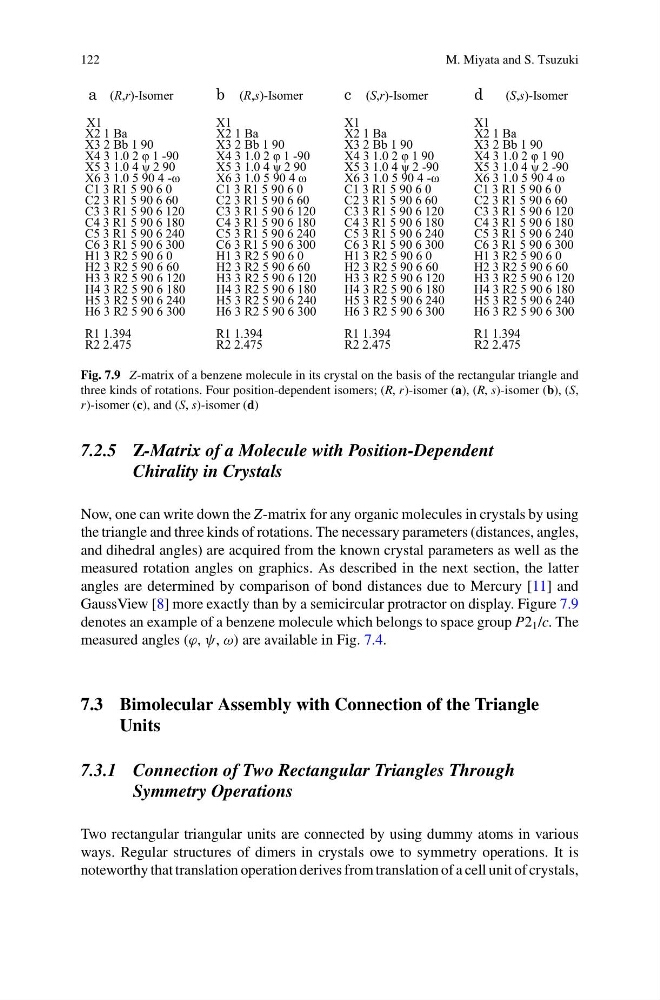
Fig. 7.9 Z-matrix of a benzene molecule in its crystal on the basis of the rectangular triangle and
three kinds of rotations. Four position-dependent isomers; (R, r)-isomer (a), (R, s)-isomer (b), (S,
r)-isomer (c), and (S, s)-isomer (d)
7.2.5 Z-Matrix of a Molecule with Position-Dependent
Chirality in Crystals
Now, one can write down the Z-matrix for any organic molecules in crystals by using
the triangle and three kinds of rotations. The necessary parameters (distances, angles,
and dihedral angles) are acquired from the known crystal parameters as well as the
measured rotation angles on graphics. As described in the next section, the latter
angles are determined by comparison of bond distances due to Mercury [11] and
GaussView [8] more exactly than by a semicircular protractor on display. Figure 7.9
denotes an example of a benzene molecule which belongs to space group P2 1 /c. The
measured angles (ϕ, ψ, ω) are available in Fig. 7.4.
7.3 Bimolecular Assembly with Connection of the Triangle
Units
7.3.1 Connection of Two Rectangular Triangles Through
Symmetry Operations
Two rectangular triangular units are connected by using dummy atoms in various
ways. Regular structures of dimers in crystals owe to symmetry operations. It is
noteworthy that translation operation derives from translation of a cell unit of crystals,
M. Miyata and S. Tsuzuki
a (R,r)-Isomer
X1
X2 1 Ba
X3 2 Bb 1 90
X4 3 1.0 2 φ 1 -90
X5 3 1.0 4 ψ 2 90
X6 3 1.0 5 90 4 -ω
C1 3 R1 5 90 6 0
C2 3 R1 5 90 6 60
C3 3 R1 5 90 6 120
C4 3 R1 5 90 6 180
C5 3 R1 5 90 6 240
C6 3 R1 5 90 6 300
H1 3 R2 5 90 6 0
H2 3 R2 5 90 6 60
H3 3 R2 5 90 6 120
H4 3 R2 5 90 6 180
H5 3 R2 5 90 6 240
H6 3 R2 5 90 6 300
R1 1.394
R2 2.475
b (R,s)-Isomer
X1
X2 1 Ba
X3 2 Bb 1 90
X4 3 1.0 2 φ 1 -90
X5 3 1.0 4 ψ 2 90
X6 3 1.0 5 90 4 ω
C1 3 R1 5 90 6 0
C2 3 R1 5 90 6 60
C3 3 R1 5 90 6 120
C4 3 R1 5 90 6 180
C5 3 R1 5 90 6 240
C6 3 R1 5 90 6 300
H1 3 R2 5 90 6 0
H2 3 R2 5 90 6 60
H3 3 R2 5 90 6 120
H4 3 R2 5 90 6 180
H5 3 R2 5 90 6 240
H6 3 R2 5 90 6 300
R1 1.394
R2 2.475
c (S,r)-Isomer
X1
X2 1 Ba
X3 2 Bb 1 90
X4 3 1.0 2 φ 1 90
X5 3 1.0 4 ψ 2 -90
X6 3 1.0 5 90 4 -ω
C1 3 R1 5 90 6 0
C2 3 R1 5 90 6 60
C3 3 R1 5 90 6 120
C4 3 R1 5 90 6 180
C5 3 R1 5 90 6 240
C6 3 R1 5 90 6 300
H1 3 R2 5 90 6 0
H2 3 R2 5 90 6 60
H3 3 R2 5 90 6 120
H4 3 R2 5 90 6 180
H5 3 R2 5 90 6 240
H6 3 R2 5 90 6 300
R1 1.394
R2 2.475
d (S,s)-Isomer
X1
X2 1 Ba
X3 2 Bb 1 90
X4 3 1.0 2 φ 1 90
X5 3 1.0 4 ψ 2 -90
X6 3 1.0 5 90 4 ω
C1 3 R1 5 90 6 0
C2 3 R1 5 90 6 60
C3 3 R1 5 90 6 120
C4 3 R1 5 90 6 180
C5 3 R1 5 90 6 240
C6 3 R1 5 90 6 300
H1 3 R2 5 90 6 0
H2 3 R2 5 90 6 60
H3 3 R2 5 90 6 120
H4 3 R2 5 90 6 180
H5 3 R2 5 90 6 240
H6 3 R2 5 90 6 300
R1 1.394
R2 2.475
Fig. 7.9 Z-matrix of a benzene molecule in its crystal on the basis of the rectangular triangle and
three kinds of rotations. Four position-dependent isomers; (R, r)-isomer (a), (R, s)-isomer (b), (S,
r)-isomer (c), and (S, s)-isomer (d)
7.2.5 Z-Matrix of a Molecule with Position-Dependent
Chirality in Crystals
Now, one can write down the Z-matrix for any organic molecules in crystals by using
the triangle and three kinds of rotations. The necessary parameters (distances, angles,
and dihedral angles) are acquired from the known crystal parameters as well as the
measured rotation angles on graphics. As described in the next section, the latter
angles are determined by comparison of bond distances due to Mercury [11] and
GaussView [8] more exactly than by a semicircular protractor on display. Figure 7.9
denotes an example of a benzene molecule which belongs to space group P2 1 /c. The
measured angles (ϕ, ψ, ω) are available in Fig. 7.4.
7.3 Bimolecular Assembly with Connection of the Triangle
Units
7.3.1 Connection of Two Rectangular Triangles Through
Symmetry Operations
Two rectangular triangular units are connected by using dummy atoms in various
ways. Regular structures of dimers in crystals owe to symmetry operations. It is
noteworthy that translation operation derives from translation of a cell unit of crystals,