

7 Supramolecular, Hierarchical, and Energetical Interpretation …
121
d
b
a
c
X6
X6
(X5)
X3
Dz(+ω)
s
r
Dz(-ω)
X4
X5
Ay(ψ)
X4
X3
X2
X2[X1]
X3
X4
X4
Ax(φ)
Ax(φ)
S
R
Ax:
φ
φ
φ
φ
Ay:
ψ
ψ
ψ
ψ
Az:
90
90
90
90
Dx:
- 90 - 90
+90 +90
Dy:
+90 +90
- 90
- 90
Dz:
- ω
+ω
- ω +ω
(R,r) (R,s) (S,r) (S,s)
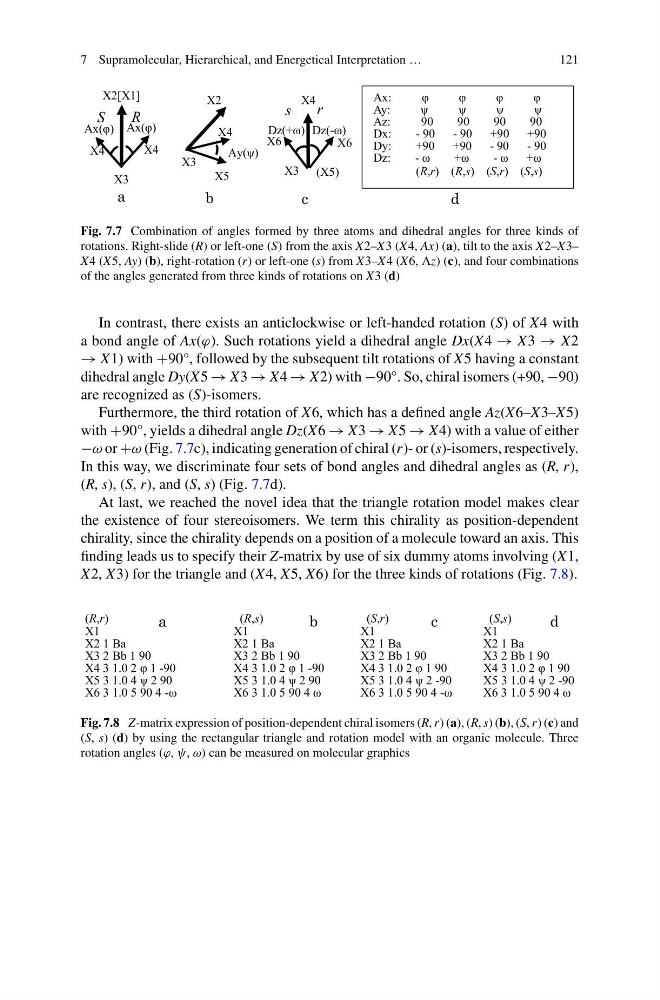
Fig. 7.7 Combination of angles formed by three atoms and dihedral angles for three kinds of
rotations. Right-slide (R) or left-one (S) from the axis X2–X3 (X4, Ax) (a), tilt to the axis X2–X3–
X4 (X5, Ay) (b), right-rotation (r) or left-one (s) from X3–X4 (X6, Az) (c), and four combinations
of the angles generated from three kinds of rotations on X3 (d)
In contrast, there exists an anticlockwise or left-handed rotation (S) of X4 with
a bond angle of Ax(ϕ). Such rotations yield a dihedral angle Dx(X4 → X3 → X2
→ X1) with +90°, followed by the subsequent tilt rotations of X5 having a constant
dihedral angle Dy(X5 → X3 → X4 → X2) with −90°. So, chiral isomers (+90, −90)
are recognized as (S)-isomers.
Furthermore, the third rotation of X6, which has a defined angle Az(X6–X3–X5)
with +90°, yields a dihedral angle Dz(X6 → X3 → X5 → X4) with a value of either
−ω or +ω (Fig. 7.7c), indicating generation of chiral (r)- or (s)-isomers, respectively.
In this way, we discriminate four sets of bond angles and dihedral angles as (R, r),
(R, s), (S, r), and (S, s) (Fig. 7.7d).
At last, we reached the novel idea that the triangle rotation model makes clear
the existence of four stereoisomers. We term this chirality as position-dependent
chirality, since the chirality depends on a position of a molecule toward an axis. This
finding leads us to specify their Z-matrix by use of six dummy atoms involving (X1,
X2, X3) for the triangle and (X4, X5, X6) for the three kinds of rotations (Fig. 7.8).
(R,r)
X1
X2 1 Ba
X3 2 Bb 1 90
X4 3 1.0 2 φ 1 -90
X5 3 1.0 4 ψ 2 90
X6 3 1.0 5 90 4 -ω
(R,s)
X1
X2 1 Ba
X3 2 Bb 1 90
X4 3 1.0 2 φ 1 -90
X5 3 1.0 4 ψ 2 90
X6 3 1.0 5 90 4 ω
(S,r)
X1
X2 1 Ba
X3 2 Bb 1 90
X4 3 1.0 2 φ 1 90
X5 3 1.0 4 ψ 2 -90
X6 3 1.0 5 90 4 -ω
(S,s)
X1
X2 1 Ba
X3 2 Bb 1 90
X4 3 1.0 2 φ 1 90
X5 3 1.0 4 ψ 2 -90
X6 3 1.0 5 90 4 ω
a
b
c
d
Fig. 7.8 Z-matrix expression of position-dependent chiral isomers (R, r) (a), (R, s) (b), (S, r) (c) and
(S, s) (d) by using the rectangular triangle and rotation model with an organic molecule. Three
rotation angles (ϕ, ψ, ω) can be measured on molecular graphics
121
d
b
a
c
X6
X6
(X5)
X3
Dz(+ω)
s
r
Dz(-ω)
X4
X5
Ay(ψ)
X4
X3
X2
X2[X1]
X3
X4
X4
Ax(φ)
Ax(φ)
S
R
Ax:
φ
φ
φ
φ
Ay:
ψ
ψ
ψ
ψ
Az:
90
90
90
90
Dx:
- 90 - 90
+90 +90
Dy:
+90 +90
- 90
- 90
Dz:
- ω
+ω
- ω +ω
(R,r) (R,s) (S,r) (S,s)
Fig. 7.7 Combination of angles formed by three atoms and dihedral angles for three kinds of
rotations. Right-slide (R) or left-one (S) from the axis X2–X3 (X4, Ax) (a), tilt to the axis X2–X3–
X4 (X5, Ay) (b), right-rotation (r) or left-one (s) from X3–X4 (X6, Az) (c), and four combinations
of the angles generated from three kinds of rotations on X3 (d)
In contrast, there exists an anticlockwise or left-handed rotation (S) of X4 with
a bond angle of Ax(ϕ). Such rotations yield a dihedral angle Dx(X4 → X3 → X2
→ X1) with +90°, followed by the subsequent tilt rotations of X5 having a constant
dihedral angle Dy(X5 → X3 → X4 → X2) with −90°. So, chiral isomers (+90, −90)
are recognized as (S)-isomers.
Furthermore, the third rotation of X6, which has a defined angle Az(X6–X3–X5)
with +90°, yields a dihedral angle Dz(X6 → X3 → X5 → X4) with a value of either
−ω or +ω (Fig. 7.7c), indicating generation of chiral (r)- or (s)-isomers, respectively.
In this way, we discriminate four sets of bond angles and dihedral angles as (R, r),
(R, s), (S, r), and (S, s) (Fig. 7.7d).
At last, we reached the novel idea that the triangle rotation model makes clear
the existence of four stereoisomers. We term this chirality as position-dependent
chirality, since the chirality depends on a position of a molecule toward an axis. This
finding leads us to specify their Z-matrix by use of six dummy atoms involving (X1,
X2, X3) for the triangle and (X4, X5, X6) for the three kinds of rotations (Fig. 7.8).
(R,r)
X1
X2 1 Ba
X3 2 Bb 1 90
X4 3 1.0 2 φ 1 -90
X5 3 1.0 4 ψ 2 90
X6 3 1.0 5 90 4 -ω
(R,s)
X1
X2 1 Ba
X3 2 Bb 1 90
X4 3 1.0 2 φ 1 -90
X5 3 1.0 4 ψ 2 90
X6 3 1.0 5 90 4 ω
(S,r)
X1
X2 1 Ba
X3 2 Bb 1 90
X4 3 1.0 2 φ 1 90
X5 3 1.0 4 ψ 2 -90
X6 3 1.0 5 90 4 -ω
(S,s)
X1
X2 1 Ba
X3 2 Bb 1 90
X4 3 1.0 2 φ 1 90
X5 3 1.0 4 ψ 2 -90
X6 3 1.0 5 90 4 ω
a
b
c
d
Fig. 7.8 Z-matrix expression of position-dependent chiral isomers (R, r) (a), (R, s) (b), (S, r) (c) and
(S, s) (d) by using the rectangular triangle and rotation model with an organic molecule. Three
rotation angles (ϕ, ψ, ω) can be measured on molecular graphics