

120
M. Miyata and S. Tsuzuki
X1
90°
X6
X3
X4
X5
X2
X2
X5
X1
X3
X2(X1)
X4
X4
X3
X6
X6
X3(X2)
a
e
d
c
b
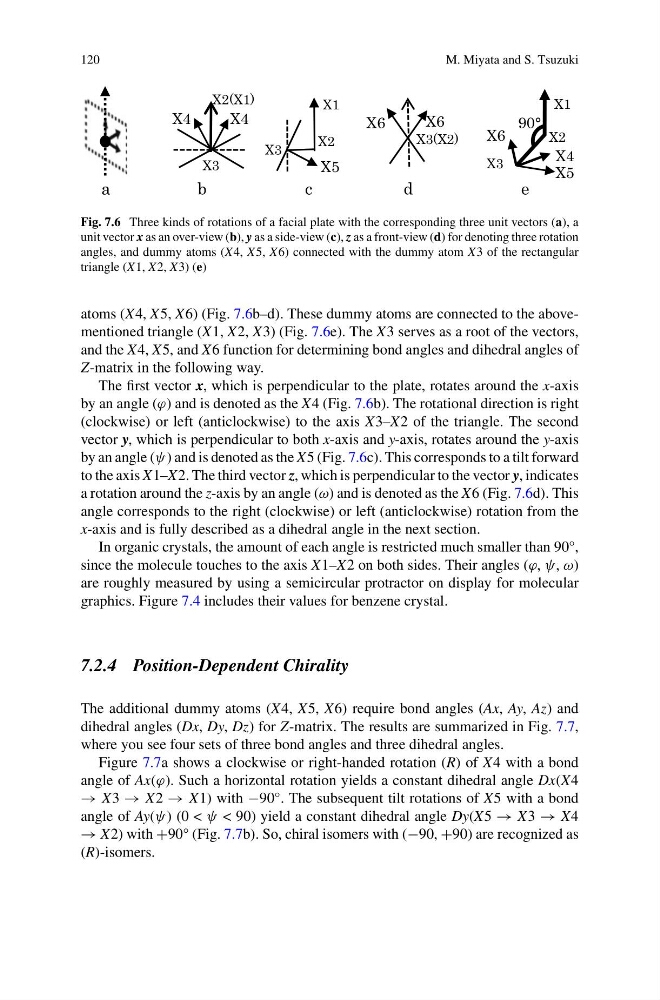
Fig. 7.6 Three kinds of rotations of a facial plate with the corresponding three unit vectors (a), a
unit vector x as an over-view (b), y as a side-view (c), z as a front-view (d) for denoting three rotation
angles, and dummy atoms (X4, X5, X6) connected with the dummy atom X3 of the rectangular
triangle (X1, X2, X3) (e)
atoms (X4, X5, X6) (Fig. 7.6b–d). These dummy atoms are connected to the abovementioned triangle (X1, X2, X3) (Fig. 7.6e). The X3 serves as a root of the vectors,
and the X4, X5, and X6 function for determining bond angles and dihedral angles of
Z-matrix in the following way.
The first vector x, which is perpendicular to the plate, rotates around the x-axis
by an angle (ϕ) and is denoted as the X4 (Fig. 7.6b). The rotational direction is right
(clockwise) or left (anticlockwise) to the axis X3–X2 of the triangle. The second
vector y, which is perpendicular to both x-axis and y-axis, rotates around the y-axis
by an angle (ψ) and is denoted as the X5 (Fig. 7.6c). This corresponds to a tilt forward
to the axis X1–X2. The third vector z, which is perpendicular to the vector y, indicates
a rotation around the z-axis by an angle (ω) and is denoted as the X6 (Fig. 7.6d). This
angle corresponds to the right (clockwise) or left (anticlockwise) rotation from the
x-axis and is fully described as a dihedral angle in the next section.
In organic crystals, the amount of each angle is restricted much smaller than 90°,
since the molecule touches to the axis X1–X2 on both sides. Their angles (ϕ, ψ, ω)
are roughly measured by using a semicircular protractor on display for molecular
graphics. Figure 7.4 includes their values for benzene crystal.
7.2.4 Position-Dependent Chirality
The additional dummy atoms (X4, X5, X6) require bond angles (Ax, Ay, Az) and
dihedral angles (Dx, Dy, Dz) for Z-matrix. The results are summarized in Fig. 7.7,
where you see four sets of three bond angles and three dihedral angles.
Figure 7.7a shows a clockwise or right-handed rotation (R) of X4 with a bond
angle of Ax(ϕ). Such a horizontal rotation yields a constant dihedral angle Dx(X4
→ X3 → X2 → X1) with −90°. The subsequent tilt rotations of X5 with a bond
angle of Ay(ψ) (0 < ψ < 90) yield a constant dihedral angle Dy(X5 → X3 → X4
→ X2) with +90° (Fig. 7.7b). So, chiral isomers with (−90, +90) are recognized as
(R)-isomers.
M. Miyata and S. Tsuzuki
X1
90°
X6
X3
X4
X5
X2
X2
X5
X1
X3
X2(X1)
X4
X4
X3
X6
X6
X3(X2)
a
e
d
c
b
Fig. 7.6 Three kinds of rotations of a facial plate with the corresponding three unit vectors (a), a
unit vector x as an over-view (b), y as a side-view (c), z as a front-view (d) for denoting three rotation
angles, and dummy atoms (X4, X5, X6) connected with the dummy atom X3 of the rectangular
triangle (X1, X2, X3) (e)
atoms (X4, X5, X6) (Fig. 7.6b–d). These dummy atoms are connected to the abovementioned triangle (X1, X2, X3) (Fig. 7.6e). The X3 serves as a root of the vectors,
and the X4, X5, and X6 function for determining bond angles and dihedral angles of
Z-matrix in the following way.
The first vector x, which is perpendicular to the plate, rotates around the x-axis
by an angle (ϕ) and is denoted as the X4 (Fig. 7.6b). The rotational direction is right
(clockwise) or left (anticlockwise) to the axis X3–X2 of the triangle. The second
vector y, which is perpendicular to both x-axis and y-axis, rotates around the y-axis
by an angle (ψ) and is denoted as the X5 (Fig. 7.6c). This corresponds to a tilt forward
to the axis X1–X2. The third vector z, which is perpendicular to the vector y, indicates
a rotation around the z-axis by an angle (ω) and is denoted as the X6 (Fig. 7.6d). This
angle corresponds to the right (clockwise) or left (anticlockwise) rotation from the
x-axis and is fully described as a dihedral angle in the next section.
In organic crystals, the amount of each angle is restricted much smaller than 90°,
since the molecule touches to the axis X1–X2 on both sides. Their angles (ϕ, ψ, ω)
are roughly measured by using a semicircular protractor on display for molecular
graphics. Figure 7.4 includes their values for benzene crystal.
7.2.4 Position-Dependent Chirality
The additional dummy atoms (X4, X5, X6) require bond angles (Ax, Ay, Az) and
dihedral angles (Dx, Dy, Dz) for Z-matrix. The results are summarized in Fig. 7.7,
where you see four sets of three bond angles and three dihedral angles.
Figure 7.7a shows a clockwise or right-handed rotation (R) of X4 with a bond
angle of Ax(ϕ). Such a horizontal rotation yields a constant dihedral angle Dx(X4
→ X3 → X2 → X1) with −90°. The subsequent tilt rotations of X5 with a bond
angle of Ay(ψ) (0 < ψ < 90) yield a constant dihedral angle Dy(X5 → X3 → X4
→ X2) with +90° (Fig. 7.7b). So, chiral isomers with (−90, +90) are recognized as
(R)-isomers.