

7 Supramolecular, Hierarchical, and Energetical Interpretation …
119
α:90, β:110, γ:90
Ae =α=90
Af1=β=110
Af2=180-β=70
Ag=γ=90
Rotations along b-axis
x(φ): 20 y(ψ): 30 z(ω): 27
Angles for z-matrix
Bond angles
Ax: 20 Ay: 30 Az: 90
Dihedral angles
Dx: -90; -90; +90; +90
Dy: +90; +90; -90; -90
Dz: -27 ; +27; -27; +27
Benzene
Monoclinic
Space group P2 1 /c
a:5.417, b:5.376. c:7.532
Ba=b=5.376
Bb=c/4=1.883
Bc=a=5.417
a
b
c
d
Fig. 7.4 Relation between lattice parameters and Z-matrix of a benzene crystal. Parameters of
distances (a) and angles (b) for a unit cell and a triangle. Three kinds of rotations along b-axis (c).
Bond and dihedral angles for Z-matrix (d)
X2 (Ba) is 5.376 Å which corresponds to a unit length of b-axis, while one between
X2 and X3 (Bb) is 1.883 Å which does to the one-fourth length of c-axis. These Ba
and Bb are available for Z-matrix in Fig. 7.2d.
In this way, the triangle model is related to the crystal structure, but one problem
remains. In spite of a fixed orientation to the axis in Fig. 7.3c, molecular graphics
mostly displays diverse orientations in crystals. At last, we reached an idea that such
a difference derives from any rotations of the molecule toward the axis (Fig. 7.3d).
The next section describes how to simulate the rotations.
7.2.3 Positioning for Three Kinds of Rotations
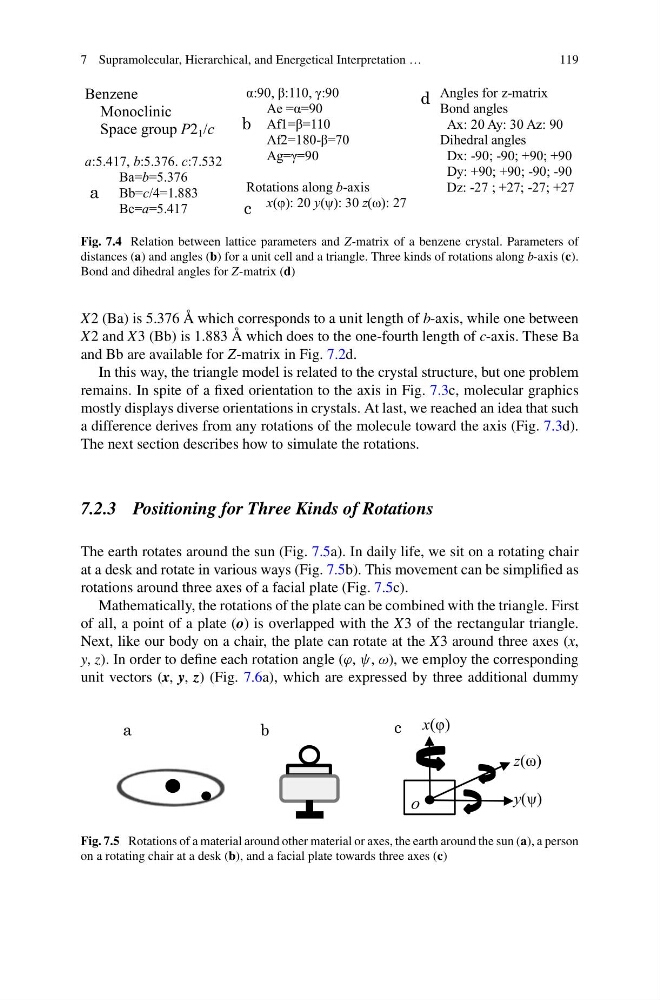
The earth rotates around the sun (Fig. 7.5a). In daily life, we sit on a rotating chair
at a desk and rotate in various ways (Fig. 7.5b). This movement can be simplified as
rotations around three axes of a facial plate (Fig. 7.5c).
Mathematically, the rotations of the plate can be combined with the triangle. First
of all, a point of a plate (o) is overlapped with the X3 of the rectangular triangle.
Next, like our body on a chair, the plate can rotate at the X3 around three axes (x,
y, z). In order to define each rotation angle (ϕ, ψ, ω), we employ the corresponding
unit vectors (x, y, z) (Fig. 7.6a), which are expressed by three additional dummy
b
a
c x(φ)
z(ω)
y(ψ)
o
Fig. 7.5 Rotations of a material around other material or axes, the earth around the sun (a), a person
on a rotating chair at a desk (b), and a facial plate towards three axes (c)
119
α:90, β:110, γ:90
Ae =α=90
Af1=β=110
Af2=180-β=70
Ag=γ=90
Rotations along b-axis
x(φ): 20 y(ψ): 30 z(ω): 27
Angles for z-matrix
Bond angles
Ax: 20 Ay: 30 Az: 90
Dihedral angles
Dx: -90; -90; +90; +90
Dy: +90; +90; -90; -90
Dz: -27 ; +27; -27; +27
Benzene
Monoclinic
Space group P2 1 /c
a:5.417, b:5.376. c:7.532
Ba=b=5.376
Bb=c/4=1.883
Bc=a=5.417
a
b
c
d
Fig. 7.4 Relation between lattice parameters and Z-matrix of a benzene crystal. Parameters of
distances (a) and angles (b) for a unit cell and a triangle. Three kinds of rotations along b-axis (c).
Bond and dihedral angles for Z-matrix (d)
X2 (Ba) is 5.376 Å which corresponds to a unit length of b-axis, while one between
X2 and X3 (Bb) is 1.883 Å which does to the one-fourth length of c-axis. These Ba
and Bb are available for Z-matrix in Fig. 7.2d.
In this way, the triangle model is related to the crystal structure, but one problem
remains. In spite of a fixed orientation to the axis in Fig. 7.3c, molecular graphics
mostly displays diverse orientations in crystals. At last, we reached an idea that such
a difference derives from any rotations of the molecule toward the axis (Fig. 7.3d).
The next section describes how to simulate the rotations.
7.2.3 Positioning for Three Kinds of Rotations
The earth rotates around the sun (Fig. 7.5a). In daily life, we sit on a rotating chair
at a desk and rotate in various ways (Fig. 7.5b). This movement can be simplified as
rotations around three axes of a facial plate (Fig. 7.5c).
Mathematically, the rotations of the plate can be combined with the triangle. First
of all, a point of a plate (o) is overlapped with the X3 of the rectangular triangle.
Next, like our body on a chair, the plate can rotate at the X3 around three axes (x,
y, z). In order to define each rotation angle (ϕ, ψ, ω), we employ the corresponding
unit vectors (x, y, z) (Fig. 7.6a), which are expressed by three additional dummy
b
a
c x(φ)
z(ω)
y(ψ)
o
Fig. 7.5 Rotations of a material around other material or axes, the earth around the sun (a), a person
on a rotating chair at a desk (b), and a facial plate towards three axes (c)