

104
K. Kawakami
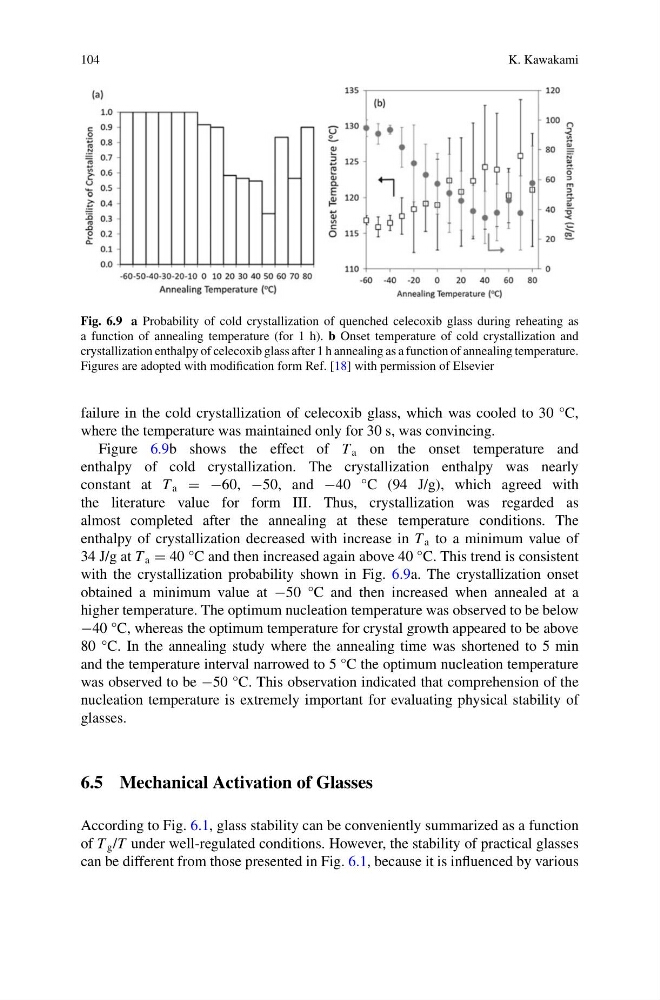
Fig. 6.9 a Probability of cold crystallization of quenched celecoxib glass during reheating as
a function of annealing temperature (for 1 h). b Onset temperature of cold crystallization and
crystallization enthalpy of celecoxib glass after 1 h annealing as a function of annealing temperature.
Figures are adopted with modification form Ref. [18] with permission of Elsevier
failure in the cold crystallization of celecoxib glass, which was cooled to 30 °C,
where the temperature was maintained only for 30 s, was convincing.
Figure 6.9b shows the effect of T a on the onset temperature and
enthalpy of cold crystallization. The crystallization enthalpy was nearly
constant at T a = −60, −50, and −40 °C (94 J/g), which agreed with
the literature value for form III. Thus, crystallization was regarded as
almost completed after the annealing at these temperature conditions. The
enthalpy of crystallization decreased with increase in T a to a minimum value of
34 J/g at T a = 40 °C and then increased again above 40 °C. This trend is consistent
with the crystallization probability shown in Fig. 6.9a. The crystallization onset
obtained a minimum value at −50 °C and then increased when annealed at a
higher temperature. The optimum nucleation temperature was observed to be below
−40 °C, whereas the optimum temperature for crystal growth appeared to be above
80 °C. In the annealing study where the annealing time was shortened to 5 min
and the temperature interval narrowed to 5 °C the optimum nucleation temperature
was observed to be −50 °C. This observation indicated that comprehension of the
nucleation temperature is extremely important for evaluating physical stability of
glasses.
6.5 Mechanical Activation of Glasses
According to Fig. 6.1, glass stability can be conveniently summarized as a function
of T g /T under well-regulated conditions. However, the stability of practical glasses
can be different from those presented in Fig. 6.1, because it is influenced by various
K. Kawakami
Fig. 6.9 a Probability of cold crystallization of quenched celecoxib glass during reheating as
a function of annealing temperature (for 1 h). b Onset temperature of cold crystallization and
crystallization enthalpy of celecoxib glass after 1 h annealing as a function of annealing temperature.
Figures are adopted with modification form Ref. [18] with permission of Elsevier
failure in the cold crystallization of celecoxib glass, which was cooled to 30 °C,
where the temperature was maintained only for 30 s, was convincing.
Figure 6.9b shows the effect of T a on the onset temperature and
enthalpy of cold crystallization. The crystallization enthalpy was nearly
constant at T a = −60, −50, and −40 °C (94 J/g), which agreed with
the literature value for form III. Thus, crystallization was regarded as
almost completed after the annealing at these temperature conditions. The
enthalpy of crystallization decreased with increase in T a to a minimum value of
34 J/g at T a = 40 °C and then increased again above 40 °C. This trend is consistent
with the crystallization probability shown in Fig. 6.9a. The crystallization onset
obtained a minimum value at −50 °C and then increased when annealed at a
higher temperature. The optimum nucleation temperature was observed to be below
−40 °C, whereas the optimum temperature for crystal growth appeared to be above
80 °C. In the annealing study where the annealing time was shortened to 5 min
and the temperature interval narrowed to 5 °C the optimum nucleation temperature
was observed to be −50 °C. This observation indicated that comprehension of the
nucleation temperature is extremely important for evaluating physical stability of
glasses.
6.5 Mechanical Activation of Glasses
According to Fig. 6.1, glass stability can be conveniently summarized as a function
of T g /T under well-regulated conditions. However, the stability of practical glasses
can be different from those presented in Fig. 6.1, because it is influenced by various