

6 Managing Thermal History to Stabilize/Destabilize …
105
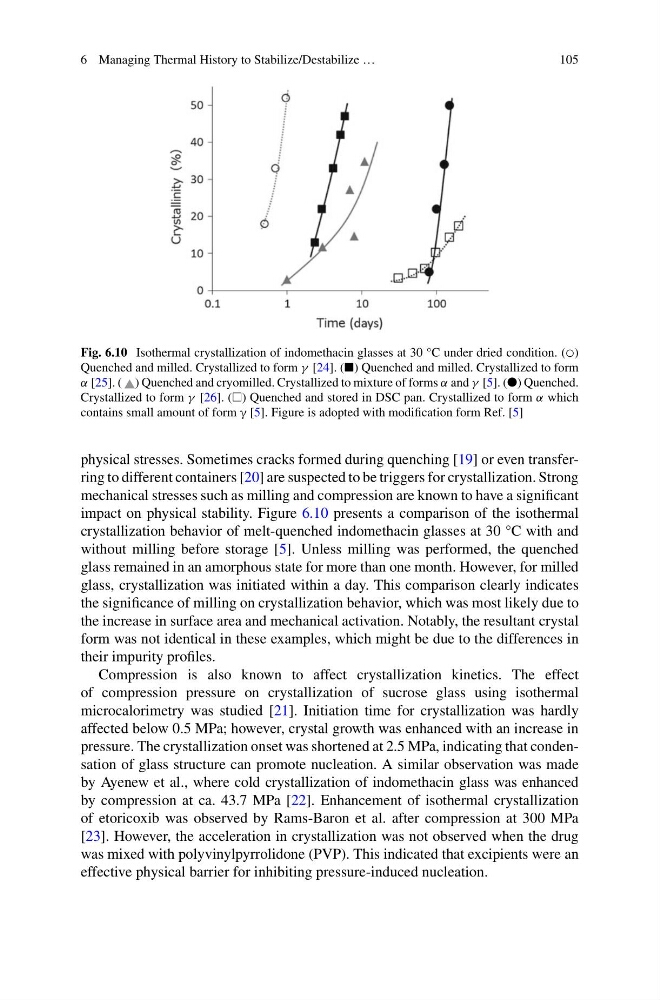
Fig. 6.10 Isothermal crystallization of indomethacin glasses at 30 °C under dried condition. (◯)
Quenched and milled. Crystallized to form γ [24]. () Quenched and milled. Crystallized to form
α [25]. ( ) Quenched and cryomilled. Crystallized to mixture of forms α and γ [5]. (●) Quenched.
Crystallized to form γ [26]. () Quenched and stored in DSC pan. Crystallized to form α which
contains small amount of form γ [5]. Figure is adopted with modification form Ref. [5]
physical stresses. Sometimes cracks formed during quenching [19] or even transferring to different containers [20] are suspected to be triggers for crystallization. Strong
mechanical stresses such as milling and compression are known to have a significant
impact on physical stability. Figure 6.10 presents a comparison of the isothermal
crystallization behavior of melt-quenched indomethacin glasses at 30 °C with and
without milling before storage [5]. Unless milling was performed, the quenched
glass remained in an amorphous state for more than one month. However, for milled
glass, crystallization was initiated within a day. This comparison clearly indicates
the significance of milling on crystallization behavior, which was most likely due to
the increase in surface area and mechanical activation. Notably, the resultant crystal
form was not identical in these examples, which might be due to the differences in
their impurity profiles.
Compression is also known to affect crystallization kinetics. The effect
of compression pressure on crystallization of sucrose glass using isothermal
microcalorimetry was studied [21]. Initiation time for crystallization was hardly
affected below 0.5 MPa; however, crystal growth was enhanced with an increase in
pressure. The crystallization onset was shortened at 2.5 MPa, indicating that condensation of glass structure can promote nucleation. A similar observation was made
by Ayenew et al., where cold crystallization of indomethacin glass was enhanced
by compression at ca. 43.7 MPa [22]. Enhancement of isothermal crystallization
of etoricoxib was observed by Rams-Baron et al. after compression at 300 MPa
[23]. However, the acceleration in crystallization was not observed when the drug
was mixed with polyvinylpyrrolidone (PVP). This indicated that excipients were an
effective physical barrier for inhibiting pressure-induced nucleation.
105
Fig. 6.10 Isothermal crystallization of indomethacin glasses at 30 °C under dried condition. (◯)
Quenched and milled. Crystallized to form γ [24]. () Quenched and milled. Crystallized to form
α [25]. ( ) Quenched and cryomilled. Crystallized to mixture of forms α and γ [5]. (●) Quenched.
Crystallized to form γ [26]. () Quenched and stored in DSC pan. Crystallized to form α which
contains small amount of form γ [5]. Figure is adopted with modification form Ref. [5]
physical stresses. Sometimes cracks formed during quenching [19] or even transferring to different containers [20] are suspected to be triggers for crystallization. Strong
mechanical stresses such as milling and compression are known to have a significant
impact on physical stability. Figure 6.10 presents a comparison of the isothermal
crystallization behavior of melt-quenched indomethacin glasses at 30 °C with and
without milling before storage [5]. Unless milling was performed, the quenched
glass remained in an amorphous state for more than one month. However, for milled
glass, crystallization was initiated within a day. This comparison clearly indicates
the significance of milling on crystallization behavior, which was most likely due to
the increase in surface area and mechanical activation. Notably, the resultant crystal
form was not identical in these examples, which might be due to the differences in
their impurity profiles.
Compression is also known to affect crystallization kinetics. The effect
of compression pressure on crystallization of sucrose glass using isothermal
microcalorimetry was studied [21]. Initiation time for crystallization was hardly
affected below 0.5 MPa; however, crystal growth was enhanced with an increase in
pressure. The crystallization onset was shortened at 2.5 MPa, indicating that condensation of glass structure can promote nucleation. A similar observation was made
by Ayenew et al., where cold crystallization of indomethacin glass was enhanced
by compression at ca. 43.7 MPa [22]. Enhancement of isothermal crystallization
of etoricoxib was observed by Rams-Baron et al. after compression at 300 MPa
[23]. However, the acceleration in crystallization was not observed when the drug
was mixed with polyvinylpyrrolidone (PVP). This indicated that excipients were an
effective physical barrier for inhibiting pressure-induced nucleation.