

6 Managing Thermal History to Stabilize/Destabilize …
103
6.4 Nucleation During Low-Temperature Storage
to Promote Crystallization
The optimum nucleation temperature, i.e., the temperature where the nucleation
rate becomes maximum, is usually located well below the optimum crystal growth
temperature. Thus, low-temperature storage can influence the physical stability of the
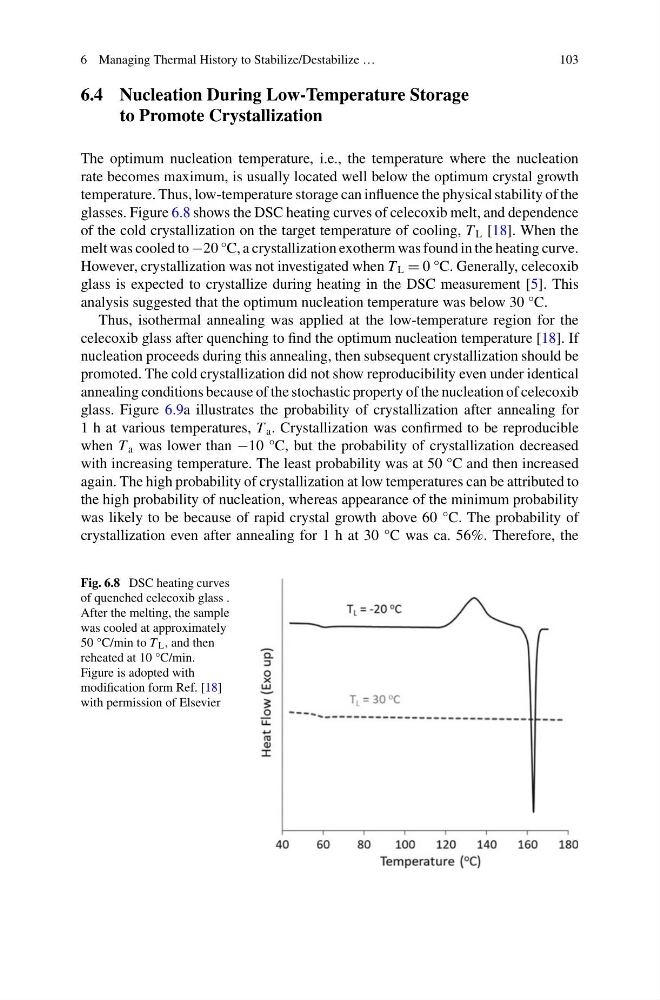
glasses. Figure 6.8 shows the DSC heating curves of celecoxib melt, and dependence
of the cold crystallization on the target temperature of cooling, T L [18]. When the
melt was cooled to −20 °C, a crystallization exotherm was found in the heating curve.
However, crystallization was not investigated when T L = 0 °C. Generally, celecoxib
glass is expected to crystallize during heating in the DSC measurement [5]. This
analysis suggested that the optimum nucleation temperature was below 30 °C.
Thus, isothermal annealing was applied at the low-temperature region for the
celecoxib glass after quenching to find the optimum nucleation temperature [18]. If
nucleation proceeds during this annealing, then subsequent crystallization should be
promoted. The cold crystallization did not show reproducibility even under identical
annealing conditions because of the stochastic property of the nucleation of celecoxib
glass. Figure 6.9a illustrates the probability of crystallization after annealing for
1 h at various temperatures, T a . Crystallization was confirmed to be reproducible
when T a was lower than −10 °C, but the probability of crystallization decreased
with increasing temperature. The least probability was at 50 °C and then increased
again. The high probability of crystallization at low temperatures can be attributed to
the high probability of nucleation, whereas appearance of the minimum probability
was likely to be because of rapid crystal growth above 60 °C. The probability of
crystallization even after annealing for 1 h at 30 °C was ca. 56%. Therefore, the
Fig. 6.8 DSC heating curves
of quenched celecoxib glass .
After the melting, the sample
was cooled at approximately
50 °C/min to T L , and then
reheated at 10 °C/min.
Figure is adopted with
modification form Ref. [18]
with permission of Elsevier
103
6.4 Nucleation During Low-Temperature Storage
to Promote Crystallization
The optimum nucleation temperature, i.e., the temperature where the nucleation
rate becomes maximum, is usually located well below the optimum crystal growth
temperature. Thus, low-temperature storage can influence the physical stability of the
glasses. Figure 6.8 shows the DSC heating curves of celecoxib melt, and dependence
of the cold crystallization on the target temperature of cooling, T L [18]. When the
melt was cooled to −20 °C, a crystallization exotherm was found in the heating curve.
However, crystallization was not investigated when T L = 0 °C. Generally, celecoxib
glass is expected to crystallize during heating in the DSC measurement [5]. This
analysis suggested that the optimum nucleation temperature was below 30 °C.
Thus, isothermal annealing was applied at the low-temperature region for the
celecoxib glass after quenching to find the optimum nucleation temperature [18]. If
nucleation proceeds during this annealing, then subsequent crystallization should be
promoted. The cold crystallization did not show reproducibility even under identical
annealing conditions because of the stochastic property of the nucleation of celecoxib
glass. Figure 6.9a illustrates the probability of crystallization after annealing for
1 h at various temperatures, T a . Crystallization was confirmed to be reproducible
when T a was lower than −10 °C, but the probability of crystallization decreased
with increasing temperature. The least probability was at 50 °C and then increased
again. The high probability of crystallization at low temperatures can be attributed to
the high probability of nucleation, whereas appearance of the minimum probability
was likely to be because of rapid crystal growth above 60 °C. The probability of
crystallization even after annealing for 1 h at 30 °C was ca. 56%. Therefore, the
Fig. 6.8 DSC heating curves
of quenched celecoxib glass .
After the melting, the sample
was cooled at approximately
50 °C/min to T L , and then
reheated at 10 °C/min.
Figure is adopted with
modification form Ref. [18]
with permission of Elsevier