

102
K. Kawakami
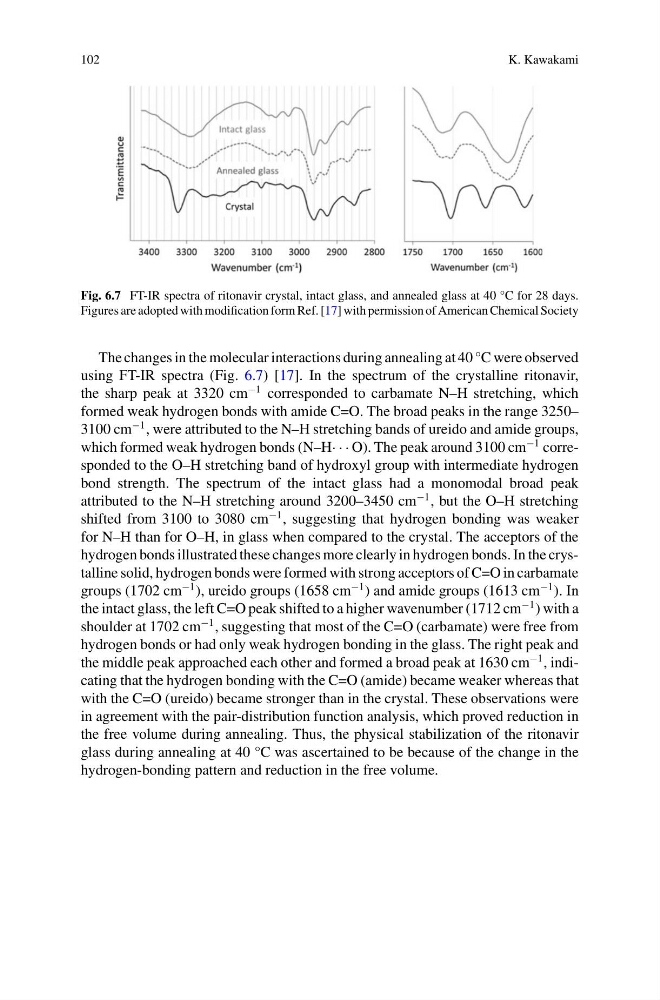
Fig. 6.7 FT-IR spectra of ritonavir crystal, intact glass, and annealed glass at 40 °C for 28 days.
Figures are adopted with modification form Ref. [17] with permission of American Chemical Society
The changes in the molecular interactions during annealing at 40 °C were observed
using FT-IR spectra (Fig. 6.7) [17]. In the spectrum of the crystalline ritonavir,
the sharp peak at 3320 cm
−1 corresponded to carbamate N–H stretching, which
formed weak hydrogen bonds with amide C=O. The broad peaks in the range 3250–
3100 cm
−1 , were attributed to the N–H stretching bands of ureido and amide groups,
which formed weak hydrogen bonds (N–H· · · O). The peak around 3100 cm
−1 corresponded to the O–H stretching band of hydroxyl group with intermediate hydrogen
bond strength. The spectrum of the intact glass had a monomodal broad peak
attributed to the N–H stretching around 3200–3450 cm
−1 , but the O–H stretching
shifted from 3100 to 3080 cm
−1 , suggesting that hydrogen bonding was weaker
for N–H than for O–H, in glass when compared to the crystal. The acceptors of the
hydrogen bonds illustrated these changes more clearly in hydrogen bonds. In the crystalline solid, hydrogen bonds were formed with strong acceptors of C=O in carbamate
groups (1702 cm
−1 ), ureido groups (1658 cm
−1 ) and amide groups (1613 cm
−1 ). In
the intact glass, the left C=O peak shifted to a higher wavenumber (1712 cm
−1 ) with a
shoulder at 1702 cm
−1 , suggesting that most of the C=O (carbamate) were free from
hydrogen bonds or had only weak hydrogen bonding in the glass. The right peak and
the middle peak approached each other and formed a broad peak at 1630 cm
−1 , indicating that the hydrogen bonding with the C=O (amide) became weaker whereas that
with the C=O (ureido) became stronger than in the crystal. These observations were
in agreement with the pair-distribution function analysis, which proved reduction in
the free volume during annealing. Thus, the physical stabilization of the ritonavir
glass during annealing at 40 °C was ascertained to be because of the change in the
hydrogen-bonding pattern and reduction in the free volume.
K. Kawakami
Fig. 6.7 FT-IR spectra of ritonavir crystal, intact glass, and annealed glass at 40 °C for 28 days.
Figures are adopted with modification form Ref. [17] with permission of American Chemical Society
The changes in the molecular interactions during annealing at 40 °C were observed
using FT-IR spectra (Fig. 6.7) [17]. In the spectrum of the crystalline ritonavir,
the sharp peak at 3320 cm
−1 corresponded to carbamate N–H stretching, which
formed weak hydrogen bonds with amide C=O. The broad peaks in the range 3250–
3100 cm
−1 , were attributed to the N–H stretching bands of ureido and amide groups,
which formed weak hydrogen bonds (N–H· · · O). The peak around 3100 cm
−1 corresponded to the O–H stretching band of hydroxyl group with intermediate hydrogen
bond strength. The spectrum of the intact glass had a monomodal broad peak
attributed to the N–H stretching around 3200–3450 cm
−1 , but the O–H stretching
shifted from 3100 to 3080 cm
−1 , suggesting that hydrogen bonding was weaker
for N–H than for O–H, in glass when compared to the crystal. The acceptors of the
hydrogen bonds illustrated these changes more clearly in hydrogen bonds. In the crystalline solid, hydrogen bonds were formed with strong acceptors of C=O in carbamate
groups (1702 cm
−1 ), ureido groups (1658 cm
−1 ) and amide groups (1613 cm
−1 ). In
the intact glass, the left C=O peak shifted to a higher wavenumber (1712 cm
−1 ) with a
shoulder at 1702 cm
−1 , suggesting that most of the C=O (carbamate) were free from
hydrogen bonds or had only weak hydrogen bonding in the glass. The right peak and
the middle peak approached each other and formed a broad peak at 1630 cm
−1 , indicating that the hydrogen bonding with the C=O (amide) became weaker whereas that
with the C=O (ureido) became stronger than in the crystal. These observations were
in agreement with the pair-distribution function analysis, which proved reduction in
the free volume during annealing. Thus, the physical stabilization of the ritonavir
glass during annealing at 40 °C was ascertained to be because of the change in the
hydrogen-bonding pattern and reduction in the free volume.