

Northern Alboran Sea fishing has experienced an important reduction despite
aforementioned changes of relative importance in value of different ports. In fact,
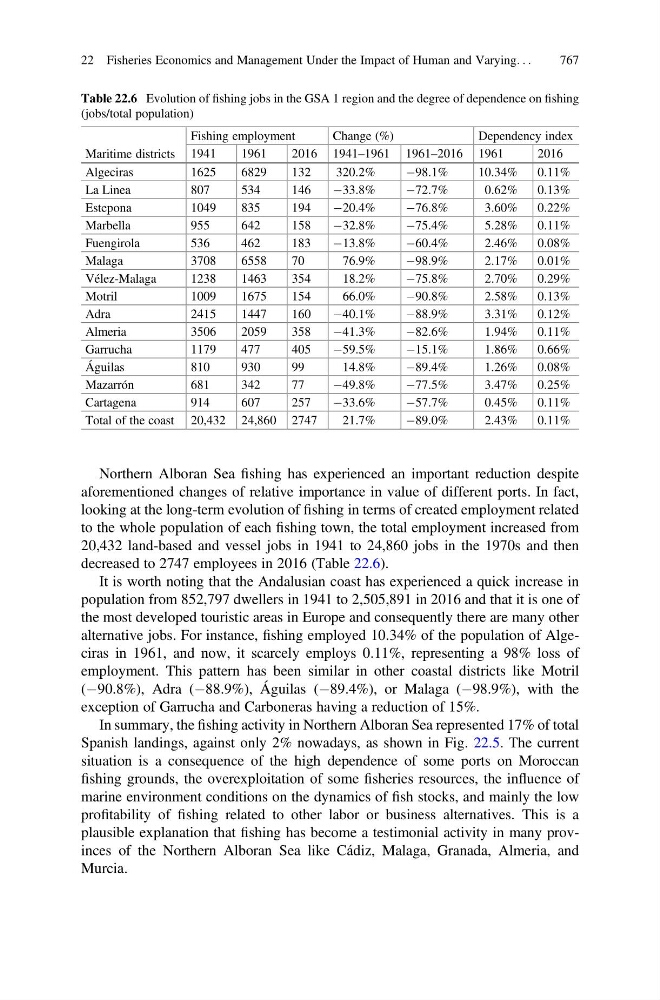
looking at the long-term evolution of fishing in terms of created employment related
to the whole population of each fishing town, the total employment increased from
20,432 land-based and vessel jobs in 1941 to 24,860 jobs in the 1970s and then
decreased to 2747 employees in 2016 (Table 22.6).
It is worth noting that the Andalusian coast has experienced a quick increase in
population from 852,797 dwellers in 1941 to 2,505,891 in 2016 and that it is one of
the most developed touristic areas in Europe and consequently there are many other
alternative jobs. For instance, fishing employed 10.34% of the population of Algeciras in 1961, and now, it scarcely employs 0.11%, representing a 98% loss of
employment. This pattern has been similar in other coastal districts like Motril
(À90.8%), Adra (À88.9%), Águilas (À89.4%), or Malaga (À98.9%), with the
exception of Garrucha and Carboneras having a reduction of 15%.
In summary, the fishing activity in Northern Alboran Sea represented 17% of total
Spanish landings, against only 2% nowadays, as shown in Fig. 22.5. The current
situation is a consequence of the high dependence of some ports on Moroccan
fishing grounds, the overexploitation of some fisheries resources, the influence of
marine environment conditions on the dynamics of fish stocks, and mainly the low
profitability of fishing related to other labor or business alternatives. This is a
plausible explanation that fishing has become a testimonial activity in many provinces of the Northern Alboran Sea like Cádiz, Malaga, Granada, Almeria, and
Murcia.
Table 22.6 Evolution of fishing jobs in the GSA 1 region and the degree of dependence on fishing
(jobs/total population)
Maritime districts
Fishing employment
Change (%)
Dependency index
1941
1961
2016 1941–1961 1961–2016 1961
2016
Algeciras
1625
6829
132
320.2%
À98.1%
10.34%
0.11%
La Linea
807
534
146
À33.8%
À72.7%
0.62%
0.13%
Estepona
1049
835
194
À20.4%
À76.8%
3.60%
0.22%
Marbella
955
642
158
À32.8%
À75.4%
5.28%
0.11%
Fuengirola
536
462
183
À13.8%
À60.4%
2.46%
0.08%
Malaga
3708
6558
70
76.9%
À98.9%
2.17%
0.01%
Vélez-Malaga
1238
1463
354
18.2%
À75.8%
2.70%
0.29%
Motril
1009
1675
154
66.0%
À90.8%
2.58%
0.13%
Adra
2415
1447
160
À40.1%
À88.9%
3.31%
0.12%
Almeria
3506
2059
358
À41.3%
À82.6%
1.94%
0.11%
Garrucha
1179
477
405
À59.5%
À15.1%
1.86%
0.66%
Águilas
810
930
99
14.8%
À89.4%
1.26%
0.08%
Mazarrón
681
342
77
À49.8%
À77.5%
3.47%
0.25%
Cartagena
914
607
257
À33.6%
À57.7%
0.45%
0.11%
Total of the coast 20,432 24,860 2747
21.7%
À89.0%
2.43%
0.11%
22 Fisheries Economics and Management Under the Impact of Human and Varying. . .
767