

post-breeding exodus of Balearic shearwaters and Audouin’s gulls (June); postbreeding migration of most species and arrival of wintering birds (September);
pre-breeding migration of Balearic shearwaters (October); post-breeding exodus of
Scopoli’s shearwaters (November); start of the exodus of wintering species
(February); and arrival of Scopoli’s shearwaters and the other breeding populations
of seabirds (April).
The only critically endangered species in this area is the Balearic shearwater
(BirdLife International 2016). However, in the Alboran Sea, accidental captures on
fishing gear, which is the major threat to the species in other areas of the Mediterranean, do not appear to be cause of a decline in their numbers (García-Barcelona
et al. 2010a, b; Genovart et al. 2016). The main threats to seabirds in the Alboran Sea
and the Strait of Gibraltar can be grouped into terrestrial and marine threats.
Terrestrial threats include the presence of invasive species (rats, cats, etc.) in bird
colonies and urban development. Marine threats include fishery bycatch (professional and recreational), overfishing, marine pollution, and, to a lesser extent, marine
infrastructures (e.g. wind farms) (SEO/BirdLife 2012). The presence of rats in some
procellariform colonies (e.g. in the Chafarinas Islands) is a particularly serious
problem (Igual et al. 2009). The main seabird bycatch of the Spanish pelagic
longline fleet comprises wintering species (i.e. Northern gannets and Great skuas),
but yellow-legged gulls are also bycaught (García-Barcelona et al. 2010a, 2016).
Little is known about bycatch by demersal longliners. Although this fleet is much
smaller than the pelagic longline fleet, it typically fishes close to the Alboran Natural
Reserve. Thus, there is a risk of breeding species being bycaught near Alboran
Island, which lies within this reserve. However, fishermen claim that seabird
bycatches are very rare because they set longlines at night (Skipper Carlos Molina
Hernández, personal communication). In the Strait of Gibraltar, artisanal fisheries
targeting bluefin tuna (Thunnus thynnus) have a low impact on seabirds (i.e. northern
gannets, Cory’s shearwaters, and gulls) (García-Barcelona et al. 2017b). On the
coast, there is increasing concern regarding fishing lines and trolling bait abandoned
or lost by recreational fishermen in urban beaches and harbours. Several species of
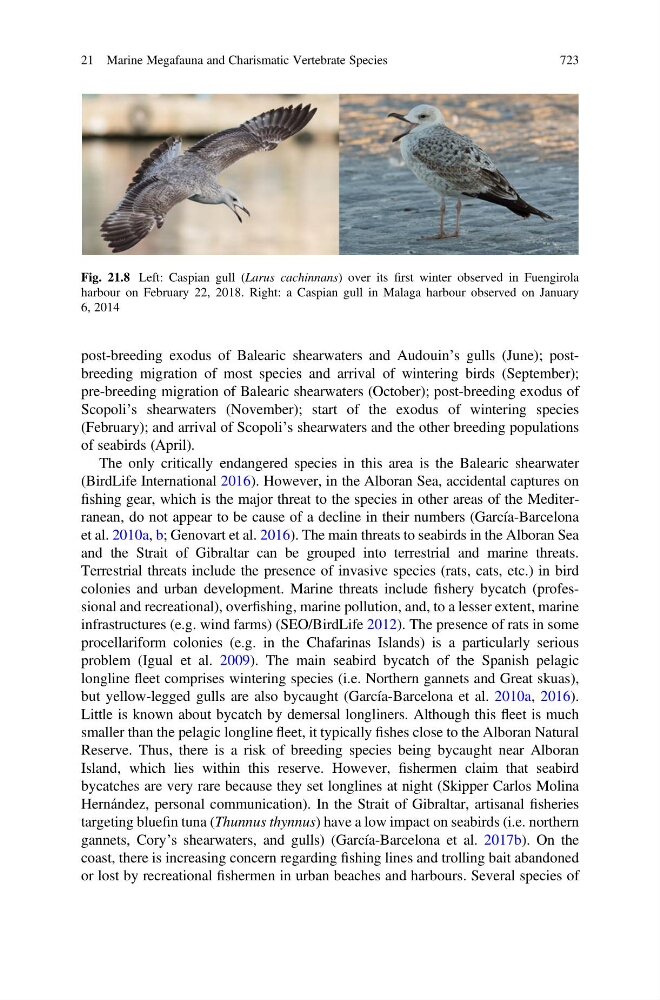
Fig. 21.8 Left: Caspian gull (Larus cachinnans) over its first winter observed in Fuengirola
harbour on February 22, 2018. Right: a Caspian gull in Malaga harbour observed on January
6, 2014
21 Marine Megafauna and Charismatic Vertebrate Species
723