

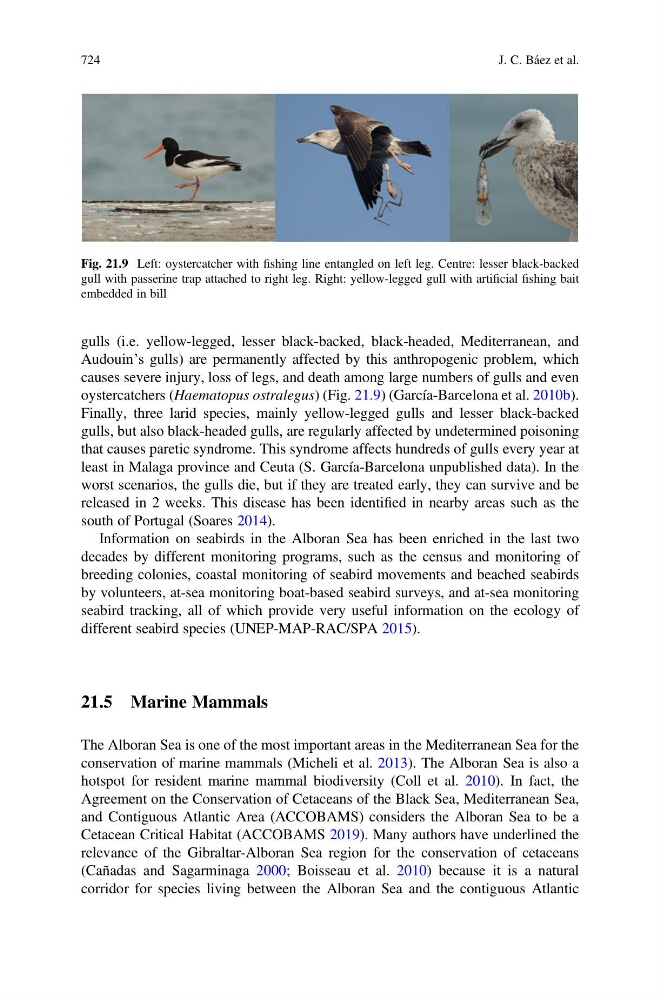
gulls (i.e. yellow-legged, lesser black-backed, black-headed, Mediterranean, and
Audouin’s gulls) are permanently affected by this anthropogenic problem, which
causes severe injury, loss of legs, and death among large numbers of gulls and even
oystercatchers (Haematopus ostralegus) (Fig. 21.9) (García-Barcelona et al. 2010b).
Finally, three larid species, mainly yellow-legged gulls and lesser black-backed
gulls, but also black-headed gulls, are regularly affected by undetermined poisoning
that causes paretic syndrome. This syndrome affects hundreds of gulls every year at
least in Malaga province and Ceuta (S. García-Barcelona unpublished data). In the
worst scenarios, the gulls die, but if they are treated early, they can survive and be
released in 2 weeks. This disease has been identified in nearby areas such as the
south of Portugal (Soares 2014).
Information on seabirds in the Alboran Sea has been enriched in the last two
decades by different monitoring programs, such as the census and monitoring of
breeding colonies, coastal monitoring of seabird movements and beached seabirds
by volunteers, at-sea monitoring boat-based seabird surveys, and at-sea monitoring
seabird tracking, all of which provide very useful information on the ecology of
different seabird species (UNEP-MAP-RAC/SPA 2015).
21.5 Marine Mammals
The Alboran Sea is one of the most important areas in the Mediterranean Sea for the
conservation of marine mammals (Micheli et al. 2013). The Alboran Sea is also a
hotspot for resident marine mammal biodiversity (Coll et al. 2010). In fact, the
Agreement on the Conservation of Cetaceans of the Black Sea, Mediterranean Sea,
and Contiguous Atlantic Area (ACCOBAMS) considers the Alboran Sea to be a
Cetacean Critical Habitat (ACCOBAMS 2019). Many authors have underlined the
relevance of the Gibraltar-Alboran Sea region for the conservation of cetaceans
(Cañadas and Sagarminaga 2000; Boisseau et al. 2010) because it is a natural
corridor for species living between the Alboran Sea and the contiguous Atlantic
Fig. 21.9 Left: oystercatcher with fishing line entangled on left leg. Centre: lesser black-backed
gull with passerine trap attached to right leg. Right: yellow-legged gull with artificial fishing bait
embedded in bill
724
J. C. Báez et al.