

Barcelona, unpublished observation). Since then, other isolated winter Caspian gulls
have been recorded in the Malaga province (Fig. 21.8) (García-Barcelona 2015,
2017). There has been an inter-annual increase of this wintering species in the
Iberian Peninsula (Gil-Velasco et al. 2017).
Due to the geographically strategic position of the Alboran Sea, which has strong
westerly winds and sea storms during winter, individual vagrant birds can arrive in
the Mediterranean area via the Strait of Gibraltar. This occurred in the case of the
black-legged kittiwake (Rissa tridactyla) after cyclones Joris and Klaus made
landfall in Spain in January 2009 (García-Barcelona and Domínguez Santaella
2009).
The abundance of migratory species differs between the northern and southern
coasts of the Alboran sea (Paracuellos and Jerez 2003; García-Barcelona et al. 2015).
For example, Balearic shearwaters prefer to use the northern coast to move across the
Strait of Gibraltar, whereas Scopoli’s shearwaters migrate in much greater numbers
along the south coast (Navarrete 2008; Arcos et al. 2012). Several coastal areas by
the Alboran Sea are relevant pre-nuptial and post-nuptial migration corridors. The
most important area by far is the Strait of Gibraltar (e.g. Programa Migres 2009;
Montero et al. 2005).
Other important areas in the Alboran Sea are the transboundary coastal area
Oranie and Moulouya (Morocco and Algeria), the Cap des Trois Fourches (Nador,
Morocco), and Ceuta (e.g. Arcos et al. 2009; Critical Ecosystem Partnership Foundation 2010; Navarrete 2008).
The time of migration of seabirds in the Alboran area differs according to species.
Most migratory seabirds leave the Mediterranean Sea and migrate to the European
and African Atlantic coasts during summer after breeding and then fly back in the
following spring (March–April) to start a new reproductive cycle. However, some
species do not follow this pattern. For example, Balearic shearwaters migrate early
(June), remain in the Atlantic for around 3 months, and then return in autumn
(October/November), which is when Scopoli’s shearwaters start their post-breeding
migration. In fact, there is an intensive seasonal dynamic in the western Alboran Sea:
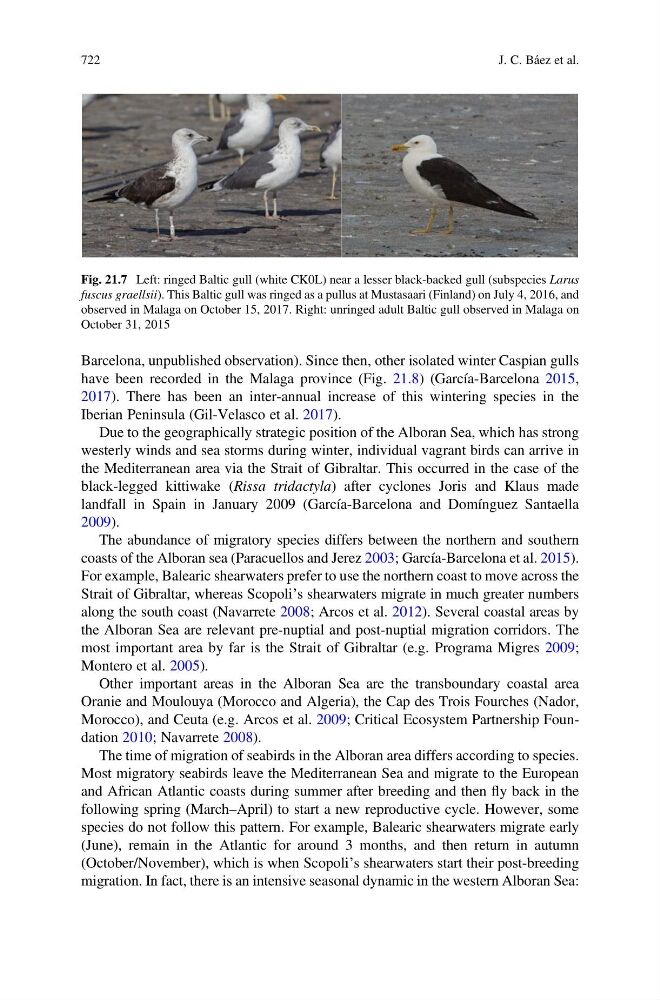
Fig. 21.7 Left: ringed Baltic gull (white CK0L) near a lesser black-backed gull (subspecies Larus
fuscus graellsii). This Baltic gull was ringed as a pullus at Mustasaari (Finland) on July 4, 2016, and
observed in Malaga on October 15, 2017. Right: unringed adult Baltic gull observed in Malaga on
October 31, 2015
722
J. C. Báez et al.