

beaches, or organic material floating in small river mouths after rain (GarcíaBarcelona 2016). In fact, in the Malaga area, this species is more likely to be
observed inland (except in rubbish dumps) than by the sea.
In the Alboran Sea, L. f. graellsii is the most abundant of the three subspecies of
the polytypic lesser black-backed gull (i.e. L. f. graellsii, L. f. intermedius, and L. f.
fuscus). About its origin, the ringed lesser black-backed gulls observed in Malaga
were born in the Netherlands (32%), the UK (24%), and Norway (21%) mainly
(García-Barcelona 2007). However, the 60% of the lesser black-backed gulls in the
north of Spain come from the UK (Álvarez Laó 2005). Carrera (1988) estimated that
4000 to 10,000 lesser black-backed gulls overwintered on the Spanish coast of the
Alboran Sea. Between 1984 and 2009, the population increased by more than 400%
to around 30,000 (Mouriño 2009). The largest population is in Malaga province.
Since the 1990s, there has also been an increase in the European breeding population, particularly in urban environments (e.g. Rock 2002). Between 2007 and 2016,
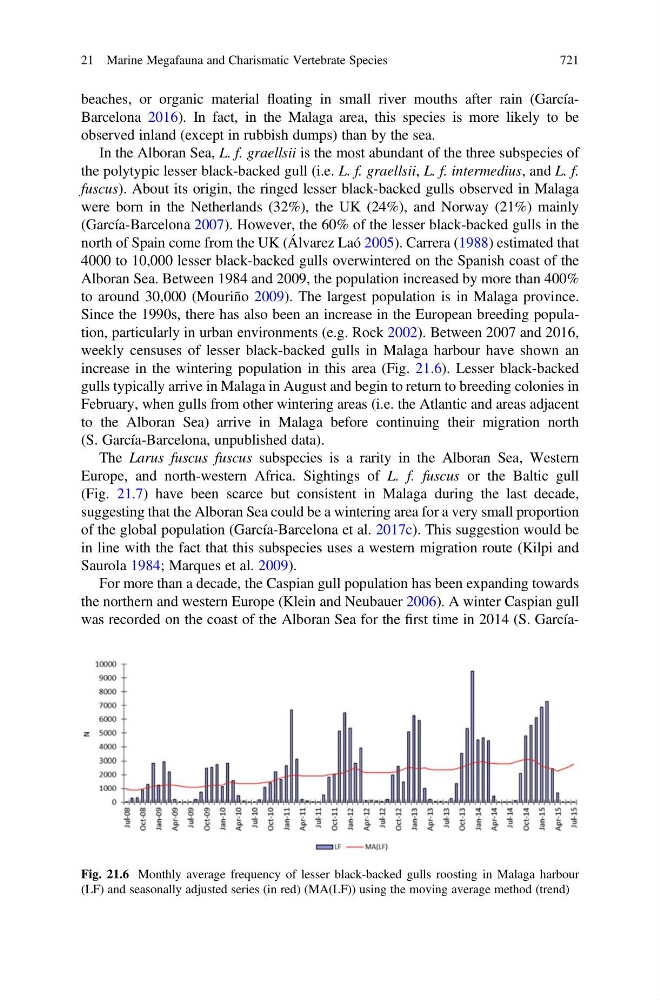
weekly censuses of lesser black-backed gulls in Malaga harbour have shown an
increase in the wintering population in this area (Fig. 21.6). Lesser black-backed
gulls typically arrive in Malaga in August and begin to return to breeding colonies in
February, when gulls from other wintering areas (i.e. the Atlantic and areas adjacent
to the Alboran Sea) arrive in Malaga before continuing their migration north
(S. García-Barcelona, unpublished data).
The Larus fuscus fuscus subspecies is a rarity in the Alboran Sea, Western
Europe, and north-western Africa. Sightings of L. f. fuscus or the Baltic gull
(Fig. 21.7) have been scarce but consistent in Malaga during the last decade,
suggesting that the Alboran Sea could be a wintering area for a very small proportion
of the global population (García-Barcelona et al. 2017c). This suggestion would be
in line with the fact that this subspecies uses a western migration route (Kilpi and
Saurola 1984; Marques et al. 2009).
For more than a decade, the Caspian gull population has been expanding towards
the northern and western Europe (Klein and Neubauer 2006). A winter Caspian gull
was recorded on the coast of the Alboran Sea for the first time in 2014 (S. GarcíaFig. 21.6 Monthly average frequency of lesser black-backed gulls roosting in Malaga harbour
(LF) and seasonally adjusted series (in red) (MA(LF)) using the moving average method (trend)
21 Marine Megafauna and Charismatic Vertebrate Species
721