

which act as feeding areas. In addition, the Strait of Gibraltar acts as a migratory
corridor for this species. During 2009, more than 17,000 specimens were counted
crossing the Strait of Gibraltar (Arcos et al. 2012).
A large population of Mediterranean gulls overwinters in the Alboran Sea, which,
after Tarragona (NE Spain), is the second most important wintering area for this gull
in the western Mediterranean. The bulk of them overwinter in the north-western area
(especially Malaga province). During this period, there are more than 10,000 birds
increasing to more than 15,000 during prenuptial migration (Arcos et al. 2012;
García-Barcelona 2016). Similar to the situation in Tarragona, in the Malaga Bay
area, the Mediterranean gull feeds on fishery discards and on terrestrial sources, such
as invertebrates (earthworms, flying ants, other invertebrates), olives, food scraps on
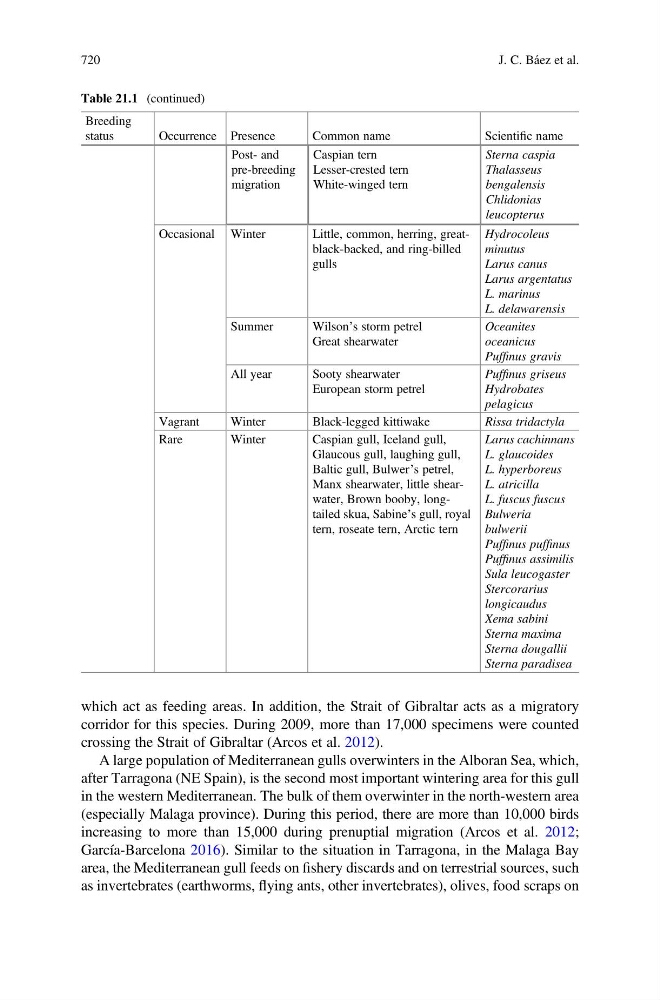
Table 21.1 (continued)
Breeding
status
Occurrence Presence
Common name
Scientific name
Post- and
pre-breeding
migration
Caspian tern
Lesser-crested tern
White-winged tern
Sterna caspia
Thalasseus
bengalensis
Chlidonias
leucopterus
Occasional Winter
Little, common, herring, greatblack-backed, and ring-billed
gulls
Hydrocoleus
minutus
Larus canus
Larus argentatus
L. marinus
L. delawarensis
Summer
Wilson’s storm petrel
Great shearwater
Oceanites
oceanicus
Puffinus gravis
All year
Sooty shearwater
European storm petrel
Puffinus griseus
Hydrobates
pelagicus
Vagrant
Winter
Black-legged kittiwake
Rissa tridactyla
Rare
Winter
Caspian gull, Iceland gull,
Glaucous gull, laughing gull,
Baltic gull, Bulwer’s petrel,
Manx shearwater, little shearwater, Brown booby, longtailed skua, Sabine’s gull, royal
tern, roseate tern, Arctic tern
Larus cachinnans
L. glaucoides
L. hyperboreus
L. atricilla
L. fuscus fuscus
Bulweria
bulwerii
Puffinus puffinus
Puffinus assimilis
Sula leucogaster
Stercorarius
longicaudus
Xema sabini
Sterna maxima
Sterna dougallii
Sterna paradisea
720
J. C. Báez et al.