

Estimation of Octopus Growth in the Alboran Sea
The average monthly temperature in three different areas, Bay of Malaga, Cabo de
Gata in the Alboran Sea, and Cabo de Palos, throughout the last 5 years is shown in
Fig. 20.4. During the winter and early spring (December–April), temperatures were
similar in the three areas (range of 14.3–16.1
C). However, from May there is a
differentiation with greater increases in temperature as we move eastwards, reaching
maximum average temperatures in August of 26.6
C, 24.8
C, and 23.4
C in Cabo
de Palos, Cabo de Gata, and the Bay of Malaga, respectively. With regard to
significant wave height, the worst conditions during the last 5 years were in Cabo
de Gata, while the best conditions, with a mean significant wave height lower than
0.5 m, were found in Malaga. Of the three areas studied, the Bay of Malaga presents
the best location for octopus fattening, characterized by a lower incidence of the
prevailing winds in the area, as well as temperatures more suitable for octopus
fattening for longer, nearly 11 months a year. In Cabo de Gata and Cabo de Palos,
the high temperatures during the months of July, August, and September would limit
this activity to the period between October and June.
Figure 20.13 is a representation of the estimated growth during two cycles of
fattening of octopus subadults fed with natural diet and kept in offshore conditions
within the areas studied. During the winter, starting in November with an initial body
weight of 0.5 kg, 2,0–2,2 kg could be reached by the end of February in Cabo de
Palos and Cabo de Gata, while in the Bay of Malaga, 2.9 kg could be reached. In
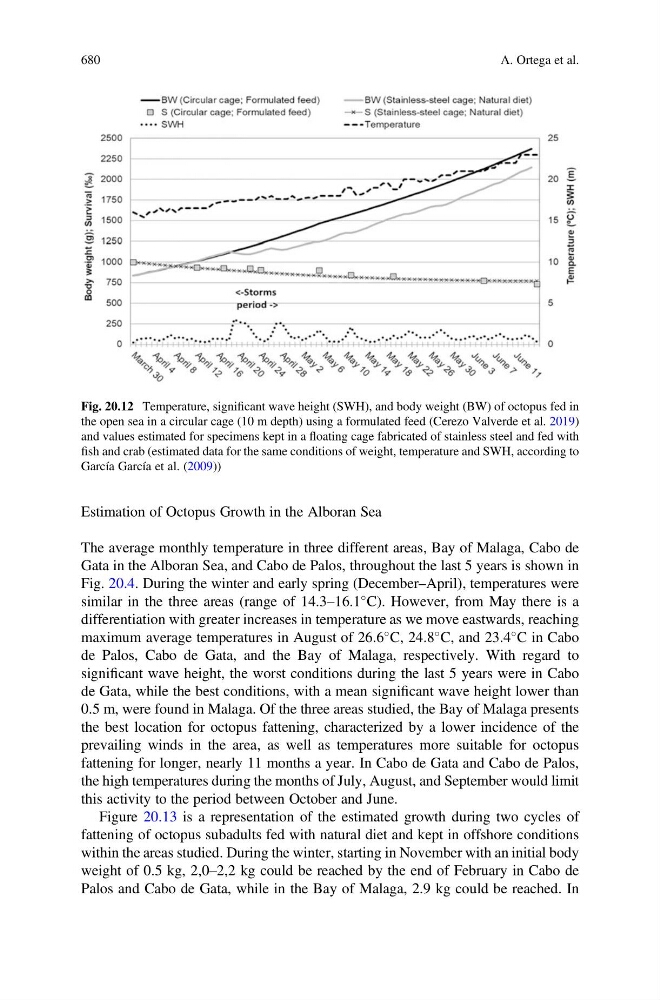
Fig. 20.12 Temperature, significant wave height (SWH), and body weight (BW) of octopus fed in
the open sea in a circular cage (10 m depth) using a formulated feed (Cerezo Valverde et al. 2019)
and values estimated for specimens kept in a floating cage fabricated of stainless steel and fed with
fish and crab (estimated data for the same conditions of weight, temperature and SWH, according to
García García et al. (2009))
680
A. Ortega et al.