

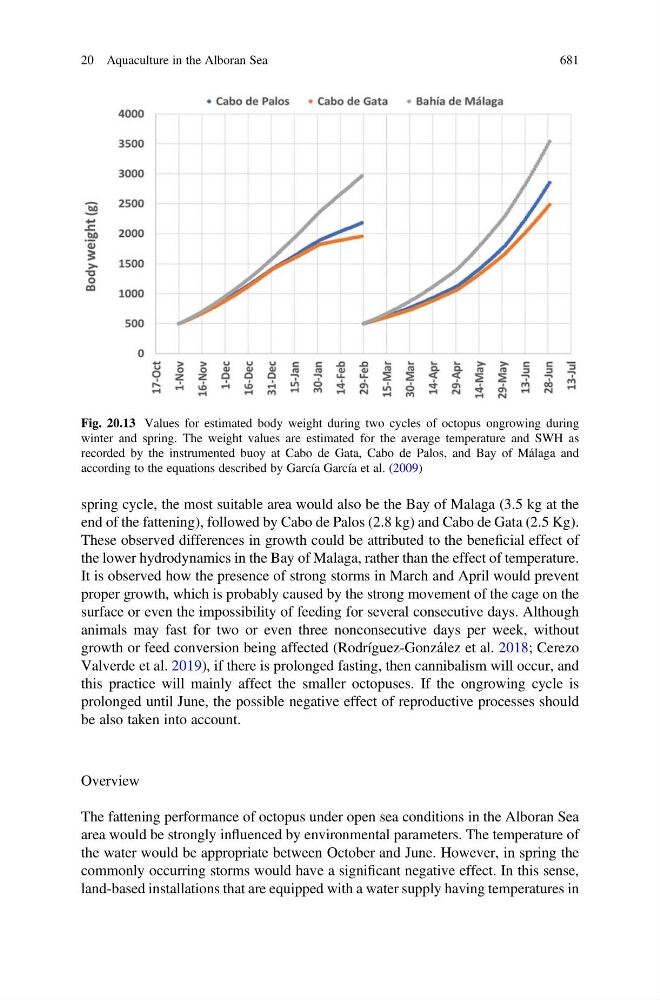
spring cycle, the most suitable area would also be the Bay of Malaga (3.5 kg at the
end of the fattening), followed by Cabo de Palos (2.8 kg) and Cabo de Gata (2.5 Kg).
These observed differences in growth could be attributed to the beneficial effect of
the lower hydrodynamics in the Bay of Malaga, rather than the effect of temperature.
It is observed how the presence of strong storms in March and April would prevent
proper growth, which is probably caused by the strong movement of the cage on the
surface or even the impossibility of feeding for several consecutive days. Although
animals may fast for two or even three nonconsecutive days per week, without
growth or feed conversion being affected (Rodríguez-González et al. 2018; Cerezo
Valverde et al. 2019), if there is prolonged fasting, then cannibalism will occur, and
this practice will mainly affect the smaller octopuses. If the ongrowing cycle is
prolonged until June, the possible negative effect of reproductive processes should
be also taken into account.
Overview
The fattening performance of octopus under open sea conditions in the Alboran Sea
area would be strongly influenced by environmental parameters. The temperature of
the water would be appropriate between October and June. However, in spring the
commonly occurring storms would have a significant negative effect. In this sense,
land-based installations that are equipped with a water supply having temperatures in
Fig. 20.13 Values for estimated body weight during two cycles of octopus ongrowing during
winter and spring. The weight values are estimated for the average temperature and SWH as
recorded by the instrumented buoy at Cabo de Gata, Cabo de Palos, and Bay of Málaga and
according to the equations described by García García et al. (2009)
20 Aquaculture in the Alboran Sea
681