

A sharp decreasing trend was recorded from 2011 onward (Fig. 18.25). Landing
sizes ranged between 8 and 82 cm TL with a maximum of around 20 and 24 cm
TL. Mean values are 24.19 (Æ8.02 SD).
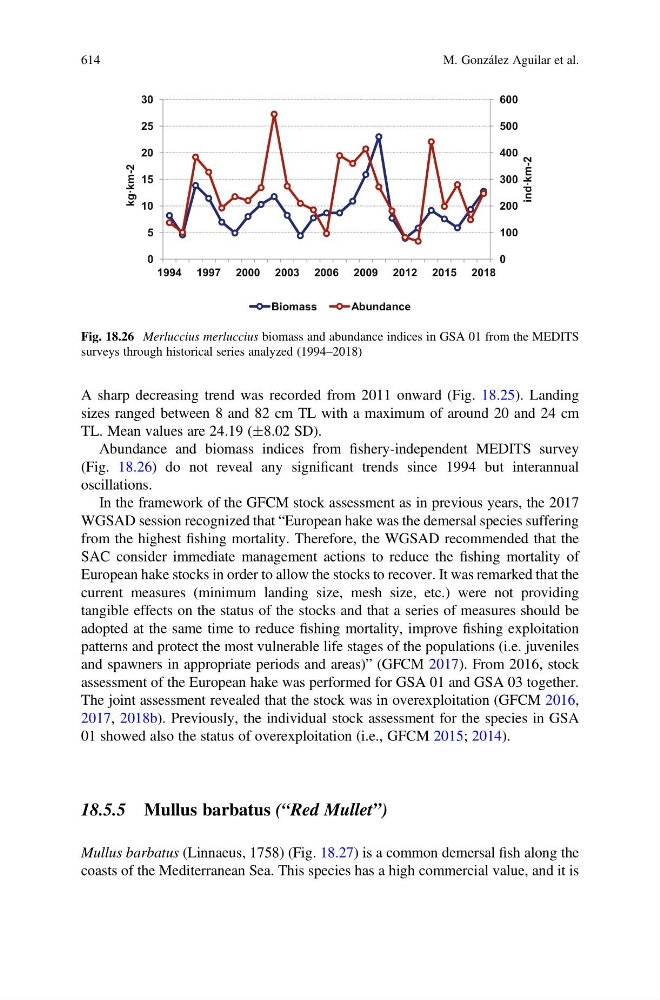
Abundance and biomass indices from fishery-independent MEDITS survey
(Fig. 18.26) do not reveal any significant trends since 1994 but interannual
oscillations.
In the framework of the GFCM stock assessment as in previous years, the 2017
WGSAD session recognized that “European hake was the demersal species suffering
from the highest fishing mortality. Therefore, the WGSAD recommended that the
SAC consider immediate management actions to reduce the fishing mortality of
European hake stocks in order to allow the stocks to recover. It was remarked that the
current measures (minimum landing size, mesh size, etc.) were not providing
tangible effects on the status of the stocks and that a series of measures should be
adopted at the same time to reduce fishing mortality, improve fishing exploitation
patterns and protect the most vulnerable life stages of the populations (i.e. juveniles
and spawners in appropriate periods and areas)” (GFCM 2017). From 2016, stock
assessment of the European hake was performed for GSA 01 and GSA 03 together.
The joint assessment revealed that the stock was in overexploitation (GFCM 2016,
2017, 2018b). Previously, the individual stock assessment for the species in GSA
01 showed also the status of overexploitation (i.e., GFCM 2015; 2014).
18.5.5 Mullus barbatus (“Red Mullet”)
Mullus barbatus (Linnaeus, 1758) (Fig. 18.27) is a common demersal fish along the
coasts of the Mediterranean Sea. This species has a high commercial value, and it is
0
100
200
300
400
500
600
0
5
10
15
20
25
30
1994 1997 2000 2003 2006 2009 2012 2015 2018
ind·km-2
kg·km-2
Biomass
Abundance
Fig. 18.26 Merluccius merluccius biomass and abundance indices in GSA 01 from the MEDITS
surveys through historical series analyzed (1994–2018)
614
M. González Aguilar et al.
sizes ranged between 8 and 82 cm TL with a maximum of around 20 and 24 cm
TL. Mean values are 24.19 (Æ8.02 SD).
Abundance and biomass indices from fishery-independent MEDITS survey
(Fig. 18.26) do not reveal any significant trends since 1994 but interannual
oscillations.
In the framework of the GFCM stock assessment as in previous years, the 2017
WGSAD session recognized that “European hake was the demersal species suffering
from the highest fishing mortality. Therefore, the WGSAD recommended that the
SAC consider immediate management actions to reduce the fishing mortality of
European hake stocks in order to allow the stocks to recover. It was remarked that the
current measures (minimum landing size, mesh size, etc.) were not providing
tangible effects on the status of the stocks and that a series of measures should be
adopted at the same time to reduce fishing mortality, improve fishing exploitation
patterns and protect the most vulnerable life stages of the populations (i.e. juveniles
and spawners in appropriate periods and areas)” (GFCM 2017). From 2016, stock
assessment of the European hake was performed for GSA 01 and GSA 03 together.
The joint assessment revealed that the stock was in overexploitation (GFCM 2016,
2017, 2018b). Previously, the individual stock assessment for the species in GSA
01 showed also the status of overexploitation (i.e., GFCM 2015; 2014).
18.5.5 Mullus barbatus (“Red Mullet”)
Mullus barbatus (Linnaeus, 1758) (Fig. 18.27) is a common demersal fish along the
coasts of the Mediterranean Sea. This species has a high commercial value, and it is
0
100
200
300
400
500
600
0
5
10
15
20
25
30
1994 1997 2000 2003 2006 2009 2012 2015 2018
ind·km-2
kg·km-2
Biomass
Abundance
Fig. 18.26 Merluccius merluccius biomass and abundance indices in GSA 01 from the MEDITS
surveys through historical series analyzed (1994–2018)
614
M. González Aguilar et al.