

one of the main target species of many demersal fisheries operating in the Mediterranean Sea (Tserpes et al. 2002).
This species inhabits sandy and muddy bottoms, and it is distributed all around
the Mediterranean basin, including the Black Sea, and also in the eastern Atlantic
Ocean from Scandinavia to Senegal (Fischer et al. 1987). Its density is especially
high at sites characterized by a wider continental shelf. In the Mediterranean Sea, it is
reported between 5 and 300 m depth, with maximum population densities at
50–200 m while below 200 m depth catches are very low (Lombarte et al. 2000).
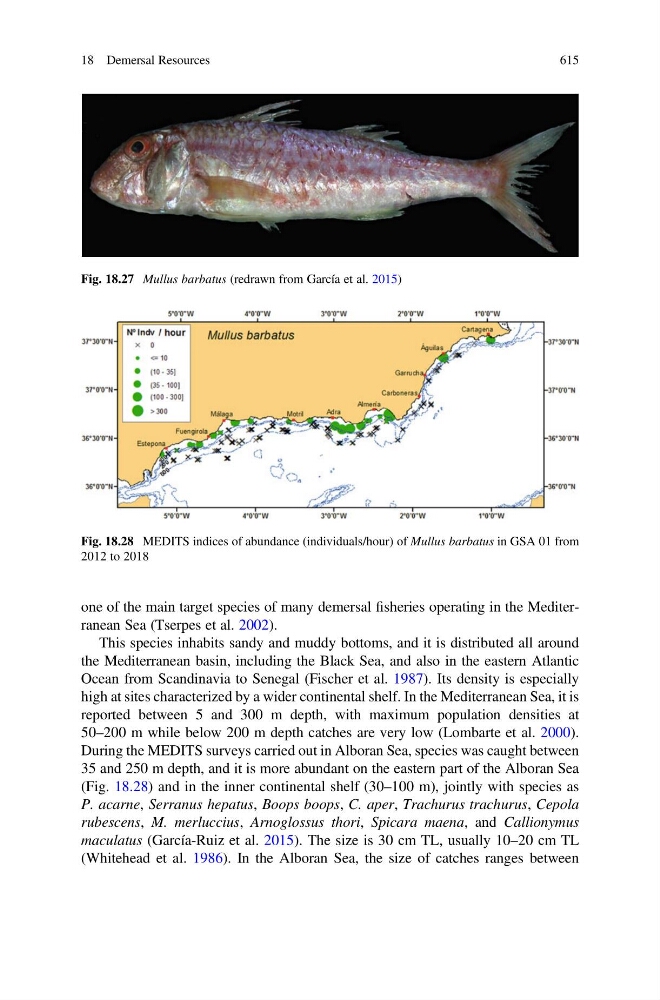
During the MEDITS surveys carried out in Alboran Sea, species was caught between
35 and 250 m depth, and it is more abundant on the eastern part of the Alboran Sea
(Fig. 18.28) and in the inner continental shelf (30–100 m), jointly with species as
P. acarne, Serranus hepatus, Boops boops, C. aper, Trachurus trachurus, Cepola
rubescens, M. merluccius, Arnoglossus thori, Spicara maena, and Callionymus
maculatus (García-Ruiz et al. 2015). The size is 30 cm TL, usually 10–20 cm TL
(Whitehead et al. 1986). In the Alboran Sea, the size of catches ranges between
Fig. 18.27 Mullus barbatus (redrawn from García et al. 2015)
Fig. 18.28 MEDITS indices of abundance (individuals/hour) of Mullus barbatus in GSA 01 from
2012 to 2018
18 Demersal Resources
615
This species inhabits sandy and muddy bottoms, and it is distributed all around
the Mediterranean basin, including the Black Sea, and also in the eastern Atlantic
Ocean from Scandinavia to Senegal (Fischer et al. 1987). Its density is especially
high at sites characterized by a wider continental shelf. In the Mediterranean Sea, it is
reported between 5 and 300 m depth, with maximum population densities at
50–200 m while below 200 m depth catches are very low (Lombarte et al. 2000).
During the MEDITS surveys carried out in Alboran Sea, species was caught between
35 and 250 m depth, and it is more abundant on the eastern part of the Alboran Sea
(Fig. 18.28) and in the inner continental shelf (30–100 m), jointly with species as
P. acarne, Serranus hepatus, Boops boops, C. aper, Trachurus trachurus, Cepola
rubescens, M. merluccius, Arnoglossus thori, Spicara maena, and Callionymus
maculatus (García-Ruiz et al. 2015). The size is 30 cm TL, usually 10–20 cm TL
(Whitehead et al. 1986). In the Alboran Sea, the size of catches ranges between
Fig. 18.27 Mullus barbatus (redrawn from García et al. 2015)
Fig. 18.28 MEDITS indices of abundance (individuals/hour) of Mullus barbatus in GSA 01 from
2012 to 2018
18 Demersal Resources
615