

between 2 and 7 million oocytes per female (Lloris et al. 2005). Batch fecundity
increases proportionally with the size of hake, and it should be noted that correlations between batch fecundity and energy reserves are still stronger than the correlations with hake size (Ferrer-Maza et al. 2014). According to Recasens et al. 2008,
the total number of eggs per female increases with size, but in relative terms the egg
production per gram of females is similar.
Prey comprises benthopelagic organisms with ontogenic changes in the diet.
Morote et al. (2011) found that larvae presented a clear preference for adult calanoid
copepods and they foraged even at low light intensity (Korta et al. 2015). Small
juveniles prey on small crustaceans (euphausiids, natantian decapods, and mysids),
while fish assume an increasing importance in the diet with increasing size of hake
(Cartes et al. 2004). According to Bozzano et al. (1997), the main preys for hakes
between 14.5 and 39.5 cm TL are anchovy and for hakes larger than 40 cm are
sardine in autumn and winter and red bandfish (Cepola macrophthalma) in spring
and summer. Hakes perform vertical migrations from near the bottom to mid-water
or near the surface to feed at night (Pitcher and Alheit 1995). One of the components
of the diet of adults is other hakes, which indicates the existence of cannibalism
(Oliver and Massuti 1995).
Merluccius merluccius is a target demersal species of the Mediterranean fishing
fleets. It is largely exploited in GSA01, mainly by trawlers on the shelf and slope
(96% landings) but also by small-scale fisheries using set longlines (1%) and gillnets
and trammel nets (4%) (average percent estimated between 2016 and 2017). The
trawler fleet is the largest in landings (274 tons in 2017). The main ports in landings
in GSA 01 during 2017 were Vélez-Málaga (50 t), Almería (47 t), Garrucha (40 t),
Cartagena (32 t), and Fuengirola (30 t) (GFCM 2018b).
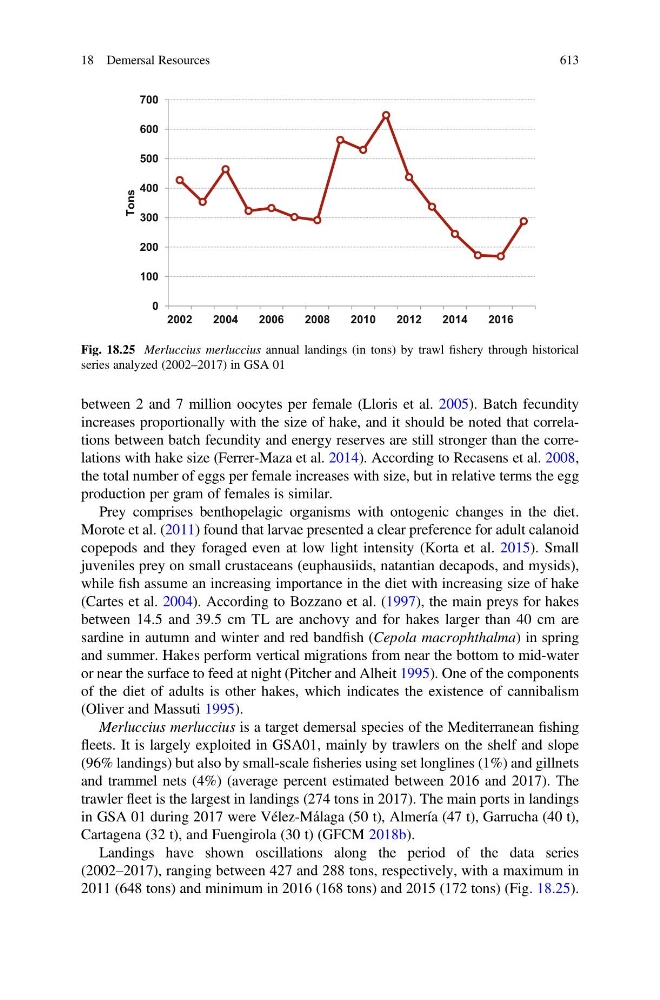
Landings have shown oscillations along the period of the data series
(2002–2017), ranging between 427 and 288 tons, respectively, with a maximum in
2011 (648 tons) and minimum in 2016 (168 tons) and 2015 (172 tons) (Fig. 18.25).
0
100
200
300
400
500
600
700
2002
2004
2006
2008
2010
2012
2014
2016
Tons
Fig. 18.25 Merluccius merluccius annual landings (in tons) by trawl fishery through historical
series analyzed (2002–2017) in GSA 01
18 Demersal Resources
613
increases proportionally with the size of hake, and it should be noted that correlations between batch fecundity and energy reserves are still stronger than the correlations with hake size (Ferrer-Maza et al. 2014). According to Recasens et al. 2008,
the total number of eggs per female increases with size, but in relative terms the egg
production per gram of females is similar.
Prey comprises benthopelagic organisms with ontogenic changes in the diet.
Morote et al. (2011) found that larvae presented a clear preference for adult calanoid
copepods and they foraged even at low light intensity (Korta et al. 2015). Small
juveniles prey on small crustaceans (euphausiids, natantian decapods, and mysids),
while fish assume an increasing importance in the diet with increasing size of hake
(Cartes et al. 2004). According to Bozzano et al. (1997), the main preys for hakes
between 14.5 and 39.5 cm TL are anchovy and for hakes larger than 40 cm are
sardine in autumn and winter and red bandfish (Cepola macrophthalma) in spring
and summer. Hakes perform vertical migrations from near the bottom to mid-water
or near the surface to feed at night (Pitcher and Alheit 1995). One of the components
of the diet of adults is other hakes, which indicates the existence of cannibalism
(Oliver and Massuti 1995).
Merluccius merluccius is a target demersal species of the Mediterranean fishing
fleets. It is largely exploited in GSA01, mainly by trawlers on the shelf and slope
(96% landings) but also by small-scale fisheries using set longlines (1%) and gillnets
and trammel nets (4%) (average percent estimated between 2016 and 2017). The
trawler fleet is the largest in landings (274 tons in 2017). The main ports in landings
in GSA 01 during 2017 were Vélez-Málaga (50 t), Almería (47 t), Garrucha (40 t),
Cartagena (32 t), and Fuengirola (30 t) (GFCM 2018b).
Landings have shown oscillations along the period of the data series
(2002–2017), ranging between 427 and 288 tons, respectively, with a maximum in
2011 (648 tons) and minimum in 2016 (168 tons) and 2015 (172 tons) (Fig. 18.25).
0
100
200
300
400
500
600
700
2002
2004
2006
2008
2010
2012
2014
2016
Tons
Fig. 18.25 Merluccius merluccius annual landings (in tons) by trawl fishery through historical
series analyzed (2002–2017) in GSA 01
18 Demersal Resources
613