

It is a benthopelagic species that lives on muddy or mud-sand grounds on the
continental shelf and slope, at depths between 50 and 370 m, although it can also be
found between 30 and 1075 m depth (Lloris et al. 2005). In the Mediterranean Sea,
the species is mainly abundant at depths ranging from 100 to 400 m, and the highest
abundance values coincide with the 100–200 m depth zone in which most nursery
grounds in the Mediterranean Sea are located (Orsi Relini et al. 2002). It occurs in
the eastern Atlantic, from Norway and Iceland coasts to Mauritania coasts, in the
Mediterranean Sea, and along the southern coast of the Black Sea (Cohen et al.
1990).
Two subspecies can be distinguished in the western Mediterranean Sea:
Merluccius merluccius merluccius, with pectoral fins larger than ventral fins, and
Merluccius merluccius smiridus with pectoral and ventral fins of equal size (Lloris
et al. 2005).
During the MEDITS surveys carried out in the Northern Alboran Sea, species was
caught between 30 and 700 m, but its abundance drops considerably below 300 m,
and it is more abundant in the outer continental shelf (100–200 m), jointly with
species as Capros aper, Gadiculus argenteus, Maurolicus muelleri, Pagellus
acarne, Micromesistius poutassou, Helicolenus dactylopterus, and Scyliorhinus
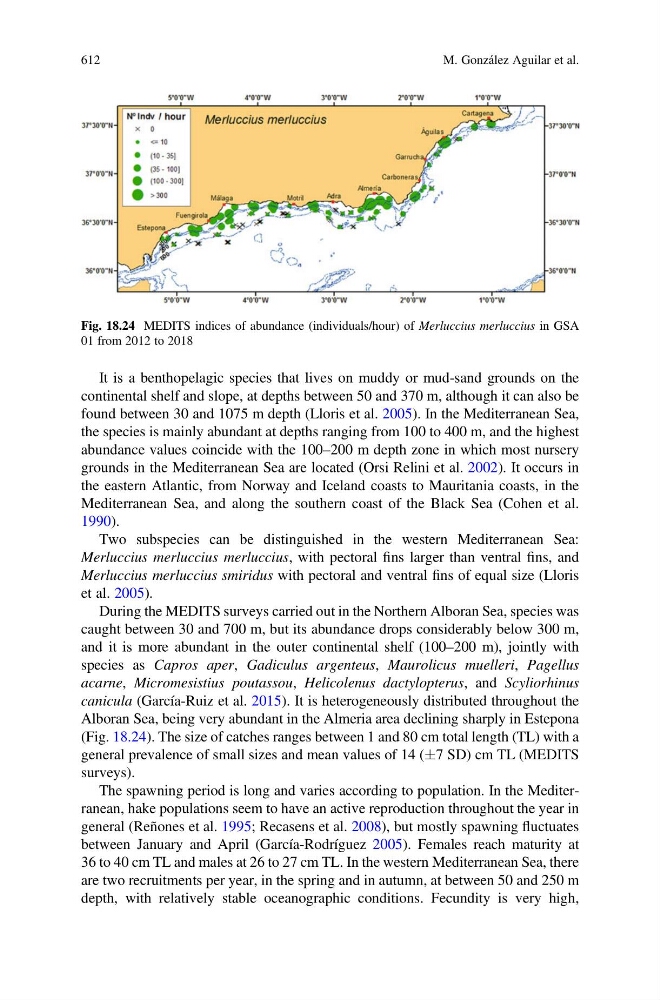
canicula (García-Ruiz et al. 2015). It is heterogeneously distributed throughout the
Alboran Sea, being very abundant in the Almeria area declining sharply in Estepona
(Fig. 18.24). The size of catches ranges between 1 and 80 cm total length (TL) with a
general prevalence of small sizes and mean values of 14 (Æ7 SD) cm TL (MEDITS
surveys).
The spawning period is long and varies according to population. In the Mediterranean, hake populations seem to have an active reproduction throughout the year in
general (Reñones et al. 1995; Recasens et al. 2008), but mostly spawning fluctuates
between January and April (García-Rodríguez 2005). Females reach maturity at
36 to 40 cm TL and males at 26 to 27 cm TL. In the western Mediterranean Sea, there
are two recruitments per year, in the spring and in autumn, at between 50 and 250 m
depth, with relatively stable oceanographic conditions. Fecundity is very high,
Fig. 18.24 MEDITS indices of abundance (individuals/hour) of Merluccius merluccius in GSA
01 from 2012 to 2018
612
M. González Aguilar et al.
continental shelf and slope, at depths between 50 and 370 m, although it can also be
found between 30 and 1075 m depth (Lloris et al. 2005). In the Mediterranean Sea,
the species is mainly abundant at depths ranging from 100 to 400 m, and the highest
abundance values coincide with the 100–200 m depth zone in which most nursery
grounds in the Mediterranean Sea are located (Orsi Relini et al. 2002). It occurs in
the eastern Atlantic, from Norway and Iceland coasts to Mauritania coasts, in the
Mediterranean Sea, and along the southern coast of the Black Sea (Cohen et al.
1990).
Two subspecies can be distinguished in the western Mediterranean Sea:
Merluccius merluccius merluccius, with pectoral fins larger than ventral fins, and
Merluccius merluccius smiridus with pectoral and ventral fins of equal size (Lloris
et al. 2005).
During the MEDITS surveys carried out in the Northern Alboran Sea, species was
caught between 30 and 700 m, but its abundance drops considerably below 300 m,
and it is more abundant in the outer continental shelf (100–200 m), jointly with
species as Capros aper, Gadiculus argenteus, Maurolicus muelleri, Pagellus
acarne, Micromesistius poutassou, Helicolenus dactylopterus, and Scyliorhinus
canicula (García-Ruiz et al. 2015). It is heterogeneously distributed throughout the
Alboran Sea, being very abundant in the Almeria area declining sharply in Estepona
(Fig. 18.24). The size of catches ranges between 1 and 80 cm total length (TL) with a
general prevalence of small sizes and mean values of 14 (Æ7 SD) cm TL (MEDITS
surveys).
The spawning period is long and varies according to population. In the Mediterranean, hake populations seem to have an active reproduction throughout the year in
general (Reñones et al. 1995; Recasens et al. 2008), but mostly spawning fluctuates
between January and April (García-Rodríguez 2005). Females reach maturity at
36 to 40 cm TL and males at 26 to 27 cm TL. In the western Mediterranean Sea, there
are two recruitments per year, in the spring and in autumn, at between 50 and 250 m
depth, with relatively stable oceanographic conditions. Fecundity is very high,
Fig. 18.24 MEDITS indices of abundance (individuals/hour) of Merluccius merluccius in GSA
01 from 2012 to 2018
612
M. González Aguilar et al.