

2016). Also, O. vulgaris reported a significant increase in their economic value (from
4.5 €Ákg
À1 average in first sale price in 2012 to more than 7 €Ákg
À1 in 2017) making
O. vulgaris an increasingly valuable resource (Ciércoles et al. 2019).
The fishery management is based on the establishment of a minimum legal weight
of landed of 1 kg (National Order: APA/973/2002 - BOE 106, 3/05/2002- and
Regional Order of 24 of February of 2016 - BOJA 41, 02/03/2016-). Also smallscale fleet has a closed season of 3 months (July until September) to protect
spawning stock, a vessel census, and a gear limitation in the maximum number of
clay pots or traps for boat and time regulation to control the fishing effort (Regional
Order: 7 of April of 2004 - BOJA 76, 20/04/2004-).
Octopus vulgaris is a difficult resource to manage, and the traditional methods of
fish stock assessment have generally been thought unsuitable for assessing cephalopods due to their biological characteristics (short life span, rapid growth, high
natural mortality, and sensitivity to environmental conditions) (Pierce et al. 2010). In
consequence there are no catch quotas and no formal stock assessment in the
Northern Alboran Sea (like most octopus fisheries in European waters). In order to
improve the situation, the ICES Working Group on Cephalopod Fisheries and Life
History (WGCEPH) organizes some stock assessment workshops with the objective
of providing the opportunity for European and invited non-European scientists to
discuss assessment issues and methodologies (Pierce et al. 2010; ICES 2018 and
others). Nowadays the production models and the model Catch-MSY seem to be the
most appropriate for the O. vulgaris assessment. In adjacent areas the experts are
working on applying these statistical models and including the effect of environmental factors (Quetglas et al. 2013, 2015; Sobrino et al. 2020).
18.5.4 Merluccius merluccius (“European Hake”)
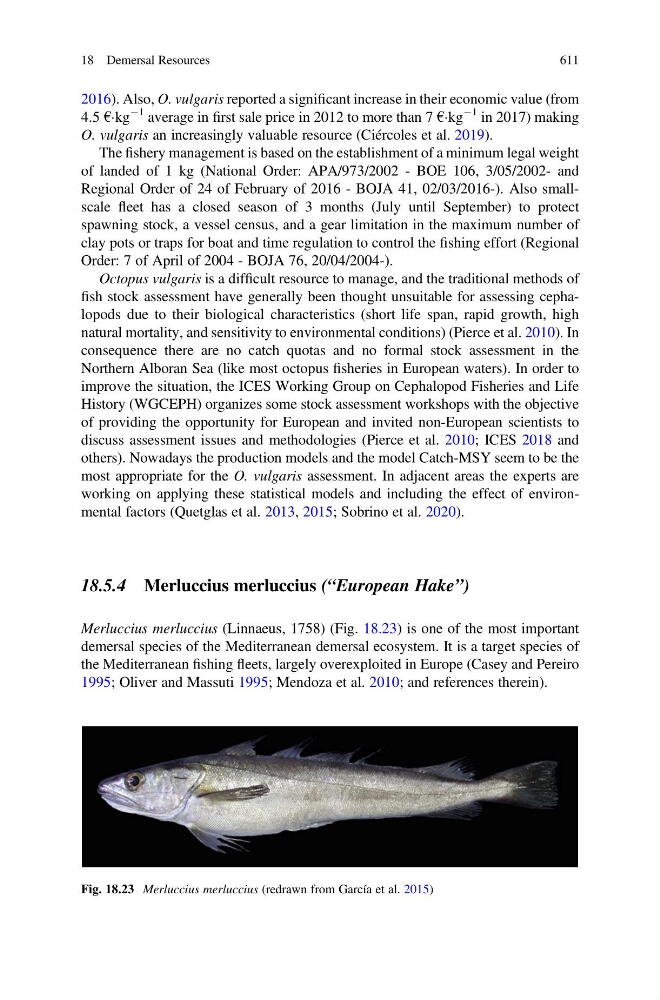
Merluccius merluccius (Linnaeus, 1758) (Fig. 18.23) is one of the most important
demersal species of the Mediterranean demersal ecosystem. It is a target species of
the Mediterranean fishing fleets, largely overexploited in Europe (Casey and Pereiro
1995; Oliver and Massuti 1995; Mendoza et al. 2010; and references therein).
Fig. 18.23 Merluccius merluccius (redrawn from García et al. 2015)
18 Demersal Resources
611
4.5 €Ákg
À1 average in first sale price in 2012 to more than 7 €Ákg
À1 in 2017) making
O. vulgaris an increasingly valuable resource (Ciércoles et al. 2019).
The fishery management is based on the establishment of a minimum legal weight
of landed of 1 kg (National Order: APA/973/2002 - BOE 106, 3/05/2002- and
Regional Order of 24 of February of 2016 - BOJA 41, 02/03/2016-). Also smallscale fleet has a closed season of 3 months (July until September) to protect
spawning stock, a vessel census, and a gear limitation in the maximum number of
clay pots or traps for boat and time regulation to control the fishing effort (Regional
Order: 7 of April of 2004 - BOJA 76, 20/04/2004-).
Octopus vulgaris is a difficult resource to manage, and the traditional methods of
fish stock assessment have generally been thought unsuitable for assessing cephalopods due to their biological characteristics (short life span, rapid growth, high
natural mortality, and sensitivity to environmental conditions) (Pierce et al. 2010). In
consequence there are no catch quotas and no formal stock assessment in the
Northern Alboran Sea (like most octopus fisheries in European waters). In order to
improve the situation, the ICES Working Group on Cephalopod Fisheries and Life
History (WGCEPH) organizes some stock assessment workshops with the objective
of providing the opportunity for European and invited non-European scientists to
discuss assessment issues and methodologies (Pierce et al. 2010; ICES 2018 and
others). Nowadays the production models and the model Catch-MSY seem to be the
most appropriate for the O. vulgaris assessment. In adjacent areas the experts are
working on applying these statistical models and including the effect of environmental factors (Quetglas et al. 2013, 2015; Sobrino et al. 2020).
18.5.4 Merluccius merluccius (“European Hake”)
Merluccius merluccius (Linnaeus, 1758) (Fig. 18.23) is one of the most important
demersal species of the Mediterranean demersal ecosystem. It is a target species of
the Mediterranean fishing fleets, largely overexploited in Europe (Casey and Pereiro
1995; Oliver and Massuti 1995; Mendoza et al. 2010; and references therein).
Fig. 18.23 Merluccius merluccius (redrawn from García et al. 2015)
18 Demersal Resources
611