

species diversity clearly manifested in the specific composition of ichthyoplankton.
An ichthyoplankton seasonal study throughout an annual cycle carried out in MA
reveals the high species diversity (Marina et al. 2015; García et al. 2015). A grand
total of 87 taxonomic groups were identified, in which 82 were to the species level. It
is interesting to note that species of the meso- and bathypelagic domains were
predominant in spite of the nine sampling stations located at shallow coastal and
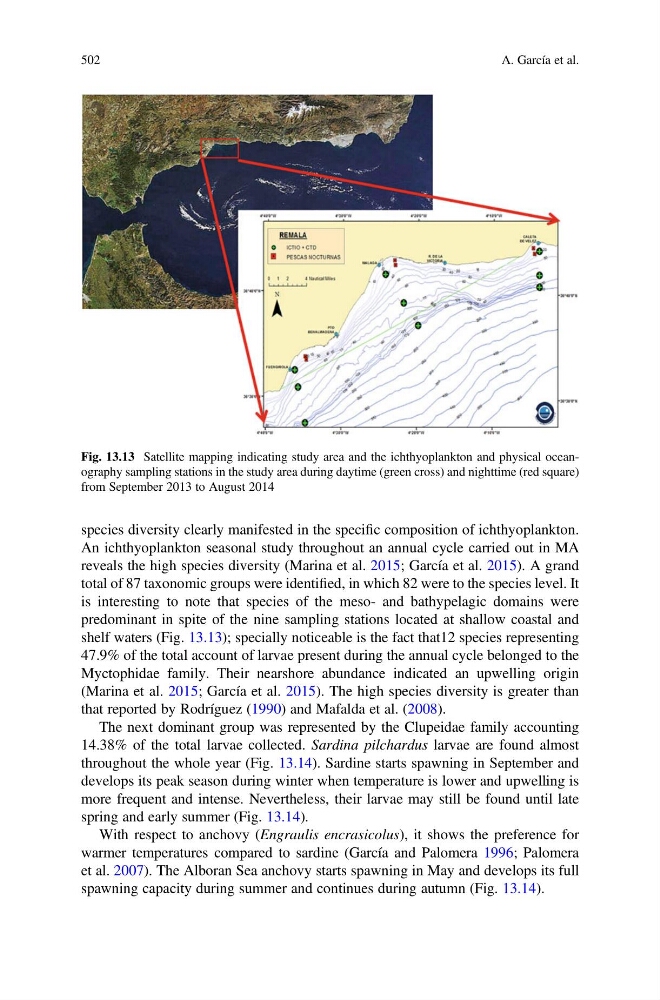
shelf waters (Fig. 13.13); specially noticeable is the fact that12 species representing
47.9% of the total account of larvae present during the annual cycle belonged to the
Myctophidae family. Their nearshore abundance indicated an upwelling origin
(Marina et al. 2015; García et al. 2015). The high species diversity is greater than
that reported by Rodríguez (1990) and Mafalda et al. (2008).
The next dominant group was represented by the Clupeidae family accounting
14.38% of the total larvae collected. Sardina pilchardus larvae are found almost
throughout the whole year (Fig. 13.14). Sardine starts spawning in September and
develops its peak season during winter when temperature is lower and upwelling is
more frequent and intense. Nevertheless, their larvae may still be found until late
spring and early summer (Fig. 13.14).
With respect to anchovy (Engraulis encrasicolus), it shows the preference for
warmer temperatures compared to sardine (García and Palomera 1996; Palomera
et al. 2007). The Alboran Sea anchovy starts spawning in May and develops its full
spawning capacity during summer and continues during autumn (Fig. 13.14).
Fig. 13.13 Satellite mapping indicating study area and the ichthyoplankton and physical oceanography sampling stations in the study area during daytime (green cross) and nighttime (red square)
from September 2013 to August 2014
502
A. García et al.
An ichthyoplankton seasonal study throughout an annual cycle carried out in MA
reveals the high species diversity (Marina et al. 2015; García et al. 2015). A grand
total of 87 taxonomic groups were identified, in which 82 were to the species level. It
is interesting to note that species of the meso- and bathypelagic domains were
predominant in spite of the nine sampling stations located at shallow coastal and
shelf waters (Fig. 13.13); specially noticeable is the fact that12 species representing
47.9% of the total account of larvae present during the annual cycle belonged to the
Myctophidae family. Their nearshore abundance indicated an upwelling origin
(Marina et al. 2015; García et al. 2015). The high species diversity is greater than
that reported by Rodríguez (1990) and Mafalda et al. (2008).
The next dominant group was represented by the Clupeidae family accounting
14.38% of the total larvae collected. Sardina pilchardus larvae are found almost
throughout the whole year (Fig. 13.14). Sardine starts spawning in September and
develops its peak season during winter when temperature is lower and upwelling is
more frequent and intense. Nevertheless, their larvae may still be found until late
spring and early summer (Fig. 13.14).
With respect to anchovy (Engraulis encrasicolus), it shows the preference for
warmer temperatures compared to sardine (García and Palomera 1996; Palomera
et al. 2007). The Alboran Sea anchovy starts spawning in May and develops its full
spawning capacity during summer and continues during autumn (Fig. 13.14).
Fig. 13.13 Satellite mapping indicating study area and the ichthyoplankton and physical oceanography sampling stations in the study area during daytime (green cross) and nighttime (red square)
from September 2013 to August 2014
502
A. García et al.